
FCC to Nearly Double Call Rates for Prison and Jail Inmates
Vote expected Tuesday could raise rates by 83 percent, advocates say.

WASHINGTON, Oct. 27, 2025 – The rates incarcerated individuals pay to call home could rise by as much as 83 percent under new rules the Federal Communications Commission expects to approve Tuesday, according to an analysis.
The analysis by Worth Rises, which found that the FCC’s proposal would cut expected family savings nearly in half and reduce call volume by 66 percent, fueled advocacy efforts of the United Church of Christ’s Media Justice Ministry and other public interest groups at the FCC last week.
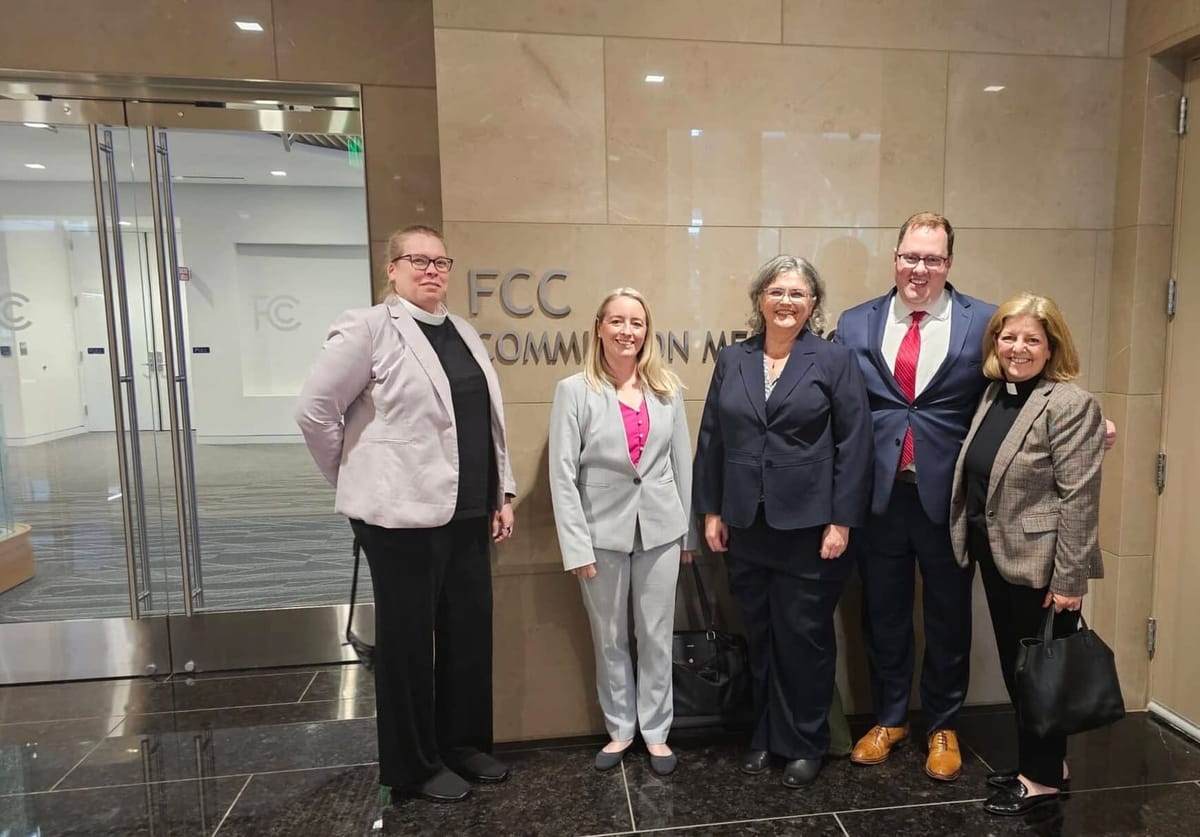
The coalition met with FCC commissioners ahead of the agency’s Oct. 28 vote to warn the proposal would force families of the incarcerated to pay hundreds of millions more each year to maintain contact with loved ones, undoing hard-won progress Congress mandated through the Martha Wright-Reed Act.
The FCC released its 88-page order on Oct. 7, proposing to raise the rate caps adopted under former Democratic Chairwoman Jessica Rosenworcel.
The document was published hours after oral arguments in the First Circuit, where prison telecom providers challenged the rules, and an FCC attorney declined to defend key provisions.
Public interest groups warn of steep new costs
In comments filed Oct. 21, UCC’s Media Justice Ministry, joined by Public Knowledge, the Benton Institute for Broadband & Society, and others, told the FCC its proposal would “impose $215 million in annual costs on consumers nationwide.”
The groups argued the draft order’s decision to incorporate $346 million in “safety and security” costs into the new rate structure represents an “unjustified about face” that “places the full burden on the consumers it was directed to protect.”
They also objected to the FCC’s plan to add a uniform $0.02-per-minute “facility additive” as “duplicative” and likely to become a “de facto site commission” passed directly to families.
“The Commission is proposing to incorrectly impose the full, unproven burden of safety and security costs on families without justification and for an indefinite period,” the filing states.
According to the analysis by Worth Rises, only three state prison systems currently charge rates above the FCC’s newly proposed rate caps, meaning 94 percent of prison systems were already at or below the revised limit. Additionally, 76 percent would already comply with the 2024 caps that the FCC was reconsidering.
How the FCC’s draft order would raise rates
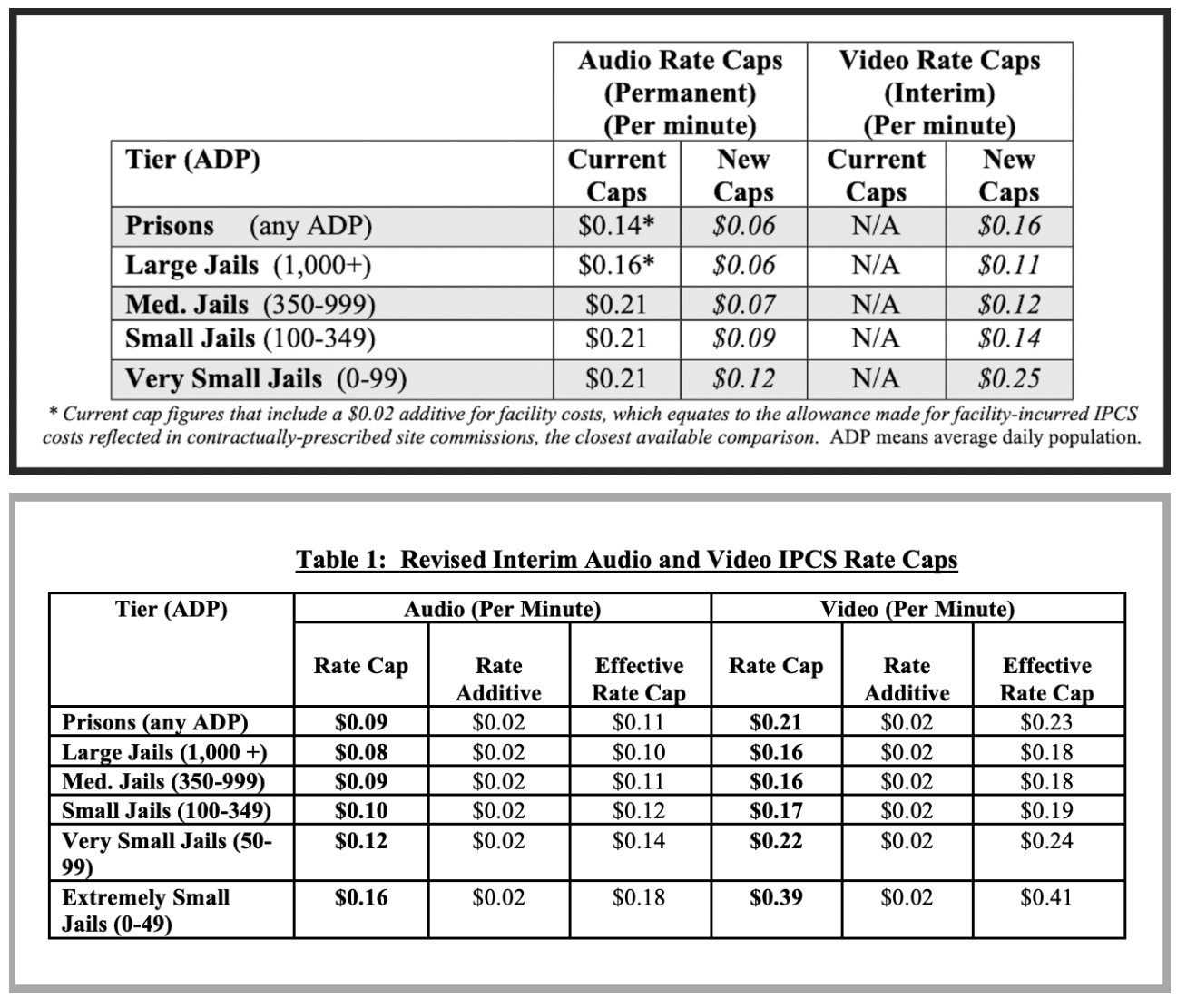
Under the FCC’s 2024 order, rates for audio calls were capped as low as $0.06 per minute for prisons and large jails, with a maximum of $0.12 per minute for the smallest facilities. Video calls were capped between $0.12 and $0.25 per minute depending on size.
The Oct. 7 draft order would nearly double those rates. It sets new “interim” caps of $0.09–$0.16 per minute for audio calls and $0.16–$0.39 per minute for video calls, plus a new $0.02 “facility additive” tacked onto every call. For a 15-minute phone call from prison, that raises the cost from roughly $0.90 to $1.67.
The 2024 rules were originally scheduled to take effect in correctional facilities on January 1 and April 1, 2025, depending on facility size.
Bianca Tylek, executive director of Worth Rises, told Broadband Breakfast that twelve states had already moved to comply with the 2024 regulations before the FCC’s reconsideration, and one state has since reversed course in response to the new draft order.
A dramatic policy reversal at the FCC
On June 30, “without notice, public comment, or any request from industry or law enforcement, staff at the FCC suspended the [2024] rules,” attorney Cheryl Leanza, policy advisor for United Church of Christ, said in a release. “The real impact is heartbreaking.”
The FCC’s Wireline Competition Bureau issued an order pausing implementation of the 2024 rate caps for at least two years, citing “unintended consequences” and warning that lower rates could discourage service in smaller jails.
That suspension opened the door to the revisions now slated for a vote at the FCC’s Oct. 28 open meeting. The move came after the FCC’s leadership shifted to a Republican majority, with Chairman Brendan Carr signaling a desire to revisit the 2024 framework.
Early fallout: Rate hikes in Oklahoma
The consequences of the FCC’s Bureau-level decision were already being felt.
With minimal public notice, on Aug. 29 the Oklahoma Department of Corrections and prison telecom provider Securus Technologies agreed to an amended contract that raised the cost of phone calls from state prisons from 6 to 14 cents per minute.
Under the amended contract, commission payments to the Department of Corrections increased significantly.
The agency will now receive $312,500 per month, about $3.75 million annually, in site access or commission fees from Securus Technologies, along with $2.2 million in in-kind security technology, including call-monitoring software, body scanners, and digital mail services.
By comparison, the previous contract paid the state only $580,000 a year from tablet revenue and no commission on phone calls.
“The state prison will rake in profits six times higher than the prior year on the backs of grandparents and clergy paying for calls,” UCC wrote in a release.
Industry, state and local prisons support the FCC’s proposal
Multiple correctional facilities weighed in with support for the FCC’s new proposed rate structure.
The American Jail Association, representing 3,000 officials from primarily county and municipal jails, argued that smaller and rural facilities rely on communications-related revenues to fund inmate programs and security functions.
“Communications related revenues have supported inmate programs, reentry, education, law library access, and the security functions that keep housing units stable and safe,” AJA argued in comments.
To implement the FCC’s 2024 order, would lead to “fewer programs, thinner staffing, degraded safety, weakened rehabilitative outcomes, and shift costs back to counties that have no immediate way to replace the lost support,” the group wrote.
In a separate filing, Securus Technologies, one of the nation’s largest prison communications providers, expressed strong support for the FCC’s draft order.
The company praised the agency for recognizing “the critical importance of safety and security measures” that enable communication in jails and prisons, while asking for more time to implement per-minute video pricing – 270 days instead of the FCC’s proposed 120 days.
Another correctional communications provider, Network Communications International Corporation, went even further, calling on the FCC to raise the rate caps beyond those proposed in the October 2025 draft order.
In an ex parte filing with Carr’s office on Tuesday, the company said the draft rates “remain too low” to cover costs, especially for smaller jails with limited budgets
Lawmakers and the general public push back
Coming to the defense of public interest advocates were thirty-five members of Congress, led by Rep. Nanette Barragán, D-Calif., who wrote Tuesday to oppose the FCC’s draft order.
“The Martha Wright-Reed Just and Reasonable Communications Act of 2022, was designed to ensure that incarcerated people could communicate with their families, clergy, and legal counsel at rates that are just, reasonable, and affordable,” the lawmakers wrote. “Your October 2025 draft order represents a dramatic and troubling departure from that progress.”
Lawmakers said the new proposal would deepen long-standing inequities, hitting small and rural communities hardest.
The FCC’s proposal would create a new tier of “extremely small” jails, facilities with fewer than 50 people on average, that would face the highest per-minute rate caps in the country, up to 18 cents for phone calls and 41 cents for video calls.
“These very small jails are disproportionately located in low-income and rural communities, where families are already predisposed to economic hardship,” the lawmakers wrote.
Dozens of individuals also filed comments urging the FCC to grant the public interest groups’ application for review of the June 30 bureau decision that paused implementation of the 2024 rate caps.
The FCC was expected to adopt the order on Tuesday. But the legal fight over prison phone rates in the First Circuit was expected to continue, even as the new proposed rules deliver many of the changes sought by telecom providers and correctional facilities.





Member discussion