
Feinman: ‘No Particular Reason’ for BEAD Labor Requirements
Former BEAD Director and others argue that Biden should have deployed BEAD funds faster.

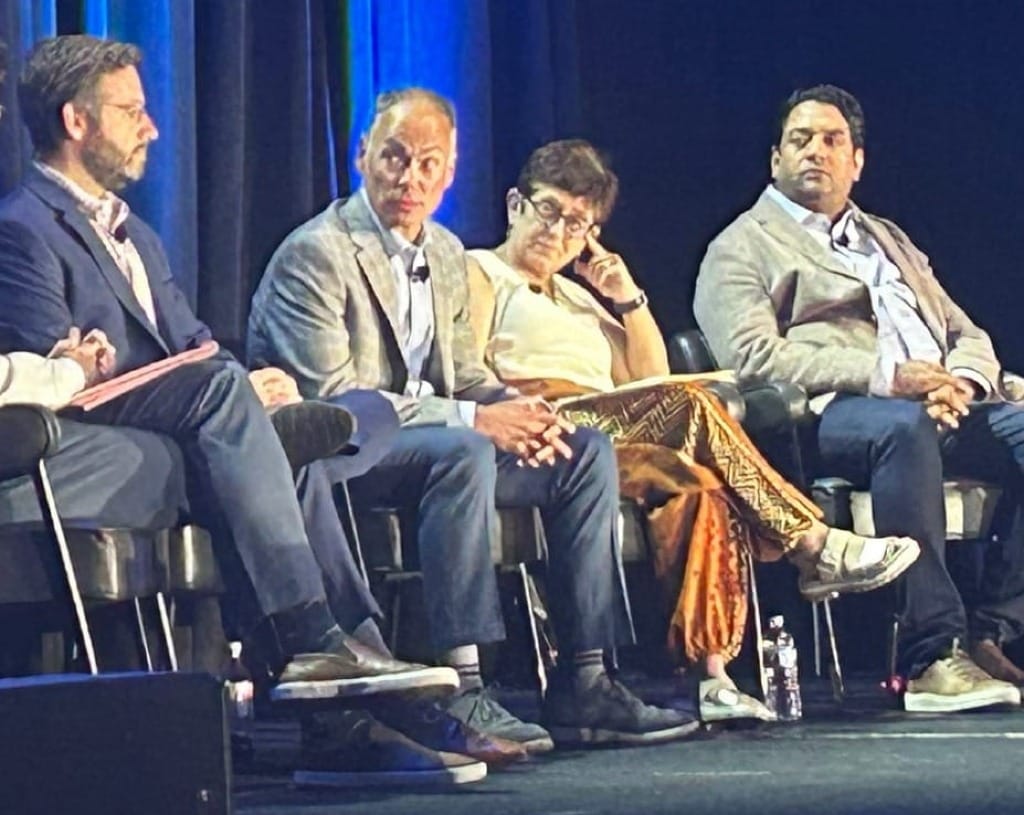
DENVER, August 6, 2025 – Evan Feinman, former administrator for the Broadband Equity, Access, and Deployment program under the Biden administration, criticized program requirements that he said slowed states’ progress Wednesday.
“There was no particular reason for us to have [Louisiana’s broadband director] write us paragraphs in his initial and final proposals about how he was following federal labor law,” said Feinman, who previously led the $42.5 billion broadband deployment program at the National Telecommunications and Information Administration.
Feinman said the NTIA spent months going “back and forth” with states on compliance documentation, distracting from the program’s core goal: “This is an infrastructure program. It’s about identifying locations and building stuff to them. We should have focused on that,” Feinman said in retrospect.

Feinman remarks came at Mountain Connect 2025 during a panel titled “What Happened with BEAD… and WHAT NOW!?!?,” where panelists discussed the flaws of the previous iteration of the program, and what they believed the future for it would hold.
Gigi Sohn, executive director at the American Association for Public Broadband, was irate that the Biden administration did not deploy funds faster.
“NTIA was nitpicky. It took too long to cure, and they did not act with a sense of urgency, particularly at the beginning of 2024,” Sohn exclaimed. “Somebody should have said, ‘We have got to move heaven and earth – we don’t know what’s going to happen with this election – and get the money to the states by the end of the year.’ And that didn’t happen.”
Kevin Gallagher, who served as senior advisor to former Commerce Secretary Gina Raimondo, noted that it was not long ago that he was fielding criticism that NTIA was moving too fast.
“It’s sort of ironic for me. I spent a ton of time defending criticism of NTIA for moving too fast,” Gallagher said. “That was actually a thing. It’s just an irony that I can’t get past.”
Feinman expressed concern that the NTIA’s recent changes to the program would result in some locations being left behind.
“We just heard from Bree Maki that nearly a third of the locations in Minnesota got no bids, not from a LEO provider or from a terrestrial,” he said. “...We’ll see [if all BEAD locations get served]. There has to be an applicant for there to be a grant.”
Panelists also expressed concern that even if all locations were to be connected to broadband service today, additional developments and the over-inclusion of satellite services would lead to a new digital divide forming in the future.
“My prediction for five years in the future is that we will be coming back again and asking Congress for another multiple tens of billions of dollars because the digital divide in rural American and frankly in urban American will still be here and still be very strong,” Sohn said. “And again, I just think that is a national shame.”
Gallagher noted that fiber lines would now be deployed to connect data centers rather than people’s homes.
“I think AI and data centers are a pretty good bet and that will require fiber,” Gallagher said. “So instead of building fiber out to people’s homes we’ll build it out to data centers.”
Veneeth Iyenger, executive director at ConnectLA, argued that fiber deployment to data centers would spur deployment to other locations.
“We plotted out within a five to ten mile circumference of [one] data center how many BEAD eligible locations were there and currently denied by BEAD,” Iyengar said. “And what we projected was that there were close to a thousand households and small businesses that currently do not have internet.”
Feinman was optimistic about the effect of data centers on rural communities. He was less optimistic about the effect of the new BEAD guidance.
“Hundreds of thousands of families are going to have to pay more to get online every month than they were going to have to pay before,” Feinman said. “And they’re going to have worse, slower service that often doesn’t meet the definition of broadband.”



Member discussion