Huang Says U.S. Risks Trailing China in AI Without Energy Reforms

NVIDIA's CEO warned China now generates twice the U.S. electricity, builds data centers in months, and claims 70% of global AI patents.

Huang Says U.S. Risks Trailing China in AI Without Energy Reforms
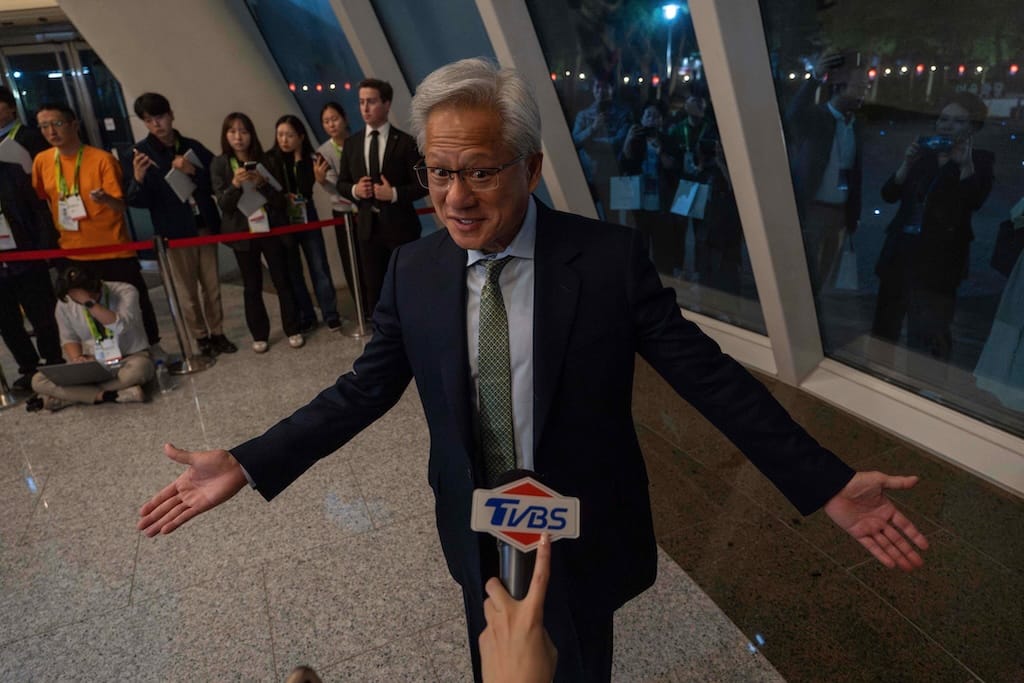
Photo of Nvidia CEO Jensen Huang at the Asia-Pacific Economic Cooperation CEO summit in South Korea on Oct. 31, 2025, by Ng Han Guan/AP

WASHINGTON, Dec. 4, 2025 - The United States needs to rapidly expand energy capacity, accelerate data-center construction and rebuild domestic industrial infrastructure, Nvidia CEO Jensen Huang said Wednesday at the Center for Strategic and International Studies

Without the energy expansion, warned the helm of the advanced chips manufacturer and the world’s highest-valued company, the U.S. risks losing long-term leadership in artificial intelligence. 

AI progress “does not start with GPUs” but with the electricity and physical capacity needed to compute at scale, he said at the bipartisan CSIS think tank. 

China had structural advantages across what he called the “five-layer stack” of AI - energy, chips, infrastructure, models, and applications - even as U.S. firms continued to design the world’s most advanced semiconductors. For example, China produced roughly twice the electricity of the U.S., giving it the power capacity required for semiconductor fabrication plants and AI supercomputing clusters. 

Also, China now accounts for nearly 70 percent of global AI patents and said the U.S.’s effective exit from the Chinese market had ensured domestic Chinese companies would build their own full AI stack and export it abroad.

Huang pointed to China’s enormous consumer markets and dense manufacturing networks as factors that allow it to commercialize AI applications at scale, especially in robotics, logistics, and industrial automation. 

China is constructing data centers at speeds the U.S. ‘cannot match’

He said China was constructing AI data centers at speeds U.S. firms “cannot match,” with approvals, land allocation, and full buildouts completed within months.

Huang said U.S. competitiveness now depended on its ability to expand electricity generation as AI workloads surge. He said NVIDIA continued improving chip-level efficiency “by five or ten times each year,” but demand for AI computation “is going up by a factor of 10,000 to a million.” He said chip fabs, robotics hubs, and hyperscale AI data centers could not be built or operated without dramatic expansion in national power supply.

Huang’s warning came as the U.S. intensified its efforts to upgrade federal permitting and expand domestic energy production. President Donald Trump issued a series of directives this year requiring agencies to accelerate environmental reviews, digitize permitting systems, and fast-track infrastructure projects - including data centers, transmission lines, and semiconductor facilities - to reduce multiyear delays. 

Such reforms are necessary if the country expects to meet the energy and construction demands of next-generation AI.

U.S. export controls a burden

Huang also warned that U.S. export controls and Chinese countermeasures have effectively removed NVIDIA from the world’s second-largest AI market. He said the company was now “banned on both sides,” leaving Chinese firms such as Huawei positioned to scale domestically without direct U.S. competition. “We have conceded essentially the entire market to them,” he said.

He argued that the United States should compete globally rather than withdraw from markets that shape technical standards.

When asked about AI’s impact on the labor force, Huang said AI would reorganize work by automating tasks rather than eliminating occupations. Radiology is an example where AI increased capacity without reducing demand for specialists. 

Both the U.S. and China face severe labor shortages in manufacturing, a dynamic he said would accelerate adoption of robotics, with China positioned to scale faster because of its engineering talent and domestic demand.

U.S. strengths

Despite the competitive pressures, Huang said the United States still held major strengths, including leadership in advanced semiconductor design, world-class research universities, and a startup ecosystem capable of turning scientific breakthroughs into commercial products. He said U.S. companies continued to define global AI software tools and that many of the most widely adopted model architectures originated in American labs.

Huang said the next decade would deliver major advances in biotechnology, materials science, and robotics, much of it driven by American research institutions applying AI to scientific discovery. He said the United States could maintain its global leadership if it expanded energy capacity, modernized permitting rules, and restored domestic manufacturing. “This is the one decade I simply will not miss,” he said.

“The best of days are ahead of us,” Huang said, “but only if we build the infrastructure to support them.”

Member discussion

Popular Tags