
'Imagine You Wake Up Tomorrow and You Don't Have Any Access to the Internet'
Experts explore how to guarantee America’s digital future, in anticipation of upcoming events on broadband, energy and resilience.


WASHINGTON, July 17, 2025 - Industry leaders are sounding the alarm about growing threats to America's digital infrastructure, from cyberattacks to natural disasters.
"Imagine if you wake up tomorrow and you suddenly realize that you don't have access to the internet. You're just literally cut off," said Mahesh Krishnaswami, founder and CEO of Taara, which is developing wireless optical communication technology. "Your bank account is going to be sort of off limits. You essentially are in a situation where it's like back to the stone ages."
The discussion, during Wednesday Broadband Breakfast Live Online, comes as America's broadband infrastructure faces mounting pressure from multiple fronts. Panelists highlighted alarming vulnerabilities in the nation's internet backbone, including the increasing interdependence between power grids and digital communications systems.
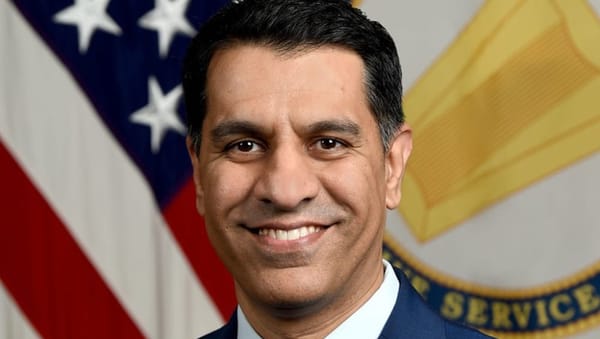
 Mahesh Krishnaswamy
Andy Berke, former Mayor of Chattanooga and former Administrator of the Rural Utilities Service, said his city's municipal broadband network faces an average of 80 foreign cyberattack attempts daily.
"People are underestimating the threat that the lack of electrons that we have on our system and the lack of resiliency that we have, what it will do to our economy," Berke said, noting that the Tennessee Valley Authority experienced rolling blackouts for the first time in its history due to unprecedented demand.
The power-internet connection emerged as a critical vulnerability. Dan York, chief of staff at the non-profit Internet Society, described how a recent power grid failure in Puerto Rico, which knocked out 90% of electrical service, still allowed internet connectivity to continue, thanks to widespread solar panels and battery backup systems.
"Most houses in Puerto Rico have solar panels," York explained. "Battery technology has gotten better. So, they've got solar panels and batteries to power their home, their home routers, their mobile devices, and the mobile providers have backed up their cell towers with generators."
This contrasted sharply with outages in Spain and Portugal, where cascading power failures caused complete internet blackouts because systems weren't designed to operate independently, he said.
Samantha Schartman, director of philanthropic programs at the non-profit group Connect Humanity, emphasized the importance of local ownership in building resilient networks. She said her organization has worked with 71 communities across 11 states in catalyzing $114 million in broadband investments.
"There is a huge over-reliance on single ISPs" in rural areas, Schartman said. "When one network goes down, it is a tiny fraction of their business. It is not the burning high alert situation that you get when it's a local ISP."
Distinguishing between redundancy and resilience
The panelists distinguished between simple redundancy and true resilience. Krishnaswami noted that redundancy typically involves backup systems that require manual intervention, while resilient networks can predict failures and automatically reroute traffic.
Natural disasters pose another growing threat. After visiting hurricane-damaged areas in North Carolina, Berke reported that residents were "more annoyed by the telecom system than anything else" during recovery efforts.
The experts called for diversified technology approaches, including emerging solutions like free space optics that use light beams to transmit data at fiber-like speeds without physical cables. Such technologies could prove less vulnerable to electromagnetic interference from events like solar storms.
"We need to kind of increase the awareness of some of these emerging technologies and make sure that we are positioning them well in advance," Krishnaswami said, "even before the event happens rather than scrambling afterwards."
Drew Clark, CEO of Broadband Breakfast and the moderator of the panel, highlighted the critical nature of securing digital infrastructure, including infrastructure resilience as part of the Broadband Equity, Access and Deployment program. He highlighted an upcoming event in July for industry leaders, the “BEAD Restructure Leaders Summit.”
And he offered a preview of the Resilient Digital Infrastructure Summit in Washington on September 18, 2025, a special event examining the real-world vulnerabilities of our nation’s digital backbone.

Resilient Digital Infrastructure Summit
A one-day conference on Sept. 18, 2025: securing vulnerable digital infrastructure
Learn About Resilient Digital InfrastructureSee full details:
 Broadband Breakfast
Resilient Digital Infrastructure Summit
September 18, 2025 | Washington, D.C.
Register for Resilient Digital Infrastructure



Member discussion