Industry, Consumer Groups Still at Odds over Broadband Nutrition Labels

Consumer Reports found 30 percent of shoppers recalled seeing the labels since they went into effect.

Industry, Consumer Groups Still at Odds over Broadband Nutrition Labels
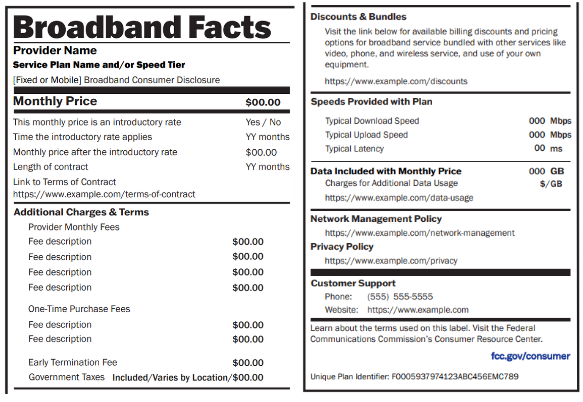
Illustration of broadband label template from the FCC website

WASHINGTON, Feb. 19, 2026 – Broadband industry associations and consumer groups are still at odds over a proposal to scale back disclosure requirements for internet plans.

The Federal Communications Commission proposed in October removing some of its broadband nutrition label requirements, which were mandated by the 2021 Infrastructure Law. Since April 2024, ISPs have had to display prices, speeds, and other service terms in the style of a nutrition label at the point of sale.

Trade groups reiterated to the FCC that it should move forward with its plan to roll back parts of the rules, calling some requirements burdensome and unnecessary. Consumer advocates disagreed, fearing consumers and the public would be less informed about what ISPs were charging for which speeds under the proposed changes.


Meanwhile, Consumer Reports sent the FCC a survey it conducted that found just 30 percent of consumers who had shopped for a broadband plan since the labels were implemented remembered seeing them. More than three-quarters of those who had seen the labels found them helpful, and nearly all of those who did not see a label said one would have been helpful.

“The broadband label was never intended to be an all-purpose disclosure requirement,” cable group NCTA wrote in reply comments posted Wednesday. “Rather, it is a relatively narrow tool that is intended to supplement the general transparency requirements by providing certain key pieces of information to a consumer in the familiar label format during the period of time when the consumer is shopping for a new plan.”

Other industry groups reiterated their opposition to making labels machine-readable, and their support for axing the requirement.

NTCA, which represents rural broadband providers, said the machine-readable labels “primarily benefit researchers and regulators rather than consumers whose interests the rules are ostensibly intended to support.” 

USTelecom agreed, calling the requirement “unduly burdensome,” as did WISPA, which represents wireless ISPs.

Consumer groups like Public Knowledge and the Benton Institute for Broadband & Society countered that blind consumers’ screen readers would be more accurate if the labels were machine-readable. They also said the research the requirement enabled was “a critical public interest function” and that claims the requirement was burdensome were “void of concrete examples of technical obstacles.”

WISPA and NTCA also opposed requirements to display state and local fees that were passed through to consumers, saying it was difficult to implement and overwhelmed users. Industry groups also said reading the labels over the phone verbatim would be unwieldy and that displaying labels in customer account portals, in addition to the point of sale, was unnecessary.

Consumer Reports survey

The Consumer Reports survey contained responses from 2,228 people, about 847 of whom had shopped around for broadband plans since April 2024, when the label rules went into effect for larger ISPs.

Of those, 23 percent said they had seen the labels and found them helpful, and another 7 percent had seen them but did not find them helpful. Another 29 percent did not see the labels and 41 percent were unsure.

“We believe that time and broader public awareness of the label could boost awareness of the label,” the group wrote in comments submitted with its report. “The results also raises the question of how easy it is for consumers to find the label, given that 29% of consumers shopping for broadband during the period when the label was active did not see the label.”

The survey also found 97 percent of respondents who did not see a label when shopping around said they would have found one helpful.

Consumer Reports said the broadband labels should be largely unchanged.

“Maintaining the program as is, and ensuring that service providers make the label easily accessible to consumers in multiple places should be a priority,” the group wrote.

Member discussion

Popular Tags