Industry Leaders Urge Congress to Boost Chip Policy to Win AI Race Against China
House Democrats slam Trump administration for undermining the Biden-era CHIPS and Science Act.

WASHINGTON, April 16, 2026 – Industry experts urged Congress to adopt policies that will allow the U.S. to better compete with China in the artificial intelligence race.
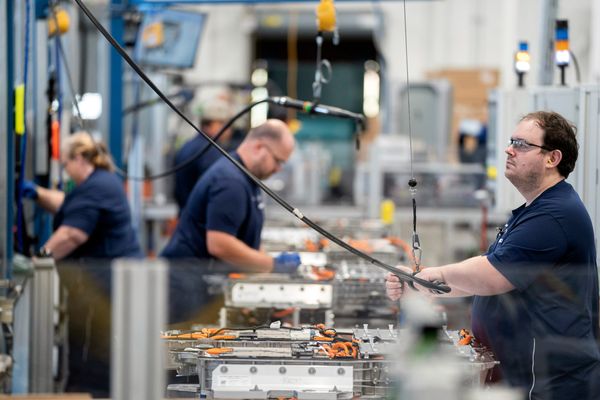
Semiconductors, commonly known as chips, have been the backbone of all modern electronics found in mobile devices, cars, and data centers, and are increasingly essential amid the AI boom. While 70% of chips are manufactured outside the U.S., lawmakers have thrown efforts into reducing the country’s reliance on foreign supply chains — namely Taiwan — and boost research and development (R&D) in AI and quantum computing domestically.
“The AI surge is responsible for over half of total semiconductor revenue — potentially reaching 500 billion dollars this year, and 1 trillion dollars by 2030,” said Rep. Gus Bilirakis, R-Fla. “AI is a critical driver of economic growth — ceding global leadership or leaving our semiconductor supply chains vulnerable to disruption at the hands of China could be catastrophic for U.S. leadership in AI.”

Industry experts urge Congress to adopt new policies
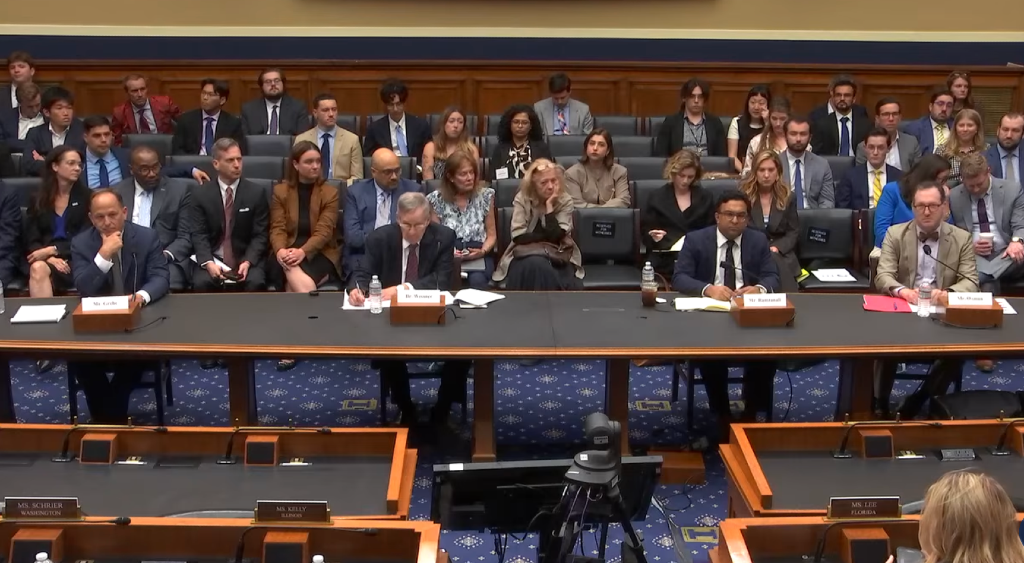
During Wednesday’s Subcommittee on Commerce, Manufacturing, and Trade hearing, House representatives heard from four industry experts on what they want to see change in congress to help with increased chip production to compete with China.
Jason Oxman, president and CEO of the Information Technology Industry Council (ITI), which represents 80 leading tech companies in the semiconductor industry, said long-term certainty in chip investment is crucial, and urged Congress to create policies that would support manufacturing and semiconductor R&D.
“Tax policy has been enormously important to encouraging investment in United States manufacturing capability,” Oxman said. “We have the advanced manufacturing tax credit that is slated to expire at the end of this year and that will be a disaster for manufacturers.”
Asad Ramzanali, director of AI and Technology Policy at Vanderbilt University, said beyond funds for manufacturing, staying ahead of other countries requires investment into R&D. He said the goal “should be to invest in what no one company or what the industry is going to do alone.”
Oxman also said the industry needs Congress’s help to enact “common sense permitting reform” that would streamline semiconductor factory and data center construction. Jason Grebe, Intel’s senior vice president of corporate planning said the U.S.’s approval process for specialty chemicals used in advanced manufacturing is slower than Taiwan, Korea, and Japan. He urged Congress to “level the playing field without compromising health or environmental protection.”
Grebe also said lawmakers should create tariff exemptions for semiconductor manufacturing equipment, especially for specialized technology the U.S. doesn’t produce. He highlighted the importance of maintaining access to global supply chains as a U.S. chipmaker.
Rep. Darren Soto, D-Fla., claimed that Trump’s tariffs are raising prices in the chip global supply chain, making it more expensive to make this technology and compete with other countries.
“We’re in competition with China, and they’re not making these mistakes,” Soto said. “They’re not starting any wars. They’re using more clean energy. They’re investing more than double what we’re investing.”
Democrats slam Trump administration for CHIPS and Science rollbacks
House Democrats blasted the Trump administration for undermining the bipartisan Biden-era legislation designed to strengthen domestic chip manufacturing, risking U.S. competitiveness in the AI race.
Passed in 2022, the CHIPS and Science Act was designed to reduce the country’s reliance on foreign supply chains. The law provided more than $50 billion in manufacturing incentives for semiconductors to be built domestically.
Several Democrats, Oxman, and Ramzanali pointed to the initial success of the CHIPS and Science Act and said its progress was undermined by funding cuts, firing of staff, and R&D rollbacks.
Rep. Kathy Castor, D-Fla., said the CHIPS and Science Act provided momentum for the private industry to invest in chip manufacturing, and condemned the administration for laying off “dozens of employees from the CHIPS program last fall” and halting the National Semiconductor Technology Center’s R&D.
“It just seems like this is self-sabotage at a time when we all really need to be working together,” Castor said.
Rep. Yvette Clarke, D-N.Y., said the Trump administration undermined chip manufacturing “seemingly out of pure pettiness,” while Soto said “failure to fully implement the CHIP act” held investment back, while cuts to the National Science Foundation halted critical research of microchips.
The representatives and industry leaders said policies need to change in order for the U.S. to stay ahead of China, which presents an “existential threat,” Oxman said.
“They’re trying to make products — companies like Huawei — export them to the rest of the world in the hope that the rest of the world adopts the China technology stack,” Oxman said. “We want the rest of the world to adopt the U.S. technology stack and the policies that Congress adopts can make that happen.”