
Railroad Crossing Killing Rural Broadband Deployment, Says Virginia Telecom Official
Virginia Supreme Court ruled that private, for-profit providers may not use advantageous broadband law, that would constitute a takings

Drew Clark
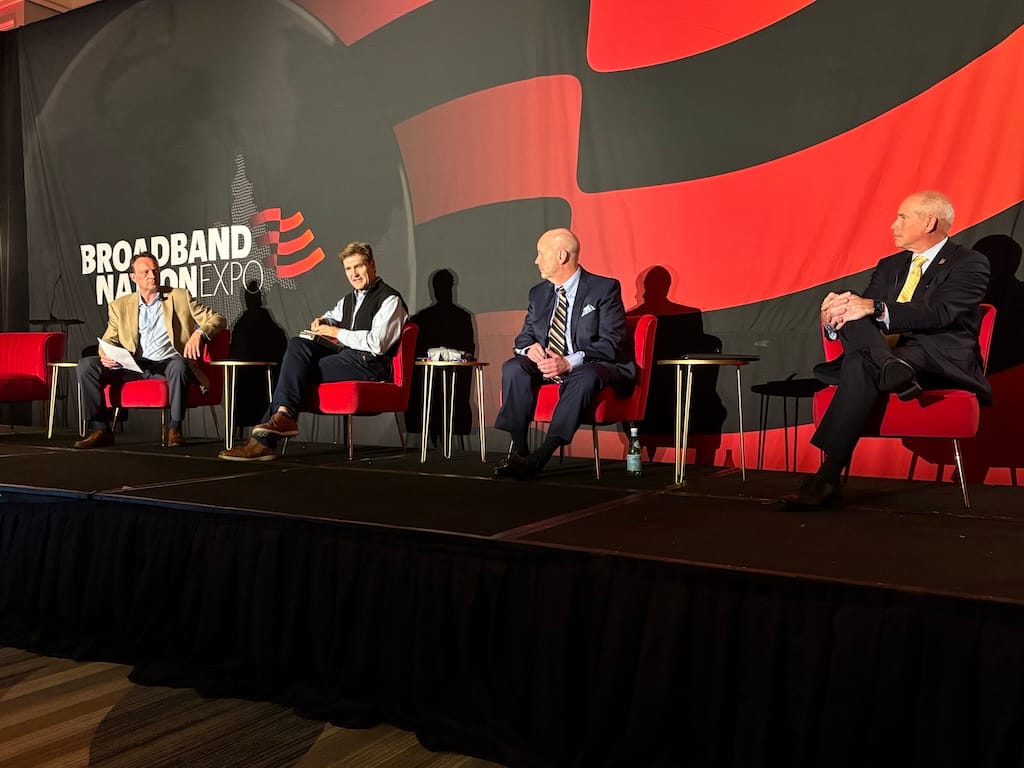
ORLANDO, Fla., Nov. 17, 2025 — "Railroads have become one of the biggest barriers to broadband deployment in Virginia," a Virginia broadband lobbyist said at a panel at the Broadband Nation Expo here on Monday.
"They charge excessive fees—hundreds of thousands of dollars—just to cross their right-of-way or run fiber alongside tracks," said the official, Ray LaMura, president of the Broadband Association of Virginia. "We had one member who wanted to run fiber along a railway to reach 60 new homes. The railroad quoted $600,000. That wiped out the entire grant budget. The project died."
The panel, moderated by Chris Pedersen, executive vice president of development and planning at Connected Nation, also explored tensions between fiber deployment and alternative technologies, including wireless and satellite.
LaMura described how the railroad crossing issue became a protracted legal battle. "We created an expedited appeals process at the State Corporation Commission, but then the railroads and the [Association of American Railroads (AAR)], sued us," he said. "We had a federal case and a state case running simultaneously."
In May, the Supreme Court of Virginia ruled in favor of Norfolk Southern in a test case over the statute, holding that private, for-profit providers such as Cox Communications could not use the law because doing so would amount to an unconstitutional taking of private property for private use under the state constitution.
The Fourth Circuit Court of Appeals later said that AAR, a national railroad industry group, had standing to pursue its federal preemption and takings claims on behalf of its members, but the railroad group voluntarily dismissed that federal lawsuit without prejudice in August.
But LaMura said the damage was done — "construction stopped on multiple projects while litigation dragged on. One provider just gave up and walked away."
Railroad crossings impacting BEAD projects
The state recently secured unanimous approval to allow BEAD funds to cover railroad crossing costs. "That's a start," LaMura said. "But fundamentally, we need federal action to rein in these excessive fees. Railroads shouldn't be able to block critical infrastructure deployment."
There was also a broader debate about fiber versus wireless and satellite deployment. Carl Guardino, vice president of government affairs and policy at Tarana Wireless, argued that wireless alternatives can avoid such infrastructure challenges entirely.
"This is exactly why wireless is attractive in some scenarios," Guardino said. "We don't have to negotiate with railroads or deal with underground infrastructure challenges. We can deploy much more quickly."
But LaMura countered that fiber remains essential for long-term infrastructure investments. "Fiber is the only technology with unlimited capacity that can scale without replacement for 30 to 50 years," he said. "When you're making generational investments with public funds, we need to choose the technology that will serve communities for 50 years, not 5 years."
Guardino defended fixed wireless performance, noting that Tarana is delivering high-speed broadband consistently to communities and that the FCC recognizes it as broadband.
Guardino also criticized satellite broadband as inadequate for many BEAD use cases. "Satellite has inherent limitations—latency issues, weather interference, and data caps that make it unsuitable for many applications," he said. "Fixed wireless offers a much better alternative to satellite, with lower latency and more reliable performance."
He argued that states should prioritize terrestrial solutions—both fiber and fixed wireless—over satellite when allocating BEAD funds. "Satellite should be a last resort, not a first choice," Guardino said.
Brian Newby, broadband program director at the State of North Dakota Broadband Program Office, identified workforce shortages, permitting delays and railroad negotiations as the biggest deployment challenges facing providers.
Health care benefits
Beyond infrastructure hurdles, panelists highlighted how fiber is enabling transformational healthcare delivery in rural areas. LaMura described Virginia's partnership with the Virginia Rural Health Association, where "doctors, nurses and hospital administrators across the state are using our fiber networks to deliver specialized care to rural patients."
"Specialists in Richmond or Northern Virginia can consult with patients in remote areas in real time," LaMura said. "It's transformational healthcare delivery, and it simply couldn't be done without the capacity and reliability of fiber."
Newby raised security concerns about satellite alternatives in the BEAD context, noting that "some state agencies require employees working from home to use terrestrial broadband because of the security and redundancy requirements."
Virginia officials said their BEAD plan prioritizes fiber while allowing alternative technologies only in truly unserved areas where they determine fiber is not economically feasible.



Member discussion