
Regional Fiber Broadband Association Deep Dive Into Tribal Broadband
Tribal leaders and industry experts gathered to address the unique permitting challenges and opportunities for fiber broadband in Arizona.

Max Hahn
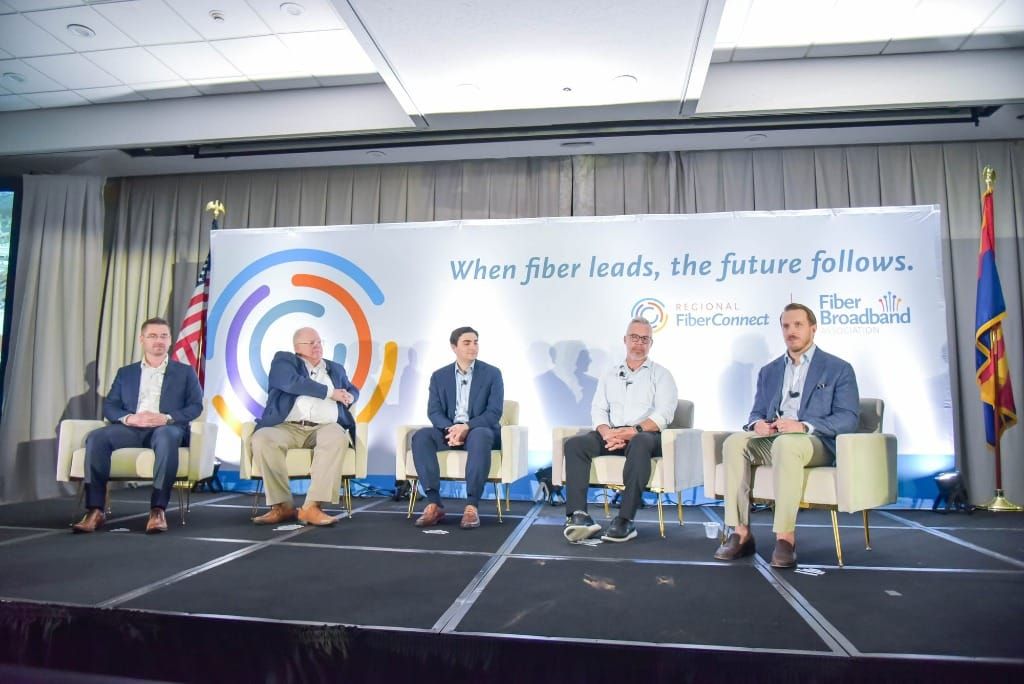
The Fiber Broadband Association hosted its sixth Regional Fiber Connect Workshop in Scottsdale on October 16. Over 275 people attended the event, which focused on the challenges and opportunities associated with delivering fiber broadband to tribal communities.
The Honorable Ricardo Leonard, Vice President of the Salt River Pima-Maricopa Indian Community set the tone for the event with a tribal blessing and opening remarks, sharing his insights on the importance of connectivity as tribes look to stay engaged with the global economy, preserve cultural heritage, and participate in economic opportunities.
The event featured a Fireside Chat with Arizona State Broadband Director Nicholas Capozzi with the Arizona Commerce Authority, remarks from Governor Katie Hobbs, and a deep dive into the plans and priorities FBA’s Tribal Broadband Roundtable has for tribal nation members.
With 22 federally recognized tribes in Arizona, the event was able to explore topics ranging from Tribes Helping Tribes: Building a Strong Future Together Through Indigenous-Led Telecom Infrastructure Projects; Empowering Tribal Nations for the Digital Future: Fiber Access, Transport, and Network Interconnection for AI-Ready Communities; as well as tribal perspectives as part of sessions focused on deployment challenges, permitting, and middle mile.
Throughout the day, tribal voices shaped the debates, discussions, and conversations. Representatives from ten tribal nations spoke during the event, helping the audience understand the issues and challenges tribal nations face, and the unique requirements that need to be recognized for organizations that want to work with them.
Tribal broadband remains a key issue for the industry, as tribal lands are remote, with homes widely spread out over the reservation. Ownership of land within the reservation is complex, which can present specific permitting challenges when looking to deploy fiber broadband.
Navigating complex permitting on tribal lands
During the Local Focus: Can You Dig It? panel, the issue of cultural review requirements specific to working on tribal lands was discussed and how this can add longer lead times for approvals. A key part of this process is ensuring the individual tribe understands the company’s commitment to protecting the community and cultural resources.
Tzeitel Buchanan, director of the Public Sector Program and Community Partnerships at Lumen Technologies agreed, “I think sometimes, depending on the tribe, it has to go to the tribal council and the tribal council only gets together once a month.” These timeframes must be factored in, along with permitting issues associated with railroads, other federal land, city and county requirements, and other issues that can require months to work through.
Donald Ray, senior vice president of Corporate Development at BAM Broadband added, “I think one of the best practices is advocating for the permitting authorities themselves and what they may or may not know they're getting into when we come to town. You know, the reality is that all of them had jobs typically before we came. And if you look at it through that lens, you realize what a nuisance we can be.”
Indigenous-led telecom: A community-first model
Across the U.S., there are 574 federally recognized tribes with over one million people living on First Nation reservations. Access to reliable broadband and telecom services is essential for economic growth, education, healthcare and community resilience – especially in underserved Tribal lands. This session, which included Jennifer Burkhalter, executive director of the National Tribal Telecommunications Association ; General Manager Wayne Sekaquaptewa of Hopi Telecom; Andrew Metcalfe, the CEO and resident of Native Network, Inc.; and Clarice Chiago-Jones, CEO and general manager of Gila River Telecommunications, Inc. explored a community-first model and how Indigenous-led telecom companies are uniquely positioned to empower other Tribal nations.
“We try to help each other up, not just through funding their infrastructure, but also through mentorship, shared lessons, technical experiences, expertise,” said Burkhalter. “It's about helping each nation build their capacity within their own community and their connectivity. An example of where I've seen that firsthand is the peer-to-peer support that helps create progress. So, one of those might be a member that successfully navigates their own process, and as NTTA, we can then help them share that roadmap with other tribal nations, and it has worked to help others secure funding that maybe they may not have been able to do as easily.”
One of the challenges is that every tribe has unique customs, history, and challenges. “I lean into these guys a lot, these kinds of organizations (NTTA) for those types of resources and business in general. Just the people that have more experience in dealing with legislative matters and tribal communities and tribal entities are heard at the national level in terms of funding and opportunities,” said Sekaquaptewa.
“In terms of tribes helping tribes, in my corner of the state, it's a very interesting topic and subject because there's history there amongst tribes and it’s hard to do because you're asking tribal leaders, whether they're cultural leaders or political leaders, for the sake of funding opportunities and deadlines, to overlook that stuff and just work within this realm in terms of sharing right-of-ways, encroachments, and stuff like that and it's a hard thing to do. You've got to make sure you have the right ears, just open minds and the right mindsets going into the discussions.
“Some areas of the globe, or even our own country, we're still kind of just butting heads about old things and kind of acting like old married couples, not able to let go. There are models that work, though, and can be used as models for forging agreements that work for everyone,” Sekaquaptewa added. “There are great partnerships. We look to our neighbors down south here in terms of gaming enterprises. Hopi's not a tribal gaming tribe but we still look to Salt River, Maricopa, the Gila River, to understand what they do in that aspect. And we see that those partnerships work.”
Sekaquaptewa emphasized that tribal organizations are working withing a limited timetable to make these fiber broadband projects a reality. “This type of funding is probably not going to happen for us in our lifetime again so I'm trying to help our neighbors and our own community leaders understand that we need to stop this bickering,” he said.
Native Network’s CEO Metcalf shared one of his company’s paths to tribal broadband. He said it started about 10 years ago in the Pacific Northwest. “The Tulalip tribe came to us and said, ‘We need some help. We want to be sovereign. We want to be self-determined. We want to run our own network.’” For Native Network, it allowed the company to leverage its experience in rural markets, working with other tribes, to create a solution that enabled the Tulalip tribe to build the first tribally owned competitive local exchange carrier in Washington. Over time, this network became a resource for other tribal nations, expanding services and ultimately developing a knowledge transfer process from tribe to tribe, so each could learn from the other’s experiences.
Building AI-ready infrastructure through digital self-determination
During the final panel of the day, tribal leaders from Fort Mojave Telecommunications and Tohono O’odham Utility Authority tackled the topic of how to empower tribal nations for the digital future. The discussion centered on the pursuit of digital self-determination and examined the strategic role of last-mile fiber, transport/backhaul networks, and access to Internet Exchange Points in ensuring Tribal inclusion in the AI-driven economy.
Brent Legg from Connected Nation moderated the panel, as was joined by Mike Scully, general manager of Fort Mojave Telecommunications, Inc.; Bill Rose, the director of IoT and Platform Sales atWesco; and Kristan Johnson, general manager at Tohono O’odham Utility Authority.
“Digital self-determination in practical terms is where the tribes and communities have control of all of its data, or of everything digital, like the data, the identities. And sovereign data governance is the law that regulates the throughput of that, where it occurs, where it's created, where it's stored, and where it's moved,” said Johnson. “This is something new to the tribes, at least to my tribe, but I think that it's something that we need to make sure that we stay on top of because it's here whether we're prepared for it or not it's not going to go anywhere.”
As tribal nations think about developing AI ready infrastructures, a question raised that it’s an understandable challenge for tribes that have an ISP but what about those that don’t, especially as AI is used to enhance tribal health services in these remote areas.
Scully added, “I think the key is that there's no two tribal environments that are going to be the same. And so, what's important for the Tohono O’odham isn't going to be the same for another tribe. And I think what must be done is to look at what you bring, what you can leverage for your community. Now, the foundation is the same, the data is the same, and I have the speed, the accessibility to those networks. But I think if you go into it with an open mind, you may be a perfect candidate in one location for a data center where it really makes no sense in another location.”
Scully continued with some advice based on his 30+ years in the business, “The first thing I ask people is, are you doing it because you think you're going make money or are you doing it as a service to your community? Because more often than not, there's no pot of gold. This is about building something that's extremely important to your community for its growth, for its future, for education, for your ability to sustain your community, your history, and everything else that goes with it.
"So, think very carefully because if you've got one home for 500 square miles, I don't think you're going to make a whole lot of money doing that. You know, money comes with density, with quantity, with enough. And even with those, it's getting extremely difficult because there's some crazy dynamics going on in the industry with people overbuilding each other right now.”
The Fiber Broadband Association will explore tribal broadband again during 2026, when the Regional Fiber Connect Workshop series stops in Oklahoma City on February 5, 2026.
Max Hahn is a B2B marketing professional with nine years of experience in the broadband industry. He is also an expert in team management, communications, content creation, and digital marketing with a focus on driving new revenue opportunities. He considers himself a lifetime learner specializing in understanding technical concepts and translating concepts into approachable content. This report is exclusive to Broadband Breakfast.



Member discussion