Roth: NTIA Now Targeting Non-Deployment Guidance ‘This Summer’
She also gave updates on California and Illinois’s BEAD plans

Jake Neenan
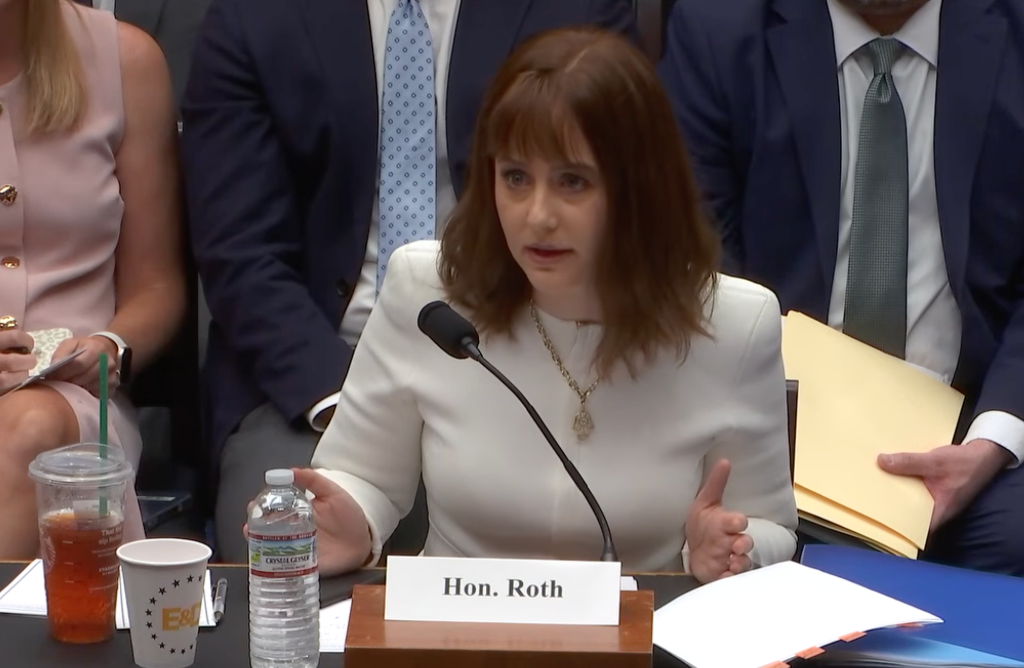
WASHINGTON, June 30, 2026 – The National Telecommunications and Information Administration is now aiming for guidance on how states can use more than $21 billion in broadband funding “this summer.”
NTIA Administrator Arielle Roth told House lawmakers that was the target during an oversight hearing Tuesday. Commerce Secretary Howard Lutnick had previously told senators the rules, which were due under an executive order in March, would be released in June.
“We’re really focused on getting the funding right,” Roth said. “We’ve received a tremendous amount of interest and comments on how the funding should be used, so we’re proceeding cautiously in producing that guidance.”
Under the agency’s $42.45 billion Broadband Equity, Access, and Deployment program, less than half the program’s budget will be used for deployment projects, partly a result of Trump administration efforts to push down those costs. States are awaiting guidance on how they can use the remaining “non-deployment” cash.
Roth said she wouldn’t get into what specifically NTIA staff were deliberating, but said the agency was “working actively to complete the guidance.”
During the hearing, which stretched more than three hours, Democratic lawmakers slammed the Trump administration’s changes to BEAD, which ditched an explicit preference for speedy but expensive fiber. Republicans praised Roth for eliminating what they saw as red tape and allowing more technologies to participate.
California, Illinois updates
Only California and Illinois have yet to receive NTIA approval on their BEAD spending plans, which were submitted last year. Roth said that of the other 54 states and territories, 52 had signed their grant agreements with the agency and could draw down money.
Rep. Scott Peters, D-Calif., said that NTIA “recently” sent California a new round of curing requests “with new issues and questions that NTIA had never previously raised.”
Roth said there were some “mapping anomalies” the agency found during its review of the state’s tentative awards.
“There were several examples in California where there were requests for really exorbitant amounts of money, ostensibly to serve apartments in the middle of nowhere,” she said. “So we had to work with the state to ensure that we address those mapping challenges.”
She said “the ball is in California’s court” in terms of responding to the agency’s requested changes.
California also has a net neutrality law, which NTIA is requiring states to exempt BEAD participants from throughout their in-state footprints.
In Illinois, Rep. Robin Kelly, D-Ill., said NTIA told the state on May 26 that it would have to cut its deployment spending by $100 million to get federal approval. The state is planning to spend most of its more than $1 billion allocation on deployment projects based on its draft plan.
“We have communicated changes to Illinois that we need to see,” Roth said. “The proposal that was submitted to us just didn’t meet the mark, in terms of finding efficiencies and meeting the principles of the benefit of the bargain reforms.”
She said the agency was also waiting on a response from Illinois, “and we look forward to seeing their revised proposal.”
General BEAD updates
Roth said NTIA was working with states to find backup plans for “about a dozen” states in which providers had refused BEAD awards.
“I think that’s to be expected in a program this size,” she said. “We planned and we have a process in place to ensure that areas that are subject to changes get served.”
She said all told only a little over 1 percent , or 40,000, of BEAD’s 4 million locations were affected by those changes.
Between Texas, Oregon, Nebraska, and New Mexico, at least 54,000 locations were included in projects in which the winning bidder backed out.
Roth said that five states have signed grant agreements with satellite providers under the program, either SpaceX or Amazon. SpaceX had told states earlier this year that it could be “untenable” for satellite providers to participate in BEAD absent some rule exemptions, something Commerce publicly shot down.
Fiber supply
Roth said NTIA wasn’t planning to waive BEAD’s domestic manufacturing requirements on fiber. There’s been sky-high demand from AI companies for the same U.S.-made fiber that rural ISPs will need for their BEAD projects.
“We don’t anticipate a waiver at this point, as long as domestic manufacturers step up as they’ve promised,” she said.
She added the agency was monitoring the fiber supply chain, and that “fiber producers have given us their word that fiber will be delivered in time to BEAD projects. We expect them to honor their commitments.”
Spectrum pipeline
Roth said agency plans for studying the 2.7-2.9 GigaHertz (GHz) band had recently cleared the 60-day Congressional review period, meaning cash to support those studies would be available soon.
“Funds are going to be available imminently to begin those studies,” she said.
NTIA is working to identify 500 megahertz of government spectrum that could be vacated or shared with the mobile industry. As part of that, incumbent agencies have to determine what interference their systems can handle and make plans to move that gear to other bands.
Agencies have to submit those plans to Congress before they can access money from the Spectrum Relocation Fund to complete those studies. The 2.7 GHz incumbents are largely the Federal Aviation Administration and the National Oceanic and Atmospheric Administration.
In response to questions on what lawmakers could do to speed the process, Roth said the 60-day Congressional review period for those plans could be shortened. There’s another six-month Congressional notification timeline for other transition funding, she noted.
CTIA, the major wireless industry group, said earlier this month that it was “ready to work with government partners on an expedited transition plan and identification process” to facilitate a 2.7 GHz auction in 2028.
Roth said NTIA would identify spectrum in the 7 GHz band for future commercial use by the end of the year, something the White House has asked for.