
Roth: NTIA Wants ‘Outcome-Driven’ Non-Deployment Spending
House Democrats want a briefing 'immediately' on the issue.

Jake Neenan

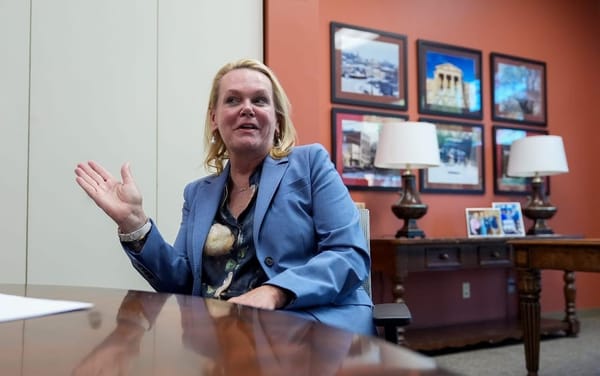
WASHINGTON, March 10, 2026 – The National Telecommunications and Information Administration wants to be “outcome-driven” in how it lets states spend $21 billion in broadband funding, the agency’s top official said Tuesday.
NTIA’s $42.45 billion Broadband, Equity, Access, and Deployment program is set to spend about half its budget on deployment projects, partly the result of Trump administration efforts to drive down costs. It’s not clear yet how states will be able to spend their remaining allocations, as the agency rescinded approval for non-deployment activities when it overhauled the program’s rules in June 2025.
Guidance on how states can use that funding was expected March 11, but the agency said it would need more time to iron out allowed uses and which states might be ineligible to use the money. An executive order directed NTIA to issue a notice providing that states with “onerous” laws on AI companies were ineligible “to the maximum extent allowed by federal law.”
“We want to ensure that any use of the funding is outcome-driven – delivers real, meaningful outcomes for American taxpayers measured against performance metrics,” NTIA Administrator Arielle Roth said. “We don’t want to just throw money out the door.”
She spoke in a wide-ranging fireside chat hosted by the Technology Policy Institute.
Roth reiterated the agency was “proceeding with the assumption the money is going to be spent.” There had been speculation that Commerce Secretary Howard Lutnick would prefer to return the money to the Treasury, something Roth said would require an act of Congress
NTIA has held listening sessions and fielded written comments on how it should use the money, and is seeking more input from state broadband officers at a closed-door conference with them this week. In a speech last year, Roth spoke positively about potentially using the money to bolster state and local permitting capacities.
Brooke Donilon, the agency’s chief of staff, said at an INCOMPAS conference the AI law restriction would target “a handful of states.”
“It’s not about a law that tanegentially, maybe impact AI,” she said. “It’s about a law that directly impacts the development and success of AI.”
Also on Tuesday, House Democrats sent a letter to Roth requesting a briefing “immediately” on how NTIA was planning to allow states to use their non-deployment funds before releasing public guidance. The lawmakers said Congress had envisioned a “broad range of acceptable uses” for the money, and argued the December executive order tying the money to AI laws was unlawful.
“Any effort to restrict or withhold funds because a state or territory has adopted laws or regulations to protect against harms from artificial intelligence is blatantly unlawful and a clear impoundment of appropriated funds,” they wrote. “NTIA should not risk tying up the BEAD Program in years of legal challenges and further delaying its already overdue implementation.”
The letter was signed by the top-ranking Democrats on various committees: Rep. Frank Pallone, D-N.J., of the House Commerce Committee, Rep. Doris Matsui, D-Calif., of the House Communications and Technology Subcommittee, and Yvette Clarke, D-N.Y., of the House Oversight Committee.
CBRS and BEAD
Asked by TPI President Scott Wallsten if stakeholders had gone to her with concerns about potential rule changes to the Citizens Broadband Radio Service and their impact on BEAD, Roth said, “I haven’t heard much in the way of concern about BEAD, but it’s definitely something that we would be sure to monitor.”
There’s been a string of advocacy before the Federal Communications Commission trying to prevent the agency from changing the rules for the shared band, either by raising power limits or even selling off some of the airwaves. Users like wireless ISPs have made the argument that their BEAD grants could be upended.
Spectrum, WRC-27
Roth and NTIA have a lot on their plate. The agency is tasked with identifying 500 megahertz of federal spectrum to auction for commercial use and is working on solidifying U.S. positions on agenda items at the World Radiocommunication Conference next year.
She said NTIA was working with “a sense of urgency” to complete studies on federal airwaves. That involves finding bands in which to relocate critical federal systems, which Roth said was a big part of the studies.
“You have critical safety-of-life systems that need to get relocated or compressed. In some cases, we don’t have the spectrum specifications of the new systems that the agencies are going to have to purchase,” she said.
The agency has already identified 5 megahertz in the National Oceanic and Atmospheric Institute's 1675-1695 MHz band. Roth said with respect to the 2.7-2.9 GHz band, the incumbent Department of Transportation is “very eager to work with us to identify spectrum in that band.”
There’s much domestic disagreement on how the U.S. should advocate other countries treat the 7.125-7.4 GHz band, also under NTIA study, at WRC-27, with the mobile carriers pushing for a mobile designation and unlicensed interests wanting to hold off while studies are ongoing.
Despite that, Roth said most of WRC-27 would be “very satellite heavy.”
“Commercial space is an area that America dominates in, and must continue to dominate,” she said, especially given that 6G standards are expected to feature better integration between terrestrial and satellite networks.






Member discussion