Sanders Convenes Chinese and American Computer Scientists to Warn of Threat from AI
'The richest, most powerful people in the world are now building a runaway train with no brakes,' Sanders said.

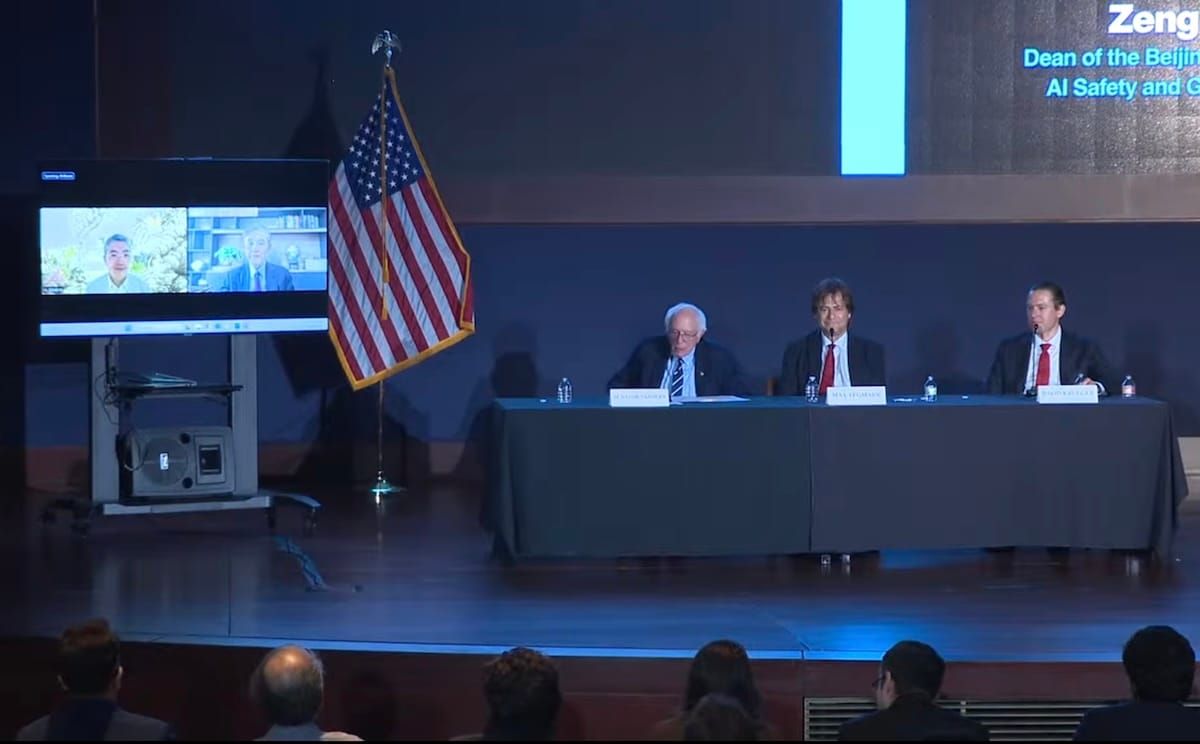
WASHINGTON, April 29, 2026 — Sen. Bernie Sanders, I-Vermont, on Wednesday convened leading artificial intelligence researchers from the United States and, via the Internet, China for a rare cross-border discussion warning that the unchecked development of AI poses an existential risk to humanity – and that governments have failed to respond with appropriate urgency.
The roughly 75-minute panel, livestreamed from the Capitol, featured Massachusetts Institute of Technology physicist Max Tegmark, University of Montreal AI researcher David Krueger, Beijing Institute of AI Safety and Governance Dean Zeng Yi, and Tsinghua University professor Xue Lan, who chairs China's national AI governance expert committee.
Sanders, a former candidate for the Democratic Party presidential nomination in 2016 and 2020, opened the event by citing Google DeepMind chief Demis Hassabis's projection that the AI revolution could be "10 times bigger than the industrial revolution and 10 times faster."

And he noted that four major AI companies are expected to spend nearly $700 billion on data centers this year alone — a figure he said is equivalent to the total cost of the Manhattan Project every three weeks.
"The richest, most powerful people in the world are now building a runaway train with no brakes," Sanders said. "They acknowledge that they don't understand how it works, and they don't know where it is heading."
‘No serious discussion’ on the threat
Sanders pointed to a 2023 statement signed by hundreds of researchers and the chief executives of OpenAI, Anthropic and Google DeepMind that placed AI extinction risk alongside pandemics and nuclear war as a global priority. Despite such warnings, he said, there has been "no serious discussion" of the threat in the U.S. Senate.
All four panelists agreed that prominent warnings from figures including Nobel laureate Geoffrey Hinton, who has put the odds of AI wiping out humanity at 10% to 20%, were not overstated.
Tegmark said his own assessment is higher, arguing the risk of civilizational collapse from unregulated AI development is "likely to be a lot higher than 20%." He said AI companies are openly trying to build superintelligence — systems that would outperform humans at every job — without knowing how to control them.
"Just go down to the Washington Zoo and ask yourself who's in the cages," Tegmark said. "Is it the smartest species around or not?"
Krueger said the field is in a state of "acute crisis" after three years of warnings have produced little government response.
Zeng, from China, said current AI systems already pose catastrophic risks, even before superintelligence arrives, because humans tend to overestimate what the technology actually understands. Citing a benchmark his institute developed identifying 94 classes of AI safety threats, he said every threat traces back to human behavior reflected in training data. "AI is a mirror," he said.
Xue, who has briefed the United Nations Security Council on AI, said international governance efforts — including AI summits in the U.K. and India and various U.N. mechanisms — remain "fragmented and not as effective as they should be." He attributed the gap to uncertainty about AI risks and geopolitical tensions between the U.S. and China.
U.S. has uniquely lax oversight, said panelists
Tegmark argued the U.S. has uniquely lax oversight of the industry, saying AI is "the only thing which is less regulated yet powerful than sandwiches." He described meeting Megan Garcia, whose son died by suicide after extended interactions with an AI chatbot that he said urged he boy to “come home” to it.
"For someone to say … that we must legalize this kind of evil for profit because China makes absolutely no sense," Tegmark said.
Xue pushed back on the framing of a U.S.-China AI race, calling it an "inaccurate narrative." He said the two countries share interests in AI safety research and in helping bridge a global "AI divide" that could leave most of the world without access to the technology.
Sanders noted that President Donald Trump and Chinese President Xi Jinping are expected to discuss AI safety at an upcoming summit and said opposition to AI development is emerging across the political spectrum. He cited polling showing 95% of Americans oppose an uncontrolled race to superintelligence.
"We have a global crisis dealing with the survival of the human race," Sanders said at the conclusion of the event.
“I think more and more people are becoming sensitive to this issue and what we've got to do is take this issue all over the world and bring countries together. We've done it in the past with regard to nuclear weapons. We've done it in the past regarding working together on pandemics. We can do it on this.”
He also thanked Zeng and Xue, joining from China at 7 a.m. on Thursday, April 30, local Chinese time.