Satellite Broadband Emerges as Major Player in Federal BEAD Program

Satellite providers are securing 22 percent of federal broadband funding by offering immediate connectivity where fiber deployment could take years.


Satellite Broadband Emerges as Major Player in Federal BEAD Program
Photo by Tim Mossholder published with permission

WASHINGTON, Dec. 4, 2025 — Satellite broadband has won more than 22 percent of federal funding allocations under the Broadband Equity Access and Deployment Program, as low-Earth orbit providers compete aggressively against fiber and fixed wireless solutions.
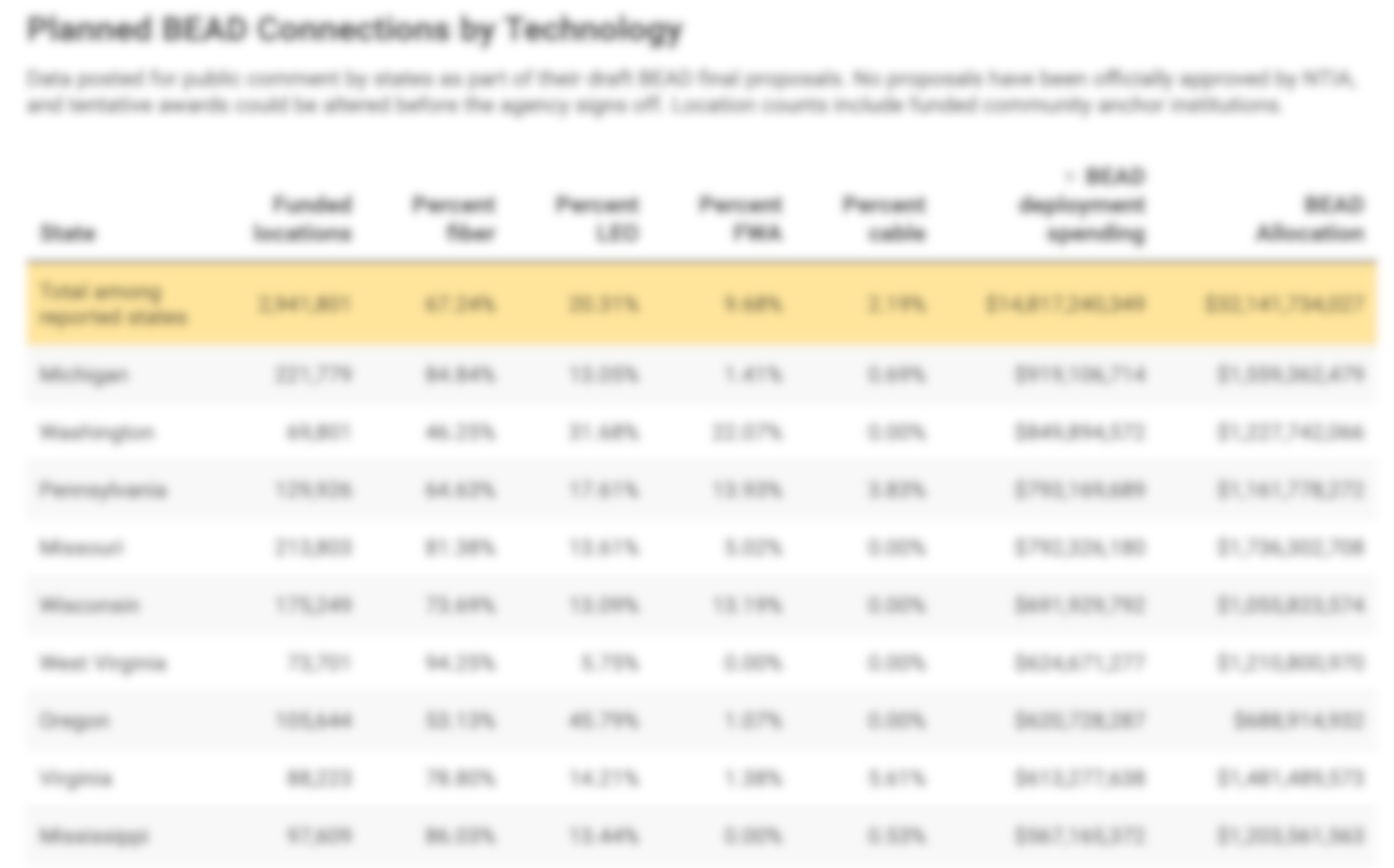
At the Broadband Breakfast Live Online panel on Wednesday on satellite’s role in the program, experts weighed the relative merits of the funding via satellite versus more than 63 percent for fiber and nearly 10 percent for fixed wireless. See Broadband Breakfast Premium BEAD chart for a detailed breakdown.

Steven Hill, president of the Satellite Broadcast and Communications Association, told the event that satellite technology offers immediate connectivity for underserved areas where fiber deployment could take years.

Broadband Breakfast on December 3, 2025 - Satellite Broadband and BEAD
As LEO constellations expand and reliability improves, attention is turning to policy considerations.

"The problem is that telling your constituents [that] they're not gonna have high speed Internet until 2030 is probably not a good election strategy," Hill said, recounting a conversation with a state policymaker who initially insisted on fiber-only solutions.

The BEAD program, part of the 2021 Infrastructure Investment and Jobs Act, allocated $42.45 billion to states for broadband deployment.

David Zumwalt, CEO of WISPA, the Association for Broadband Without Boundaries, defended the technology-neutral approach mandated by the legislation, rejecting concerns that satellite creates inferior service.

"The two-tier argument is a beautiful canard," Zumwalt said. "Let's quit trying to colonize rural America. Let's instead look at what does it take to provide services there."

Hill emphasized that satellite technology continues to evolve rapidly, with third-generation LEO satellites offering 10 times the capacity of first-generation systems launched just three years ago.

"Satellite technology is rapidly evolving," Hill said. "The speeds of satellites are only going to continue to improve."

Can satellite meet BEAD’s requirements?

The discussion addressed concerns about whether satellite providers can consistently meet BEAD's 100 megabits per second (Mbps) download and 20 Mbps upload requirements during peak usage times. 

Hill acknowledged current capacity limitations but projected significant improvements as constellation deployments expand from approximately 5,700 satellites today to potentially 15,000-30,000 satellites within 18 months.

"Each satellite's traveling at 17,000 miles an hour," Hill explained. "If there's not a lot of satellites in that particular area, those speeds are gonna slow down. But when we get to full capacity...you're gonna be able to have those speeds on a very consistent basis."

Amazon's entry into the LEO market, recently rebranding its Project Kuiper as Amazon LEO, could intensify competition, he said. Hill noted Amazon has leased virtually every non-SpaceX satellite launch slot for consumer satellites over the next three to four years.

"What happens when we have competition? We tend to get better consumer deals," Hill said.

Zumwalt emphasized that fixed wireless providers view satellite technology as a complementary technology, particularly for reaching isolated locations where terrestrial infrastructure proves cost-prohibitive.

"Satellite fills a niche," Zumwalt said. "It's an important niche because it's serving the unserved."

Member discussion

Popular Tags