
Senate Commerce Committee United in Support of Limiting Kids’ Screen Time
Still, the E-Rate program got caught in partisan crossfire, as some senators said the program led to unsupervised connectivity in schools.

Eric Urbach
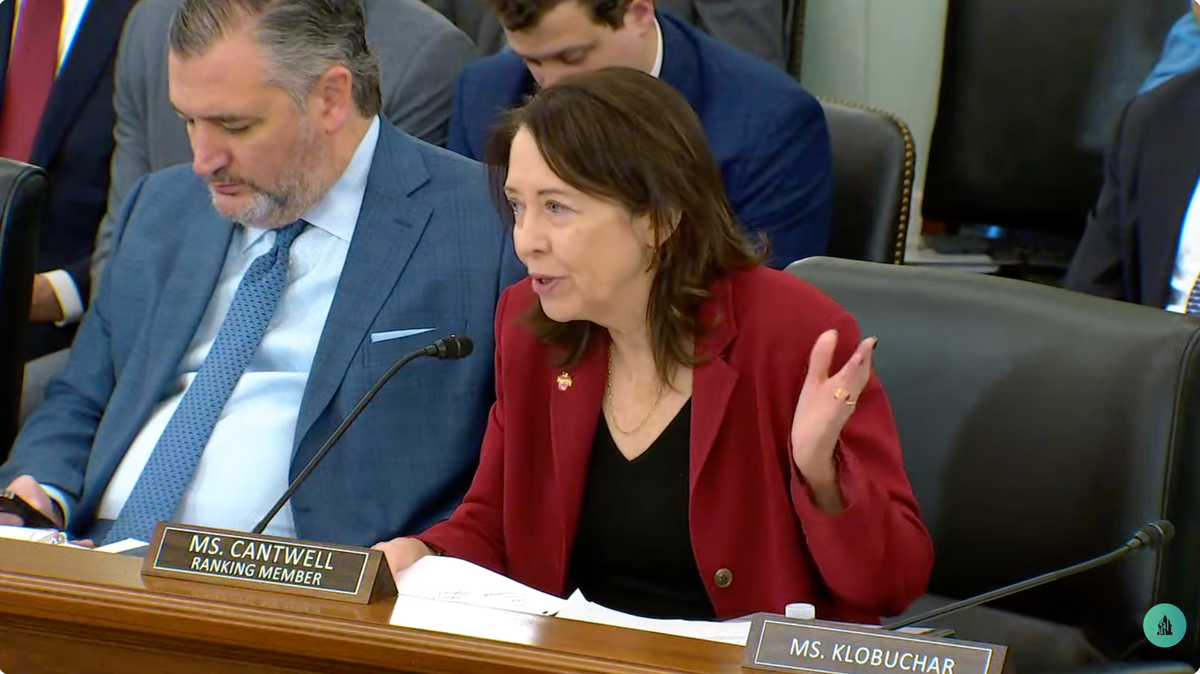
WASHINGTON, Jan. 15, 2026 – Education technology came in for bipartisan shellacking on Thursday, as both Republicans and Democrats on the Senate Commerce Committee criticized the amount of time that kids were spending on social media and on computers.
For example, when Sen. Ben Ray Luján, D-N.M., called for Congress to subpoena the CEOs of the nation’s largest social media companies to explain when they would fix their “damaging” products. Senate Commerce Committee Chairman Ted Cruz, R-Texas, thanked Luján for his comments and said he was “preaching to the choir.”
Throughout the hearing examining how technology is impacting America’s youth, witnesses suggest age limits, content blockers, privacy rules, and even outright tech bans in schools. All got an eager hearing from committee members apparently dead set on limiting the use of phones and computers by kids.
Federal E-Rate at issue
The federal E-Rate program got caught in the crosshairs, too.
Cruz accused the Biden administration of using funds to help students get online with little supervision. Ranking Member Sen. Maria Cantwell, D-Wash., said rather than “threatening” school funds, Congress should pass privacy protections.
Senators signaled bipartisan support for stronger oversight of social media and artificial intelligence use among children, but diverged on the scope and implementation.
The hearing featured multiple pieces of legislation, including, most significantly, the Kids Off Social Media Act, or KOSMA, introduced by Cruz and Sen. Brian Schatz, D-Hawaii.
If enacted, the bill would set a minimum age of 13 for social media use and require companies to remove algorithmic feeds for users under 17 among other policies.
Witnesses agreed that while the bill was a good first step, it could be strengthened.
“It’s a start, but I would raise the minimum age (for social media use) to 18,” said witness Emily Cherkin, the author of The Screentime Consultant.
Within that line of questioning Sen. Bernie Moreno, R-Ohio, suggested that legislators were “dancing around the problem” noting his belief that given the severity of the concern, the government should take more bold action to fix the issue.
Some suggest banning tech in schools
Some senators and witnesses suggested that schools consider outright bans on personal devices to limit screen time.
Sen. John Hickenlooper, D-Colo., highlighted a pilot in a western Colorado school district where students were not permitted to use cell phones during the entire school day.
He said that despite initial concern from students and parents, there was universal acclaim from the children at every grade level and almost no parental disapproval after a three month trial.
Witness Jean Twenge, a psychology professor at San Diego State University, agreed that “those types of solutions that are not incremental, tend to work better,” citing studies showing that students in schools with full-day phone bans were more likely to check out library books and engage in other offline activities.
However, a coalition of education, library, and broadband nonprofits cautioned against broad bans in a Tuesday letter to the Senate Commerce committee, instead advocating for “carefully curated” technology use and local decisionmaking.
This sentiment seemed to be absent within the chamber, as witness Jared Cooney, of LME Global, described in detail how countries in Scandinavia regulate EdTech by banning it for all primary years and most secondary years. Cooney said that the countries like Sweden and Norway had looked at the results and believed the technology wasn’t improving outcomes.
“I could ask you, ‘How do I make anthrax better?’ Maybe the answer is you don’t – you go back to not using it,” Cooney said.
Witness Dr. Jenny Radesky, associate professor of pediatrics at the University of Michigan Medical School, said that social media and AI products are designed to "optimize engagement,” often in direct odds to what parents need and without consideration of how youth think, feel and relate – which differs from adults.
“That’s why it’s not sufficient to just talk about screen time,” Radesky said. “We need to shift our thinking and action to be about design, whether tech products are centered around developmental needs and well being of youth, or designed around markets and profit share.
Sen. Andy Kim, D-N.J., highlighted the bipartisan support the committee showcased throughout the hearing.
“There is real bipartisan attention and focus on this and a lot of urgency as well,” Kim said.








Member discussion