
Senators Press FCC Chair for First Time Since Kimmel Controversy
Senators confront Carr on broadcast influence, consolidation, and FCC independence

Jericho Casper
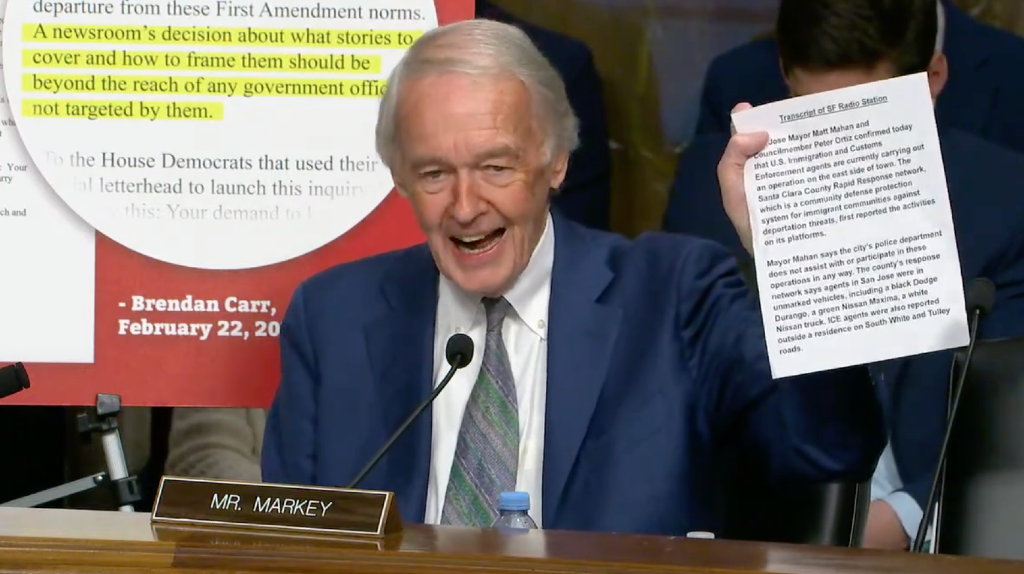
WASHINGTON, Dec. 17, 2025 – A Senate oversight hearing of the Federal Communications Commission veered into unexpected territory Wednesday when FCC Chairman Brendan Carr and Republican Commissioner Olivia Trusty denied the agency’s status as an independent regulatory body.
Their remarks, which contradict nearly a century of precedent, came as senators accused Carr of abusing his position to intimidate broadcasters and chill speech in his first year as chairman.
“The FCC is not an independent agency because –,” Carr said, before being cut off by Sen. Ben Ray Luján, D-N.M., for repeatedly speaking over senators. Minutes after the Senate Commerce Committee concluded, the word “independent” had been stripped from the FCC’s website.
“I appreciate you saying that and being honest with the American people,” Luján shot back at Carr. He then asked Trusty to address the question.
“We are not independent,” Trusty argued. “The President is the chief executive vested with all executive power in our government, and FCC commissioners do not have for-cause removal protections. So, we are not independent.”
Their assertions were at odds with the FCC’s original design under the Communications Act of 1934, which intended the commission to operate as an independent regulatory body. However, they reflect a broader trend under the Trump administration of regulatory agencies experiencing reduced independence and heightened executive influence.
Democratic Commissioner Anna Gomez pushed back, telling senators that Congress should clarify the FCC’s independent status. “Yes,” Gomez said, responding to Luján, “we should be.”
Holding up a printout of the FCC’s website which described it as an independent commission, Luján said, “If this is lying, you should fix it. If it’s not true, then change it.”
Within minutes of the hearing’s conclusion, the FCC did just that, removing the line describing the agency as independent from its about page.
It was an unexpected turn for an oversight hearing stakeholders hoped would focus on scrutinizing policies the FCC used this year to affect broadcast content.
Carr accused of abusing public interest standard
Multiple senators accused the FCC chair of intimidation, chilling speech, and weaponizing the FCC’s public interest mandate to directly influence broadcast decisions.
“You’ve launched investigations into every major broadcast network, except FOX,” said Sen. Amy Klobuchar, D-Minn., “Do you think it is appropriate to use your position to threaten companies?”
Carr defended his actions, calling broadcast “fundamentally different” from other mediums and saying the FCC had long neglected its public interest obligations. The standard established in 1934 requires broadcasters to operate in the “public interest, convenience, and necessity.”
Carr invoked the standard this year to reopen dormant news distortion complaints against ABC and CBS, threaten Comcast over its coverage of a deportation case, and to pressure other networks, leading critics to argue he was misusing the mandate.
Sen. Edward Markey, D-Mass., did not hold back. “You are not reinvigorating the public interest standard, you are weaponizing the public interest standard,” he said. “That is what the Carr FCC is doing every day.”
Carr pushed back, asserting, “Senator, broadcasters understand, perhaps for the first time in years, they’re going to be held accountable to the public interest, to broadcast hoax rules, to the news distortion policy. I think that’s a good thing.”
The exchange quickly escalated into a shouting match, with neither side relenting.
“Chilling effect does not begin to describe the neutering of our political coverage,” Markey said. “This is government censorship, plain and simple.”
Lawmakers from both parties ultimately signaled that it was time for Congress to revisit the decades old public interest standard.
It is “a simple truth,” said Senate Commerce Committee Chairman Ted Cruz, R-Texas, “that the public interest standard and its wretched offspring the ‘news distortion rule’ have outlived whatever utility they once had and it is long past time for Congress to pass reforms,” in opening remarks.
Carr had used the rule to pressure ABC to remove “Jimmy Kimmel Live!” in September, in a move widely criticized, including by Cruz, as an act of government censorship and violation of free speech.
Market, media consolidation concerns
Another major focus of the hearing was market consolidation and its impact on local and independent local media.
Ahead of the hearing, Sen. Maria Cantwell, D-Wash., released a report highlighting how mergers and acquisitions in the broadcast, wireless, and cable sectors have reduced competition, driving up prices for consumers.
“Americans are paying more than ever for streaming, cable, and wireless services. Streaming costs are up 13 percent this year alone,” Cantwell said in opening remarks. “These consolidations make it more challenging for us to give consumers real choice in the marketplace.”
Gomez echoed these concerns.
“The FCC has taken affirmative actions that have raised costs and reduced choices for consumers,” she said, referencing the loss of a potential fourth competitor in the wireless industry, higher rates for prison communications, and plans that would allow billion dollar media companies to expand at the expense of local news.
She referenced the FCC was revisiting broadcast ownership rules, which limit the number of broadcast stations an entity can own. The inquiry comes amid major mergers, including Nexstar’s proposed acquisition of TEGNA, which would expand the company’s reach to roughly 80 percent of U.S. television households.
Although the FCC may use a different metric, the combination would dramatically exceed the 39 percent national broadcast ownership cap established by Congress in 2004.
“The rule reflects Congress's judgments about the importance of competition, localism and viewpoint diversity efforts,” Gomez said. “To sidestep that statutory limit presents significant issues concerning the scope of the FCC authority.”
Carr, Cruz call for revisiting broadcast ownership caps
Carr said the agency has not made a final decision on broadcast ownership rules but emphasized that the FCC was examining ways to “constrain the power” of national programming companies over local broadcast stations.
“One of the concerns that I have in media policy as a general matter is you’ve got the national programmers, Comcast, Disney and others, that are increasingly dominating with respect to those local broadcasters,” Carr said. “So we want to make sure that they do have the ability to invest in local news gathering, because it’s also more trusted.”
Carr said the FCC was considering how to “empower those local TV stations to reclaim more of that nightly news time for actual local news and programming” rather than content produced in New York or Los Angeles.
Cruz called for updating media ownership caps in a broader modernization of the Communications Act.
“It is a wonder that the legal regime governing these issues and the commission's role in regulating them has largely not been updated since 1996,” Cruz said. “There are a number of issues, from the utility of the so-called public interest standard in the modern era, to retransmission consent rules in the streaming era, to the current media ownership caps, where a statutory update might be worthwhile.”




Member discussion