Telephone's Rise Was Shaped by Courts and Lobbying, Not Just Wires, Historians Say
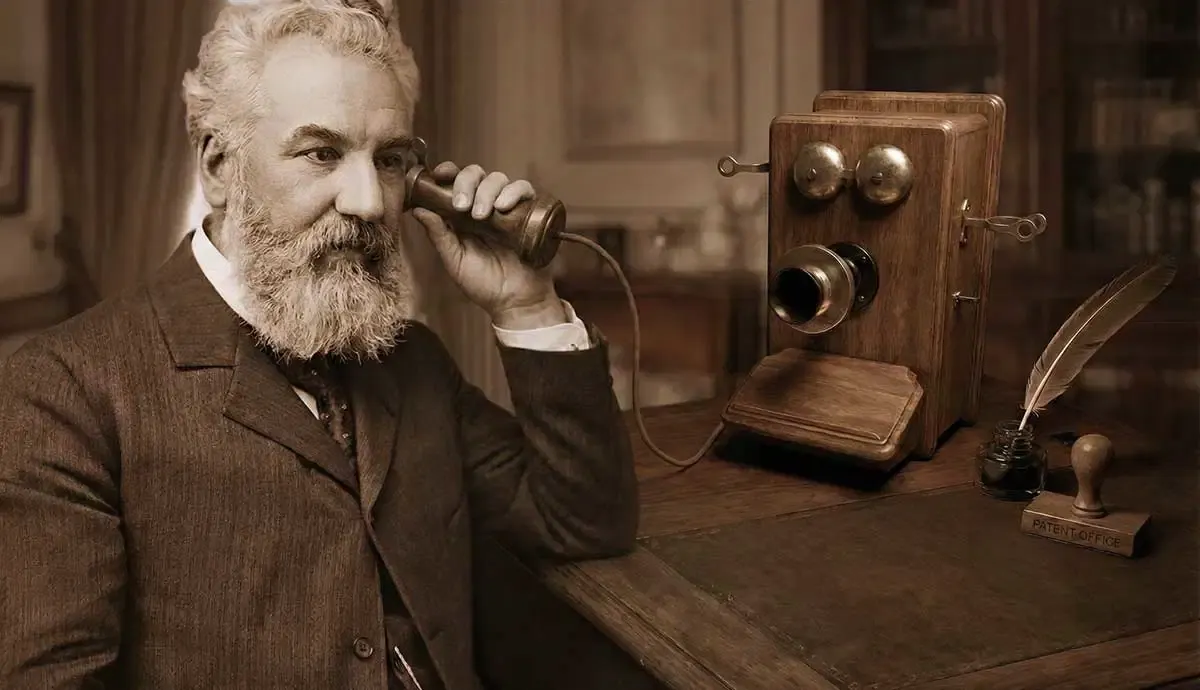
The patent Bell filed in 1876 never described a speaking telephone. His lawyers later argued it did.

WASHINGTON, June 22, 2026 — Three communications historians examined the first 50 years of the American telephone industry, from Alexander Graham Bell's 1876 patent through 1926, during Wednesday’s Broadband Breakfast Live Online.
The event was the first of three special BroadbandLive events celebrating 250 Years of American Independence and 150 Years of American Telecommunications. The webcasts are also serving as a sort of preview for an in-person event celebrating America250 / Telecom150 on October 1, 2026, at the National Press Club.
A patent that predated the invention
A single vote on the U.S. Supreme Court did more to make Bell the telephone's sole recognized inventor than his own patent did, said Christopher Beauchamp, professor of law at Brooklyn Law School and author of "Invented by Law: Alexander Graham Bell and the Patent That Changed America." The 1888 ruling fills an entire volume of the U.S. Reports, the official compilation of Supreme Court decisions, running 614 pages on its own.
Bell's 1876 patent never mentioned transmitting speech, and he had not yet transmitted an intelligible word when he received it, Beauchamp said. A teacher of the deaf with expertise in sound rather than electrical engineering, Bell had set out to build a "harmonic telegraph," a high-capacity system designed to send multiple signals over a single wire, not a device for transmitting voice.
The case that made Bell
The broad legal theory that ultimately defined Bell's patent rights came from his lawyers, not from Bell himself, Beauchamp said. The night before his first major patent trial, Bell wrote to his wife complaining that his own lawyers "don't understand this at all." The lawyers’ argument won anyway, fighting off hundreds of competing claims through the 1880s from rivals including Elisha Gray and Thomas Edison, both backed by Western Union, then the dominant telegraph company.
Western Union's eventual settlement with Bell, and its exit from the telephone business, let the technology "develop as an independent standalone technology," Beauchamp said, unlike in many other countries, where telephone service was folded into existing telegraph systems.
What universal service once meant
AT&T, the company that came to dominate the American telephone industry, coined the phrase "universal service" to mean that its own network was the only one that mattered, said Claude S. Fischer, distinguished professor in the Graduate School in Sociology at the University of California, Berkeley, and author of "America Calling: A Social History of the Telephone to 1940." The company used the phrase to discourage subscribers from relying on independent local carriers, arguing that competing systems degraded the signal.
That meaning reversed under pressure from state legislatures and the federal government, Fischer said. By the 1913 Kingsbury Commitment, an antitrust settlement in which AT&T agreed to let rival carriers connect to its network, "universal service" had come to mean that competing telephone systems had to interconnect with each other, the opposite of the company's original usage.
AT&T's market share fell to roughly half the nation's telephones by 1910 after that competitive opening, Fischer said. The company recovered to 80 or 90 percent by the 1920s through aggressive litigation against competitors and their customers, political lobbying that included bribing local officials, and the quiet acquisition of rival carriers.
The dreamers inside AT&T
Internal AT&T correspondence from the 1890s and 1900s shows a minority of company executives, dismissed internally as "ridiculous dreamers," believed telephone service could be profitably sold to farmers, working-class households, and women for social conversation, Fischer said.
They were overruled until ownership turned over around 1907, when new leadership from public relations and sales, rather than the telegraph industry, reversed the strategy. Users often teach innovators what their technology is actually for, Fischer said, citing the early automobile industry, which marketed cars as largely recreational before buyers proved their practical value for everyday transportation.
How news took over the wire
A one-way broadcast model eventually came to dominate the telegraph industry, even though the technology began as a two-way, person-to-person medium, said Menahem Blondheim, professor of communication and history at Hebrew University of Jerusalem and author of "News Over the Wires: The Telegraph and the Flow of Public Information in America, 1844 to 1897."
News transmission, the telegraph's most profitable application, drove that shift, as wire services such as the Associated Press came to dominate the wires.
A New York legal exception allowed news organizations to monopolize telegraph lines for hours at a time, while ordinary users were capped at 15 minutes under what was known as the 15-minute rule, Blondheim said. That asymmetry locked in the one-way structure that came to define commercial telegraphy.
Western Union, the dominant telegraph company, acquired many local urban telegraph systems through a subsidiary called Gold and Stock Company, Blondheim said. These systems began in the 1860s carrying stock tickers and fire and police alarms, then developed switching technology and private lines connecting homes to offices. Blondheim said this telegraph-based network converged on many of the same technical solutions, like two-way switching, that Bell was independently developing for the telephone in the 1870s.
A telegraph exchange that never happened
The famous story of Queen Victoria and U.S. President James Buchanan exchanging messages over the first transatlantic cable in 1858 is largely a myth, Blondheim said. The cable worked only briefly before failing.
But the legend of that exchange helped Cyrus Field, the financier behind the original Atlantic cable venture, maintain his monopoly on cable landing rights along the shores of the Canadian Maritimes and the northeastern United States.
Western Union later tried to circumvent that monopoly with an alternative route entirely over land and short sea crossings, Blondheim said. The proposed path ran up the West Coast through the Pacific Northwest and British Columbia, across Alaska, over the Bering Strait, and overland through Siberia to reach Europe from the east, but the plan ultimately collapsed over international telegraph regulations governing cable landing rights.