Terrence Kelly: U.S. AI Leadership Demands a Modern Network
Realizing AI's full potential requires the U.S. to build a secure, high-capacity national fiber intranet alongside the public internet.

Terrence Kelly

Artificial Intelligence is becoming increasingly central to economic productivity, national security, and the functioning of modern society.
Yet policy discussions about AI often focus on model performance and compute capacity and ignore the fact that AI results must get from the data centers where they are developed over telecommunications infrastructure to those that need them. For this to happen reliably, securely, and at scale, quality telecommunications infrastructure matters.
While telecommunications infrastructure is central to our ability to deliver AI capability, our networks were not designed for this task. In modern AI systems, the network may be part of the AI compute system itself, as very low latency, reliable data transfer is needed for good AI performance.
Latency, bandwidth, and reliability are not secondary considerations; they shape whether systems function effectively or at all. However, U.S. telecommunications networks lag behind those of most peer nations in terms of fiber penetration, in particular. This gap limits the ability to deliver AI services efficiently across the country and constrains the practical impact of U.S. technological leadership.
The fact that AI workloads are placing new demands on telecommunications systems implies that changes are needed. Unlike the public internet, which is designed to accommodate fluctuations in performance, AI applications depend on tightly coupled, massive data exchanges. These requirements place stress on existing infrastructure, such as long-haul fiber networks, metropolitan fiber systems, and access networks that connect end users, as most were not created to meet these requirements.
These evolving demands introduce new risks beyond AI. Telecommunications systems are integral to the functions of other critical infrastructures. Disruptions in one domain can affect others, creating the potential for cascading effects (e.g., power, finance, and other control systems).
In addition, the concentration of network traffic and infrastructure in specific areas, called telecom corridors and metropolitan areas, can create potential points of failure that may have disproportionate impacts. These challenges are compounded by the reality that sophisticated adversaries have penetrated and can operate within U.S. communications networks and critical infrastructure.
A modern, high-capacity fiber network operating in parallel with the public internet
For the U.S. to maximize its AI prowess and secure its systems, it needs a modern, high-capacity fiber network operating in parallel with the public internet and for some functions replacing it – a national intranet – designed to support critical functions with greater reliability, security, and performance. Such a network would support AI and make it far more effective.
Because it would be high-bandwidth, low-latency, and predictable, the proposed network would reduce or eliminate networks constraints on AI system performance and service delivery. It would also vastly improve the security of high-value systems: A network that is physically distinct from the internet reduces exposure to its many vulnerabilities.
Controlled access, monitoring, and segmentation would make it difficult for adversaries to penetrate and disrupt critical communications and systems. This would provide a more secure foundation for operations and service delivery for critical government, military, and business functions.
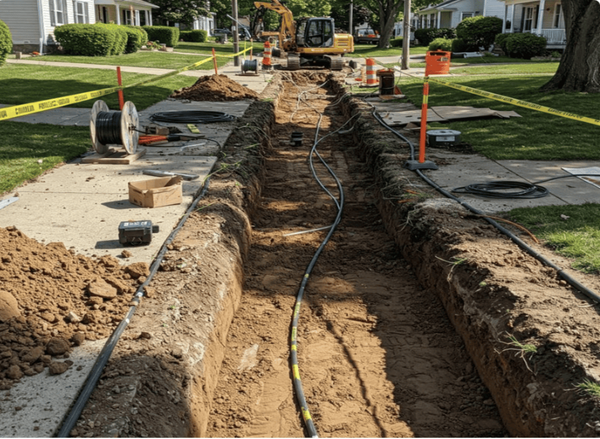
Leveraging the federal and state transportation departments rights-of-way, such a network would also increase network redundancy and geographic distribution. Eliminating current restricted corridors would help telecom function in the face of localized disruptions. It would also help state and local government provide higher-quality connectivity for businesses and households and improve AI’s ability to deliver services across the country and create widespread economic and social benefits.
Economic implications of aligning broadband infrastructure with AI
The economic case for advanced telecom networks to support AI is compelling. Research suggests that AI could, under optimistic assumptions, contribute almost $20 trillion to global GDP by 2030, with the U.S. leading this trend. However, realizing these gains requires the infrastructure to deliver AI services reliably and at scale. This, in turn, requires the U.S. to modernize its networks. If done, large commercial users, such as cloud providers, AI developers, and data-intensive industries, would enjoy significantly lower transport and connectivity costs.
Improved and expanded broadband infrastructure extends AI’s reach and enhances its productivity. Today, limitations in last-mile connectivity and network performance constrain the delivery of digital services in many regions. By improving both backbone and access networks, the U.S. would increase AI uptake and its economic development.
High-performance, reliable networks tend to attract investment in technology-intensive industries, generating significant economic benefits. These investments generate secondary benefits through job creation and increased local economic activity.
While the direct costs of building a modern national fiber backbone are significant, the potential returns from productivity gains, cost reductions, expanded market participation, and increased investment are substantially larger. The extent to which the U.S. captures these benefits will depend not only leading in models and compute, but also on the telecommunications infrastructure needed to deployed AI effectively. Both are necessary, and neither are sufficient for AI leadership today.
Terrence K. Kelly, Ph.D is the founder and president of TKK Consulting, LLC and board of director at Neo Network Development, where he’s part of the team leading the company’s proposed National Broadband Master Plan. Reach him via LinkedIn. This Expert Opinion is exclusive to Broadband Breakfast.
Broadband Breakfast accepts commentary from informed observers of the broadband scene. Please send pieces to commentary@breakfast.media. The views expressed in Expert Opinion pieces do not necessarily reflect the views of Broadband Breakfast and Breakfast Media LLC.