
Uncertain Reactions to the Executive Order on AI and BEAD Non-Deployment Funds
Experts said tying the funding to favorable state AI laws could raise legal issues, but states weren’t certain to litigate.

Jake Neenan

WASHINGTON, Dec. 12, 2025 – President Donald Trump’s executive order seeking to withhold broadband funding from states with “onerous” laws on artificial intelligence companies could face legal issues, according to experts.
The order directs National Telecommunications and Information Administration Administrator Arielle Roth to produce within 90 days a policy notice saying states with “onerous” laws on AI companies are ineligible for billions in funding under the $42.45 billion Broadband Equity, Access, and Deployment program.
States’ tentative broadband deployment grants wouldn’t be affected, but many states are spending far less than they were allocated for the program in 2023, partly due to a Trump administration focus on cost cutting. The order aimed to make states unable to use their excess cash, expected to total about $21 billion, if their AI regulations were unfavorable to the industry.
Sean Conway, former NTIA general counsel, said in an interview Friday the law standing up BEAD gives the agency’s chief a lot of leeway to decide how to run the program, and a legal challenge on that front could prove difficult. He said it was also hard to predict the strength of a potential legal challenge without seeing how the agency actually structures the policy notice.
Is the restriction sufficiently related to BEAD’s purposes?
He said there could be constitutional issues with the notice though, both whether the restriction is sufficiently related to the purposes of BEAD, and whether it amounts to the federal government improperly coercing states.
“The most interesting legal question will be ‘How does the policy notice articulate the germaneness of the condition to the purposes of the BEAD program?’” he said.
He said some of the order’s language, directing NTIA to describe in its notice how a “fragmented state regulatory landscape for AI” undermined BEAD-funded networks, appeared to be an effort to satisfy that requirement and tie the funding restriction to the program’s goal of broadband expansion.
The policy notice “must provide that States with onerous AI laws identified pursuant to section 4 of this order are ineligible for non-deployment funds, to the maximum extent allowed by Federal law,” the order says. “The Policy Notice must also describe how a fragmented State regulatory landscape for AI threatens to undermine BEAD-funded deployments, the growth of AI applications reliant on high-speed networks, and BEAD’s mission of delivering universal, high-speed connectivity.”
In a Thursday investor note published ahead of the signing, Blair Levin, New Street Research’s policy advisor and former FCC chief of staff, agreed the specific implications were difficult to judge based on the order’s broad language.
He said states looking to sue over the issue had a “material chance” of overturning the order by convincing a judge that the White House was doing by executive action something that Congress should do by legislation.
But the administration might be betting states don’t want to jeopardize their chances at large pots of federal funding, hundreds of millions in most cases, with lengthy litigation, he wrote.
“States may choose not to fight so that they can receive the funds on an earlier timeframe,” he wrote.
Conway agreed. He said states have “historically been willing to abide by program requirements that they do not prefer but are willing to tolerate.”
States likely to want ‘onerous’ defined narrowly
Levin wrote that it’s likely states will push Roth and Commerce Secretary Howard Lutnick to simply define “onerous” laws narrowly and allow most legislation to stand.
Drew Garner, director of policy engagement at the Benton Institute for Broadband & Society, said the order’s impact could potentially be widespread, given the number of states with AI-related laws on the books.
“It’s going to potentially derail this once-in-a-generation program,” he said. “And effectively hold $21 billion in funding hostage as a way to compel states to comply with the new executive policy.”
He said tying funding to promoting AI companies now didn’t appear to square with the administration’s previous BEAD policy change over the summer, a policy Benton also opposed, which made it easier for non-fiber projects to win BEAD grants.
“On one hand they are savaging the fiber projects in BEAD, and on the other saying they want BEAD to promote artificial intelligence,” he said. “Both of those things cannot be true at the same time.”
The future of non-deployment funding was already uncertain, as the Trump administration rescinded approval for non-deployment activities this summer. States had been planning to use the money on broadband adoption programs, among other things, something allowed under the law that created BEAD.
Roth said last week the agency was “operating under the assumption that states will get to use their BEAD savings” and would have more guidance in early 2026.
Broadband Breakfast reached out to NTIA for comment and will update this story when the agency responds.
Industry, lawmaker and FCC reactions
The tech industry is glad to see the White House attempt to preempt state-level AI laws.
The concept, which the administration failed to include in two pieces of legislation this year, faces opposition from Democrats and MAGA Republicans. Estimates vary, but according to the National Conference of State Legislatures, AI legislation of some kind has been introduced in all 50 states, and at least 38 have passed laws regulating the industry.
The order directs the Commerce Department to withhold some of its $42.45 billion Broadband Equity, Access, and Deployment program funding from states with “onerous” AI laws.
Tech industry trade groups NetChoice and the Consumer Technology Association hailed the order.
“NetChoice applauds President Trump for ensuring America can lead the world in AI innovation with this executive order,” Patrick Hedger, the group’s policy director, said in an emailed statement. “The federal government is the appropriate regulator to govern interstate commerce like AI tools, and we look forward to working with the White House and Congress to set nationwide standards and a clear rulebook for innovators.”
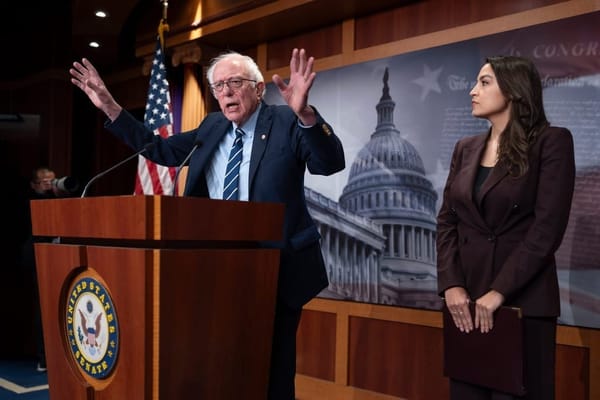
Multiple Democratic lawmakers denounced the order Friday.
Sen. Ed Markey, D-Mass., vowed in a statement to challenge the order somehow.
“After months of failed lobbying and two defeats in Congress, Big Tech has finally received the return on its ample investment in Donald Trump,” he said in a statement. “A broad, bipartisan coalition in Congress has rejected the AI moratorium again and again, and I intend to keep that streak going. I will use every tool available to challenge this indefensible and irresponsible power grab. We will defeat it again.”
Republican governors Spencer Cox of Utah and Ron DeSantis of Florida have posted negatively about the preemption plan on social media, as has Sen. Josh Hawley, R-Mo.
Sen. Marsha Blackburn, R-Tenn., was responsible for axing an AI moratorium from Republicans’ budget legislation over the summer, forcing a vote to strip the provision that passed 99-1.
“After two humiliating face plants on must-past legislation now we attempt an entirely unenforceable EO – tech bros doing upmost to turn POTUS MAGA base away from him while they line their pockets,” Steve Bannon, former Trump White House advisor and MAGA political strategist, posted on social media Thursday.
Federal Communications Commission Chairman Brendan Carr defended the order.
““President Trump’s historic Executive Order on artificial intelligence promotes America’s leadership in AI and advances our nation’s economic and national security interests. It does so by targeting excessive state regulations that would not only hold America back but insert ideological bias into AI models,” he said in a statement.
The order would direct the FCC to start a proceeding on whether to adopt a federal “reporting and disclosure standard for AI models” that would preempt state laws. Carr said the agency “welcomes President Trump’s direction” to do so.
Sen. Ted Cruz, R-Texas, also defended the order at the signing ceremony at the White House Thursday.



Member discussion