West Virginia Lawmaker Proposes Empowering State Broadband Offices on Poles
Broadband leaders nationwide face a shared challenge: Keeping utility pole disputes from slowing internet expansion.

Naomi Jindra
ARLINGTON, Va., Oct. 30, 2025 — A West Virginia lawmaker proposed empowering state granting authorities to act when pole disputes cause delays, as other officials agreed that pole attachments disagreements can be an obstacle.
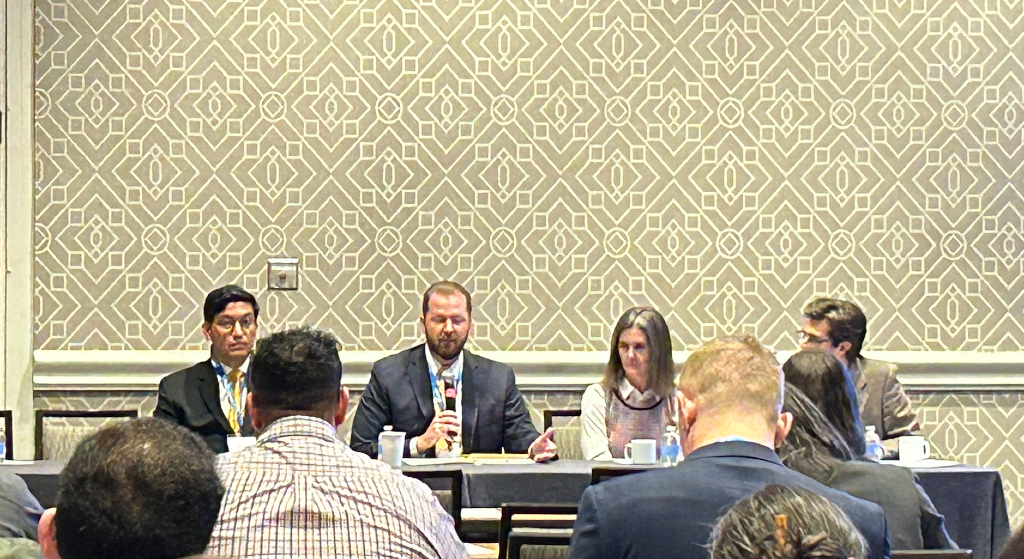
Speaking at the AnchorNets25 conference here at a session on pole attachments, West Virginia State Delegate Daniel Linville said that he’s exploring legislation that would allow state broadband offices to step in and take action when pole attachment disputes slow down projects.
Many internet providers hesitate to challenge utilities formally, even when poles delay construction, said Linville, speaking at a session on pole attachment program at the conference hosted by the Schools, Health and Libraries Broadband Coalition.
“What we find very often is that the attachments don’t want to file legally against the utility,” said Linville. “So the internet companies don’t want to file an informal proceeding against the utilities, because they’re also going to have to work with them on the next project.”
His proposed law would empower state granting authorities to directly initiate proceedings when a project is stuck.
Arguments about pole attachments arguably slow down implementation of the Broadband Equity, Access, and Deployment program, and avoiding that problem was at the center of the discussion.
Meghan Sandfoss, director of the Kentucky Office of Broadband Development, agreed that her state office experienced similar issues.
“Some of our grantees say it might actually be faster and cheaper if we just put these underground instead of putting them on the poles, which shouldn’t be the case,” said Sandfoss. “That’s a lot more ground disturbance and everything. And for BEAD, I see that being an issue, because that’s a different level of environmental review.”
“If a grantee says we’re going to go aerial on this project, and then ends up not being able to get a timely response from the pole owner, they would have to go back through the environmental review process if they’re going to go underground,” Sandfoss said. “That’s a concern — the time and expense that all these projects are taking.”
Sandfoss added that many electric cooperatives are struggling to keep up with a surge in pole requests and don’t have enough trained crews or equipment ready to meet the demand, a gap Kentucky hoped to address through workforce development programs with non-deployment funds but still waits for permission from the National Telecommunications and Information Administration.
Ernesto Falcon of the California Public Advocates Office said that California used detailed pole-data mapping to understand and help resolve pole-related bottlenecks.
“To the extent that a state has its inventory and really put up a means of collecting the information on [a] regular basis to kind of have situational awareness — we are very situationally aware of just the challenge we have,” he said.
The session was moderated by Jake Varn of The Pew Charitable Trusts.
Member discussion