AT&T, AST Complete First Handoff Between Terrestrial and Satellite Networks
AST stock was still down more than 11 percent Monday amid more news about SpaceX’s mobile ambitions


WASHINGTON, Nov. 2, 2026 – AT&T and AST SpaceMobile were able to hand off a voice call from the carrier’s terrestrial network to AST’s satellite network without interruption, the companies said Monday.
The companies said it was an industry-first engineering feat.

“If I’m trying to hand off to satellite, it’s like going from the highway up to a moving plane. So I have to connect to this moving plane in the sky, that’s what’s so challenging about it,” Brian Walsh, AT&T’s head of product development engineering, said in a video the companies posted.
AT&T and Verizon have partnered with AST to offer direct-to-device satellite service with their spectrum holdings. AST has fallen behind schedule on its satellite launches, and said last month it was expecting to provide “initial, intermittent” coverage in the U.S. before the end of the year, something it had initially hoped to accomplish in early 2026.
In April, AST had to scrap a satellite after a Blue Origin rocket deposited it in the wrong orbit. A month later, another Blue Origin rocket exploded on the launch pad. Repairs of the facility are still ongoing, taking away a source of valuable launch space.
SpaceX’s $8 billion bid also beat out AST for Grain Management’s 800 MegaHertz (MHz) spectrum, airwaves AST told the FCC it was interested in for its own direct-to-device purposes.
Monday’s technical achievement was apparently not enough to restore investor confidence amid constant chatter about SpaceX’s plans for disrupting the wireless market. AST stock was down more than 11 percent Monday, hitting its lowest point this year.
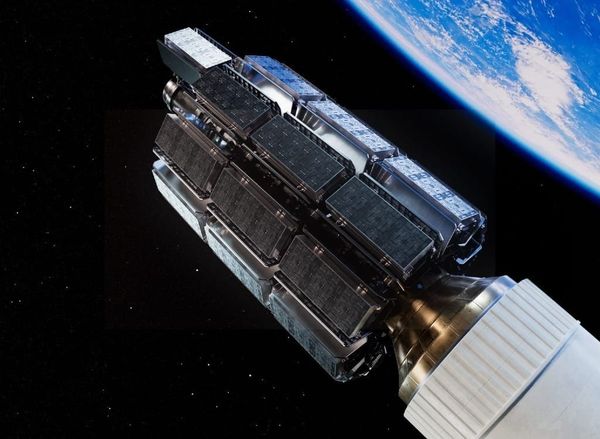
AST had hoped to reach 45 of its massive Bluebird satellites in operation early next year, but currently just 13 are in orbit. The company hasn’t announced a launch date for its next batch of three satellites, which are awaiting a ride on a SpaceX rocket at Cape Canaveral.
The company has said another 34 satellites are in production at its Midland, Texas, facility. Its third quarter earnings call is set for Monday, Nov. 9.
Competing visions for D2D
The terrestrial carriers would prefer direct-to-device service to complement their existing mobile networks, rather than form the basis for an entirely new competitor. In AT&T and Verizon’s deals with AST, as well as T-Mobile’s with SpaceX, direct-to-device connectivity would be a feature offered to the carrier’s subscribers.
SpaceX has been aggressively talking up its plans to acquire, build, or access existing terrestrial networks, and then use its satellites and exclusive spectrum to launch its own mobile service and compete with the carriers.
Just Monday, the Washington Post reported that SpaceX was interested in buying Boost Mobile, or striking a deal to use its network. Boost uses AT&T and T-Mobile infrastructure, and analysts expect the carriers would veto a transfer of its leases to SpaceX.
While AST is partnering with the carriers on their preferred direct-to-device model, the company is also pursuing its own exclusive spectrum. AST has asked federal regulators to allow it to use Ligado’s exclusive direct-to-device spectrum in a future constellation, a request that has yet to be granted.
Seamless handoffs
As X user Phillip Lyle noted, truly seamless handoffs between satellite and terrestrial networks might still be a ways off.
He noted that during a June 2025 presentation, an executive from FirstNet, AT&T’s federally funded public safety network, said on first launch there could be a break when devices moved from satellite back to terrestrial coverage.