Colorado Eyes $31.5 Million Middle Mile Build

The state’s interconnected backhaul vision depends on uncertain federal funding and expanded legal authority.

Colorado Eyes $31.5 Million Middle Mile Build
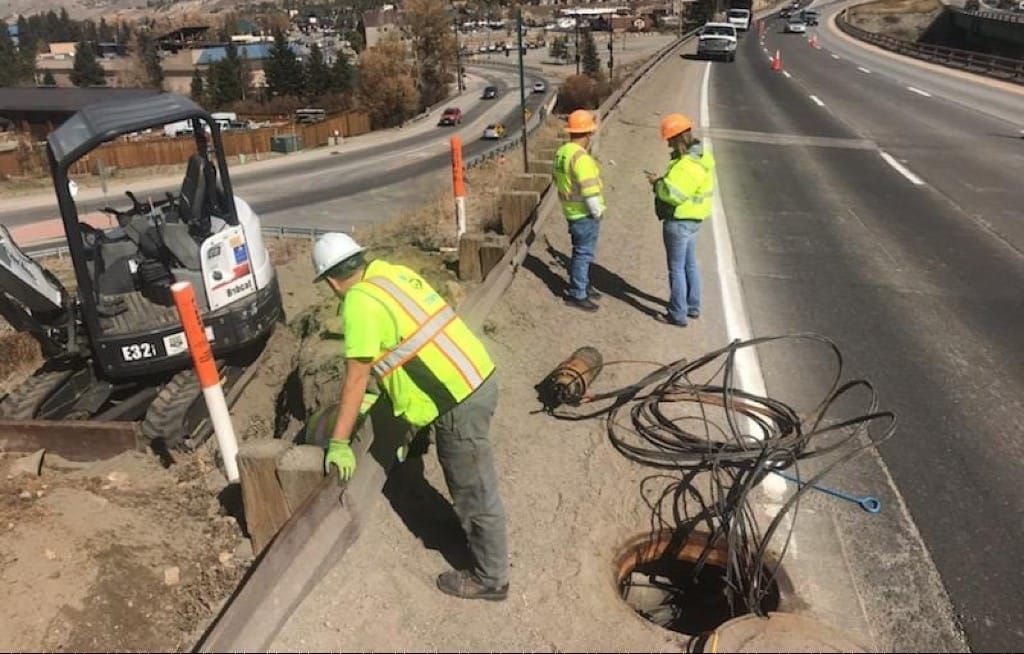
Photo of construction workers installing Project THOR fiber on Interstate 70 in Silverthorne, Colo., by the Northwest Colorado Council of Governments.

WASHINGTON, July 27, 2026 – A report released Friday by the Colorado Broadband Office lays out a phased, multibillion-dollar approach to unify the state’s patchwork of regional middle-mile networks. 

The report, which assesses the middle-mile networks operated by Region 9, Region 10, and Project THOR (Region 12) in southwest, western, and northwest Colorado, found that all three systems remain financially fragile on their own. 
Consolidating the networks and building new fiber to close remaining gaps is the CBO’s proposed answer. But the report is candid that the eligibility of key funding sources, including Broadband Equity, Access, and Deployment (BEAD) program non-deployment dollars, remain uncertain and not yet fully secured.

The report screens 27 potential middle-mile corridors across the three regions largely following state and federal highway rights-of-way. It proposes seven priority corridors for immediate action, based on a framework that weighs community anchor institution coverage, redundancy, public safety, and demand from smaller ISPs, among other criteria.

The report projects an initial price tag of roughly $31.5 million in construction costs to build out the initial set of priority fiber corridors, plus another $5 million for start-up costs to support facilities. 

“Colorado’s current middle‑mile landscape is characterized by deficient access to high-speed internet access across rural and underserved areas, where private network deployment has not fully reached all parts of the state due to financial challenges,” the report states.

“The current structure makes it difficult to attract large-scale commercial customers, leverage economies of scale, or compete effectively for major federal and state grant opportunities that favor coordinated, statewide initiatives.”

To address these challenges, the report outlines a phased pathway to transition from the current environment to a fully integrated and financially independent statewide middle-mile network.

A financial baseline in the red

The due diligence work found that Colorado’s existing regional networks pulled in roughly $2.48 million in revenue in 2025 against $2.21 million in operating expenses, with grant funding of $500,000 needed to keep the combined system cash positive. 

Forecasts show revenue dipping to $2.19 million in 2026 before climbing to $2.71 million in 2027, a trajectory the report cautions is “partly supported by external funding and may not reflect fully self-sustaining operations.”

Performance varies sharply by region. Region 9’s network is described as revenue negative even with grant support factored in, reliant on leased infrastructure and a limited internet service provider customer base. 

Region 10’s transport-and-facilities revenue is projected to grow from about $500,000 to $800,000 annually, but expenses are expected to stay higher, producing continued net operating losses. 

Project THOR, by contrast, is the financial bright spot: revenues in the $1.5 million to $1.8 million range against lower operating costs, driven by its cooperative, participation-based and cost-sharing model.

Five corridor groupings emerged for near-term construction: segments of US Highway 160 stretching from the Four Corners to the Kansas border, State Highway 145, US Highway 550, State Highway 62, and State Highway 149. 

Two of those – proposed routes along Highway 160 and 550 – can partially lean on existing Colorado Department of Transportation dark fiber assets already sitting in the highway right-of-way, with CDOT fiber covering an estimated 50 percent of the 160A corridor and 5 percent of 550B.

Using an industry-benchmarked construction cost of roughly $80,000 per mile, the report totals construction costs across the five corridor groups at $31.57 million, plus an additional $5 million to stand up two small internet exchange point (IXP) facilities. 

Ongoing costs are projected to add roughly $5,000 per mile per year in conduit leasing fees, along with about $1.5 million annually in staffing costs for three regional employees dedicated to middle-mile governance and oversight.

Proposal relies on BEAD non-deployment 

The report points to two primary funding sources for that initial capital outlay: unallocated BEAD program non-deployment funds, and state infrastructure allocations. Neither is treated as a guarantee. 

The report explicitly flags “current regulatory uncertainty surrounding BEAD non-deployment allocations” and calls on the CBO to build a parallel, diversified funding strategy, including USDA and Economic Development Administration grants, state infrastructure bank loans, bonds, and private public-private partnership financing, so that construction on the priority corridors “can proceed regardless of NTIA decisions.”

Under the report’s timeline, the CBO is expected to seek formal guidance from the National Telecommunications and Information Administration on BEAD non-deployment fund eligibility for middle-mile use within the first six months, while simultaneously working to design shovel-ready business cases for the priority corridors within 18 to 24 months.

The report models two revenue scenarios for the priority corridors based on assumed customer take rates, the share of potential subscribers along a route who actually buy service. 

At a conservative 25 percent take rate, the corridors are projected to generate roughly $685,000 a year, split between an estimated $85,500 from small fiber operators and about $603,000 from community anchor institutions and public safety. At a more optimistic 50 percent take rate, annual revenue roughly doubles to about $1.34 million.

Notably, those figures exclude any revenue-sharing arrangement Colorado might eventually strike with CDOT for use of its dark fiber on the 160A and 550B corridors, a detail the report flags as still to be negotiated, and one that could meaningfully change the math on the state’s two cheapest-to-build priority segments.

The report sets a target of reaching full operating cost recovery by the end of Year 5. Once the model is proven, between years three and five, the state plans to transition to a public-private partnership model: a consolidated statewide Governing Board that oversees an private Operate-Maintain-Commercialize (OMC) partner. 

Once that break-even point is reached, the report envisions net positive revenue being reinvested into a dedicated capital fund to finance construction of the remaining 20-plus corridors identified in the statewide gap analysis, reducing the network’s long-term dependence on new state or federal appropriations.

Underpinning all of these projections is an unresolved legal question: whether the CBO currently has the statutory authority to do what the financial model requires. 

The report identifies gaps in CBO’s to own or hold infrastructure assets, operate network services directly or through third parties, and engage in commercial, fee-based activity. 

Under current Colorado statutes, the report notes, CBO’s authority is oriented toward funding other governmental entities and grant applicants. Expanded authority to serve private-sector customers directly “may require specific legislative enablement,” it states.

The roadmap accordingly targets socializing a legislative concept during the 2027 session, with enabling legislation introduced in 2028, meaning the funding and revenue mechanics laid out are, for now, contingent on the legislature acting on schedule.

What's next?

The report recommends the CBO move quickly to lock down its funding position: securing written NTIA guidance on BEAD non-deployment eligibility, finalizing a state capital-match process, and qualifying alternative, non-BEAD sources as a hedge, all within the first six months. 

It also calls for refreshed CAPEX and OPEX benchmarking against comparable state-led middle-mile programs, arguing that the report’s current cost estimates should be treated as a starting point rather than a final budget before major capital is committed.

For a state still waiting on clarity from Washington over how BEAD dollars can be spent on middle-mile infrastructure, the $31.5 million question may not be whether Colorado can justify the investment on paper, but whether the funding sources it’s counting on will materialize.

CBO invited the public to comment on the proposal Friday, and will allow input until Friday, Aug. 7, 2026.

Popular Tags