House Subcommittee Advances Broadband Bills
Lawmakers are still working with stakeholders and the FCC to refine a bill on streamlining satellite licensing

Jake Neenan
WASHINGTON, Sept. 1, 2026 – The House Communications and Technology Subcommittee advanced Tuesday six broadband and telecom bills.
The bipartisan pieces of legislation will next have to be taken up by the full House Energy and Commerce Committee before moving to the House floor.

The bills were each adopted by voice vote without any apparent opposition.
SAT Streamlining Act
The House version of the SAT Streamlining Act would put a one-year shot clock on the Federal Communications Commission’s review of new satellite license applications. It would impose shot clocks on licenses renewals and minor modification requests
It also included a deemed granted provision, meaning if the FCC missed a deadline the application would be automatically approved. A similar provision was removed from the Senate version of the bill before it cleared that chamber’s commerce committee.
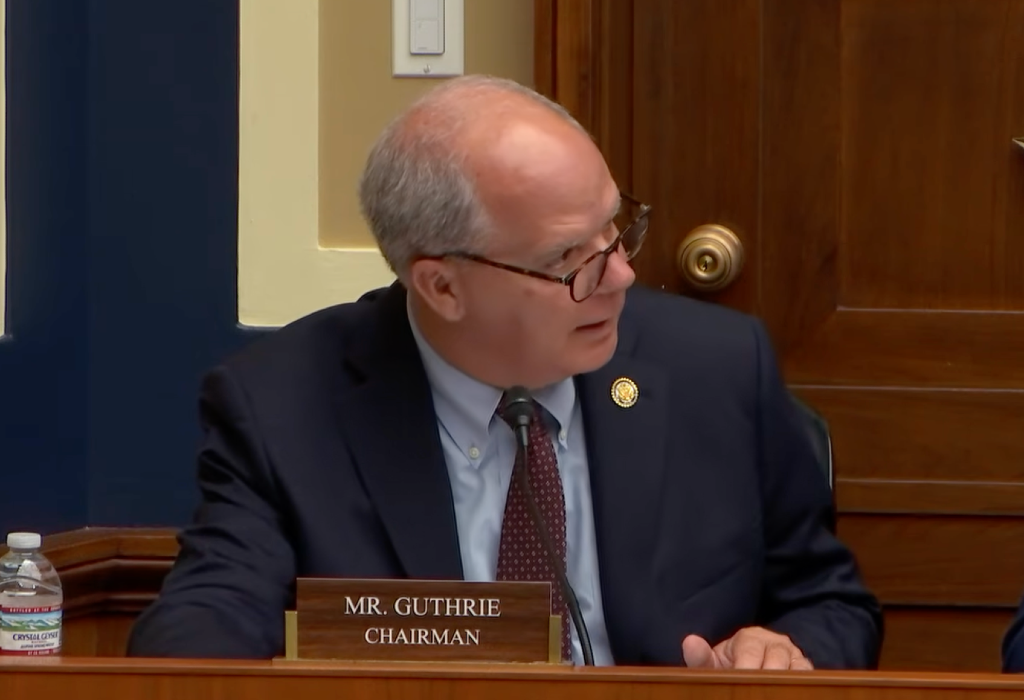
“We’re continuing our work to thoughtfully update this bill,” said House Commerce Committee Chairman Brett Guthrie, R-Ky., who led the bill along with Ranking Member Frank Pallone, D-N.J. “I appreciate the stakeholders who have provided constructive feedback, and we’re also working with the FCC on some updates to reflect a space modernization item adopted in July.”
The July order overhauled the FCC’s satellite licensing reviews, instituting a more standardized process instead of the bespoke reviews the agency has been doing. It was aimed at getting applications processed and approved faster.
The Information Technology and Innovation Foundation supported the bill, which policy analyst Ellis Scherer said in a statement would “ensure that satellite license applications are not left in regulatory limbo.”
CCIA, which represents major tech companies, including satellite operators EchoStar and Amazon, also supported the bill.
GUARD Act
The Guarding the U.S. against Adversarial Robotics Dominance (GUARD) Act would require “an appropriate national security agency” to determine whether humanoid or quadruped robots developed by nine of the U.S.’s adversaries constituted a national security risk.
If the agency didn’t make a determination in one year, the FCC would have to ban the import of new models of those robots from companies headquartered in or affiliated with those adversarial nations, including China and Iran.
The FCC has also already taken action on this front, implementing an interagency federal law enforcement report that said such robots could pose cybersecurity or supply chain risks.
But the report called for banning the import of new models from anywhere in the world, which Guthrie and Rep. Jennifer McClellan, D-Va., one of the bill’s cosponsors, said it was too far.
“I appreciate the administration’s recognition of this threat,” Guthrie said. “I do have some questions, however, about how an overly broad approach could hurt American supply chains and our ability to compete against China in the long term.”
Foreign Robocall Elimination Act
The Foreign Robocall Elimination Act would require the FCC, along with the Federal Trade Commission and the Justice Department, to convene with private sector experts and produce a report on how to combat robocalls.
The FCC has been cracking down on robocalls for years. Earlier this year the agency expanded know-your-customer requirements, and just last week effectively shut down nine providers for not responding to information requests from an existing industry group that tracks robocalls.
The bill was led by Reps. Addison McDowell, R-N.C., and Kelly Morrison, D-Minn.
AI for Secure Networks Act
The AI for Secure Networks Act would require the NTIA to conduct a study on how artificial intelligence and open radio access networks (open RAN) could be used to increase cybersecurity of telecom networks.
It was led by Reps. Robert Menendez, D-N.J., and August Pfluger, R-Texas.
Pfluger offered an amendment, which was approved by voice vote.
It would broaden the study to include emergency alerts and public safety networks. It would also take NTIA with looking into how to make AI models more secure with benchmarks and testing.
PLAN for Broadband Act
The PLAN for Broadband Act, led by Reps. Tim Walberg, R-Mich., and Scott Peters, D-Calif., would require the National Telecommunications and Information Administration to draw up a plan to close the digital divide.
That would have to include improving coordination across federal broadband grant programs and in the federal permitting process, plus reducing administrative burdens for state and local governments to participate in federal programs.
The bill was first introduced in 2022 after the Government Accountability Office found coordination of the more than 100 federal broadband programs to be lacking.
ACA Connects, which represents small and mid-size cable operators, was pleased.
“As Congress and the FCC work to lift permitting barriers, the PLAN for Broadband Act would help America's independent broadband providers better plan investments and direct resources accelerating deployment and expanding access to reliable high-speed services across the country,” ACA CEO Grant Spellmayer said in a statement.
Data BRIDGE Act
The Data BRIDGE Act would require the FCC to incorporate data on agricultural areas into its national broadband coverage map. It was led by Reps. Erin Houchin, R-Ind., and Robin Kelly, D-Ill.
The FCC is currently taking comment on streamlining data collection for the coverage map. The map serves as a guide for broadband funding agencies looking to determine where to spend their resources.
Houchin and Kelly said that bringing in existing USDA data would help direct resources at farmland where precision agriculture was increasingly demanding better connections.