How to Prepare Workers for Artificial Intelligence Disruption as Safety Nets Erode
Panelists debated AI's true impact on jobs while warning that support systems meant to help workers adapt are being cut.


WASHINGTON, July 9, 2026 — Panelists at a Broadband Breakfast Live Online webcast on AI and the workforce agreed that artificial intelligence will reshape jobs unevenly across the economy, but diverged sharply on how urgent the threat is.
Additionally, panelists discussed who bears responsibility for preparing workers, and converged on a shared warning that the public systems meant to cushion the transition are being weakened at the worst possible time.
 Broadband Breakfast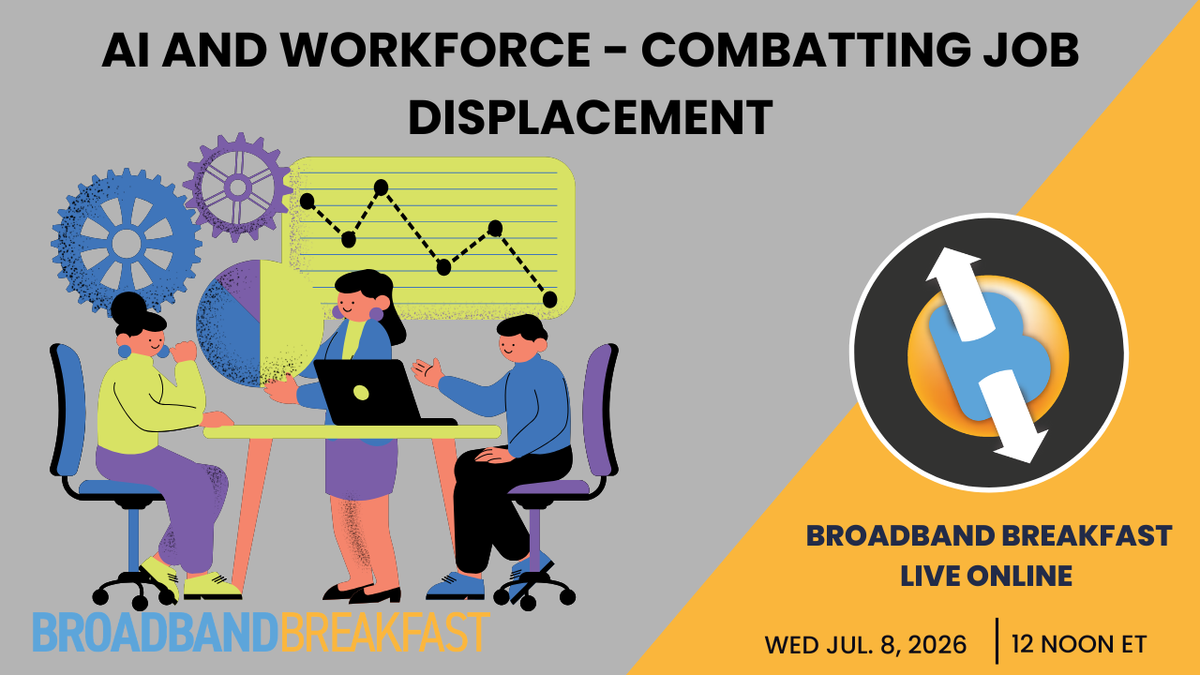

The panel was moderated by Melissa Newman, senior vice president of government affairs at the Telecommunications Industry Association.
How real is the threat to jobs?
Fears of mass unemployment reflect what economists call the lump of labor fallacy, the assumption that there is a fixed number of jobs for AI to eliminate, said Rob Atkinson, senior fellow at the Information Technology and Innovation Foundation.
He said companies that automate tasks typically lower prices and free up spending elsewhere in the economy, and predicted only modest productivity gains in the near term. "I think we have plenty of time," he said, while faulting Congress for failing to modernize training systems even as anxiety about AI mounts.
That skepticism carried into a discussion of which jobs are most exposed. The debate over risk has shifted from apocalyptic predictions a year ago to a focus on job augmentation, with routine clerical work most exposed, according to Ron Hetrick, principal economist at Lightcast. He cautioned against dismissing higher-skilled roles, saying tools that let analysts work faster still require human judgment. "I can't have you hallucinating here," he said, describing what clients expect from professionals using AI.
That framing left out a more basic problem, said Samantha Schartman, director of philanthropic programs at Connect Humanity, who argued that the debate over which sectors face the most displacement matters less than whether workers already have the digital skills and broadband access to use new tools at all.
She warned that AI exposure layered on top of the existing digital divide creates what she called "double jeopardy" for rural and lower income communities, and said gains from artificial intelligence should not obscure its costs. "There's a lot tied when people are not digitally capable and resilient," she said.
Who should bear the cost of the transition?
That access gap, all three panelists agreed, is widening just as federal support for retraining is being cut. The Affordable Connectivity Program has run dry and the Digital Equity Act was defunded, Schartman said, while Atkinson pointed to stalled reauthorization of the Workforce Innovation and Opportunity Act.
Atkinson also dismissed universal basic income as counterproductive, arguing instead for stronger unemployment insurance and expanded access to training benefits for laid off workers.
The conversation turned to whether AI developers themselves owe anything to displaced workers. Technology companies have no obligation beyond building safe products and letting market demand dictate use, Atkinson said, criticizing the industry's marketing as needlessly alarmist.
Hetrick agreed the sector's doom-laden messaging around job loss backfired. "You talk about the promise that it gives you, not the things that it takes from you," he said.
Bringing the discussion full circle, Schartman compared the moment to earlier fears about personal computers, which preceded economic growth, but urged planners to stay "eyes wide open" about AI's environmental and labor costs while building funding models resilient enough to survive shifting political winds.