Rep. Pramila Jayapal Pitches Bank-Style Federal Charters for AI Companies
Her framework would license AI companies, split AI from Big Tech platforms and put union and public-interest seats on boards

WASHINGTON, Nov. 28, 2026 – An AI company worth $1 billion or more would need Congress to approve its right to operate under a proposal from Rep. Pramila Jayapal, D-Wash. Smaller companies would need a charter from a new federal authority.
The conditions reach beyond model testing. Companies could own AI infrastructure or AI systems, but not both. Their boards would include labor and public-interest representatives, and high-risk systems would need federal approval before release.


“The crux of this bill is simple: if you want to be an AI company in this country, you have to obtain a public charter,” Jayapal said when she released the framework on Oct. 1.
The National AI Charter Act is a legislative framework, not an introduced bill. It models the licensing system on oversight of national banks.
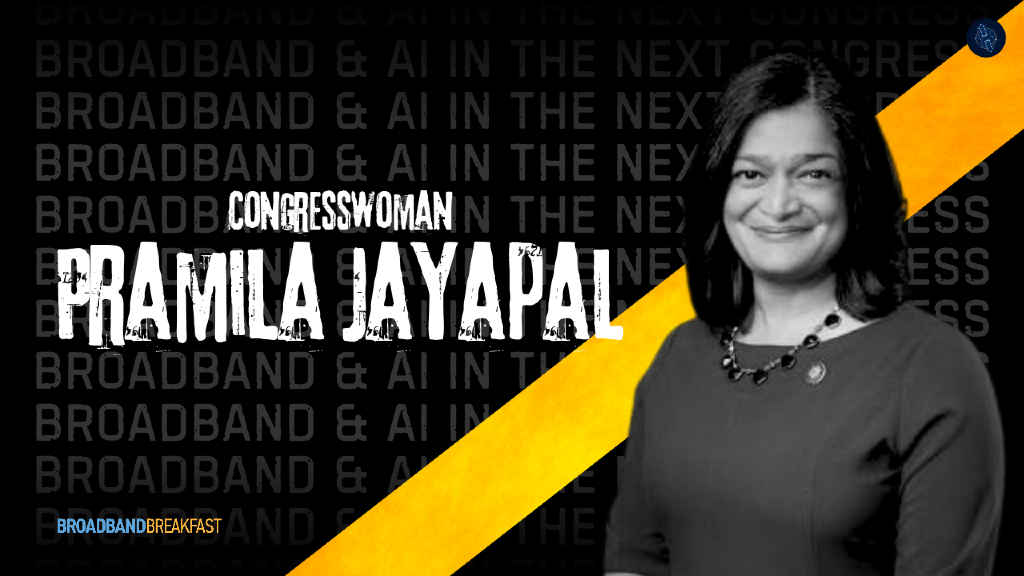
Jayapal, a House Judiciary Committee member and former chair of the Congressional Progressive Caucus, joins Drew Clark, Broadband Breakfast’s CEO and publisher, for a 9:30 a.m. fireside chat Dec. 1 at Broadband and AI in the Next Congress at the National Press Club.
Jayapal and her district
Jayapal represents Washington’s 7th District, which includes most of Seattle and nearby communities, including Shoreline and Vashon Island.
Before her election to Congress in 2016, she served in the Washington state Senate and founded OneAmerica, an immigrant advocacy organization.
Her district is home to Amazon’s headquarters. Its cloud division, Amazon Web Services, provides computing infrastructure and offers AI models through Bedrock. Amazon also develops its own Nova models.
Jayapal’s interest in tech competition predates the AI charter. In 2021, she introduced the bipartisan Ending Platform Monopolies Act, which sought to prevent dominant online platforms from owning other businesses that create conflicts of interest. The House Judiciary Committee approved the bill.
In September, she hosted a hearing on Big Tech and surveillance AI. Speakers included a former Meta employee, an AI policy researcher and a co-founder of Amazon Employees for Climate Justice.
A charter as the price of entry
Charters would require reapproval every 10 years.
A new National AI Charter Authority would approve companies valued below $1 billion, oversee compliance and manage federal testing. It would be funded by charter fees and advised by a bipartisan council of state attorneys general
Executives would sign quarterly safety and compliance certifications under penalty of perjury. Companies would have a legal duty to identify and prevent systemic risks and public harm.
The framework calls for board seats for a technical safety specialist, a union representative and a public-interest advocate. Each company would have an independent chief safety officer reporting to the board, and companies would have to recognize union representation and bargain with workers.
Separating models from infrastructure
Jayapal says separating AI infrastructure from AI systems would prevent chip and cloud companies from controlling the models that depend on them.
Chartered AI companies also could not participate in search or social media or own businesses in sectors including retail, banking and pharmaceuticals. The proposal would prohibit arrangements such as interlocking executive boards, cross-equity stakes and exclusive bundling deals.
The framework does not define “AI company” or explain how the restrictions would apply to particular corporate structures. Those details would determine which businesses need charters and what they must separate.
Companies that use market dominance to suppress competitors or lock in users could face separation orders.
Testing, shutdowns and liability
High-risk AI systems would need to demonstrate safety in isolated government testing facilities and receive federal approval before release. Government officials and certified nonprofits could also test systems in use.
Companies would have to maintain emergency shutdown capabilities that federal safety inspectors could trigger by direct order.
Data, workers and AI bonds
AI companies could not use copyrighted works, trade secrets or personal likenesses without authorization and compensation. Certain uses of surveillance data, including location, shopping and health information, would also be barred.
Companies could not compel employees to train AI systems designed to replace them. The proposal also restricts using AI to reduce pay.
A proposed Monopoly Data Tax would target companies and executive compensation associated with certain data uses. The proceeds and civil penalties would fund payments to Americans called AI Bonds.
A different approach to state rules
States could adopt stricter AI protections, and their attorneys general could enforce the federal requirements.
Jayapal is also a House co-lead of the AI Civil Rights Act, which Sen. Ed Markey, D-Mass., carries in the Senate. Markey gives the conference’s 2:40 p.m. keynote.
Former Federal Trade Commission Chair Lina Khan endorsed the charter framework. Banks, drug makers and nuclear operators have long had to meet public terms before doing business, she said, “and AI companies should be no different.”
What to watch at 'Broadband and AI in the Next Congress'
- Which businesses would qualify as AI companies and need a federal charter?
- How would structural separation apply to companies that provide cloud services and develop AI models?
- When does Jayapal expect to turn the framework into bill text, and where might it attract support?
Sign up for Broadband and AI in the Next Congress on Dec. 1.