
They Came Not to Bury, But to Praise the Telecom Act of 1996
The biggest failure, according to panelists? The continued digital divide

WASHINGTON, Jan. 28, 2026 — Four telecommunications policy veterans celebrated much of the 1996 Telecom Act and its legacy during a Wednesday BroadbandLive event, but differed on whether it had helped or hindered America’s dynamic climate of tech and telecom innovation over three decades.
The Broadband Breakfast panelists were key individuals who helped draft, implement or analyze the sweeping overhaul of U.S. communications law.
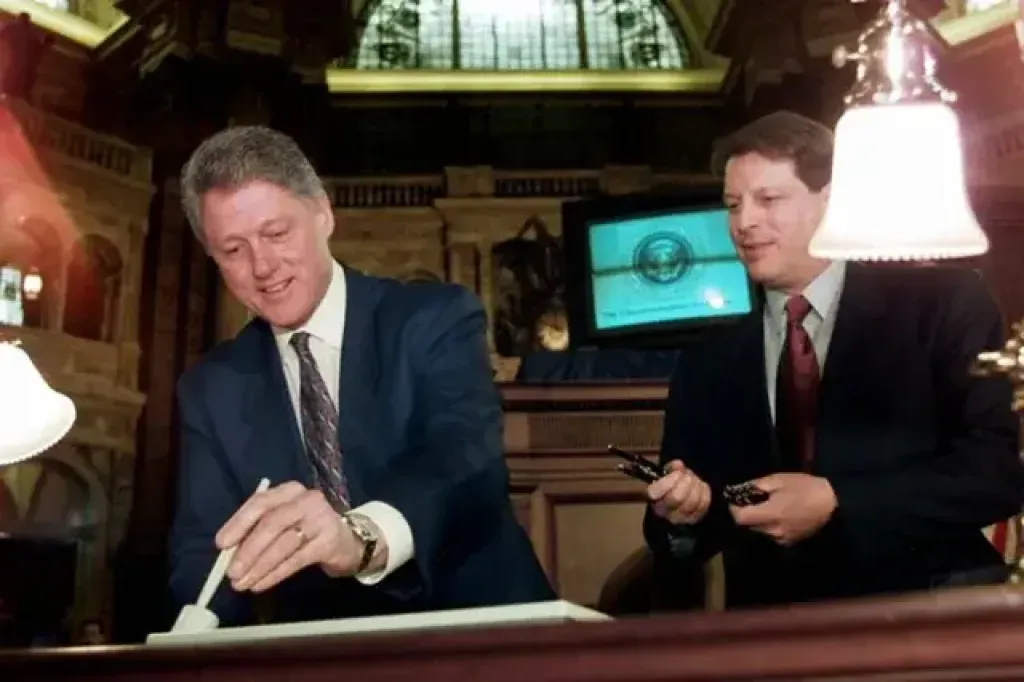
The Act, which was signed into law by President Bill Clinton on February 8, 1996, had earned bipartisan support. Most panelists agreed the law succeeded in spurring competition and technological advancement.
 Blair Levin
The law did shift U.S. communications policy from rate regulation to promoting competition, and removed barriers preventing phone and cable companies from entering each other's markets. It also established a statutory framework for universal service subsidies by the Federal Communications Commission.
But they disagreed on whether it delivered on promises of deregulation and universal service.
"I give it an A in all of them," said Blair Levin, nonresident senior fellow at the Brookings Institution and policy analyst with New Street Research, referring to the Act's goals of promoting competition, lowering prices, spurring innovation and expanding universal service.
Many of the laws and executive branch actions going on in the Clinton administration, including the beginning of spectrum auctions, the embrace of telecom competition and a laissez-faire attitude toward the Internet, were “at least from the FCC perspective, all part of the same strategy to deliver faster, better, cheaper communications through competition,” said Levin.
Levin said that the 1992 Cable Act had forced cable providers “to figure out a new business because … they had about 10 years before they were eclipsed by direct broadcast satellite.” That promoted investment in a nascent broadband infrastructure, he said.
Levin, who served as chief of staff to then-FCC Chairman Reed Hundt, noted that cable and telecom companies have underperformed the stock market in recent years due to competitive pressures.
But he called that evidence of success, because it meant other tech companies were investing in a broadband-driven ecosystem.
A ‘gentleman’s C’
But Randolph May, president of the Free State Foundation, awarded the Act "a gentleman's C." The elementation of the Telecom Act was not, he said, as deregulatory as intended.
"The reality is that over the years, the forbearance authority, which could have been used in a much more deregulatory way, hasn't been used very much," May said.
Larry Irving, former assistant secretary of commerce for communications and administrator of the National Telecommunications and Information Administration, now president of the Irving Group, credited it with enabling global telecommunications privatization.
"In less than five years after the passage of the '96 Telecom Act, there were 100 different nations [that had] privatized or began to privatize their national telecommunication systems," Irving said.
He graded the law’s attention to the digital divide as a "C-minus to D," noting that affordable broadband remained out of reach for many low-income and rural Americans until recent years. "Until the pandemic, if you lived where I grew up in Southeast Queens in New York, you did not have affordable broadband," Irving said.
John Windhausen, founder of Telepoly and former executive director and founder of the Schools, Health and Libraries Broadband Coalition, called the Act's universal service provisions "the cornerstone of our communications policy going forward."
"Universal service should be everybody," Windhausen said. "Unfortunately, there are some political leaders who are hyper-focused on waste, fraud and abuse” – to the exclusion of ensuring that everyone does indeed reap the benefits of universal communications.
The panelists noted that in 1995, there were only 20 million people using the internet globally.
"I think there was a bit of a failure of Congress to anticipate the extent to which the internet was going to change the marketplace," May said, acknowledging Congress’ oversight.
Looking ahead, the experts emphasized different priorities. Levin stressed the need to help Americans understand how to use emerging technologies like artificial intelligence. "Right now, we actually have a situation where most Americans are actually skeptical that it will help them," he said, speaking about AI and technology in general.
Irving called for greater involvement from technology companies and philanthropies in bridging the digital divide, particularly for workers facing AI-driven job displacement.




Member discussion