
USDA Nominee Glen Smith Vows Review of Rural Broadband Programs
During his nomination hearing, lawmakers pressed on coordinating USDA’s broadband programs and reviewing stalled energy projects.

Jericho Casper
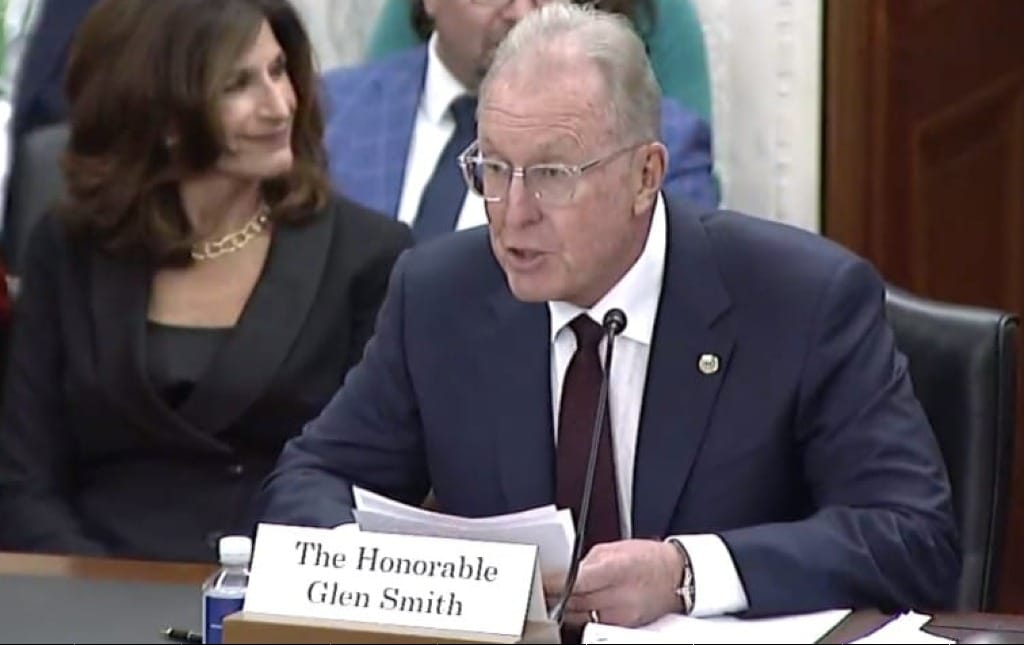
WASHINGTON, Nov. 6, 2025 – President Donald Trump’s nominee to serve as undersecretary for rural development at the Department of Agriculture, Glen Smith, pledged Wednesday to review how the agency can better coordinate its rural broadband expansion efforts.
During his nomination hearing before the Senate Agriculture Committee, Smith equated high-speed internet access with a “higher quality of life” and repeatedly called for improving broadband infrastructure to help revitalize rural economies.
Sen. Joni Ernst, R-Iowa, pressed Smith to address what she described as “duplicative” efforts among the government’s 133 broadband programs, including six under USDA Rural Development. Ernst highlighted her Streamlining Rural Broadband Act, which would merge the department’s Community Connect grant program into ReConnect. To this, Smith agreed to review USDA’s portfolio, saying it would be a “priority.”
Conversely, Sen. Tina Smith, D-Minn., voiced concern over the administration’s broader plans for USDA, noting “a lot of talk about moving things around within Rural Development,” including potentially shifting rural broadband programs to the Commerce Department.
“In Minnesota, this is giving people a lot of concern, because they trust the USDA on these issues,” Smith said. “They know that rural challenges are unique, and they believe that the USDA understands that.”
Smith responded saying he “couldn’t agree more,” emphasizing that USDA already has “the mechanisms for these programs" and he “couldn’t imagine them being housed in an agency other than USDA.”
Nominee compared broadband to rural electrification
In his written testimony, Smith framed broadband as the next great rural infrastructure mission, comparing it to the New Deal’s electrification push.
“In 1936, under the New Deal, Rural Development was charged with the challenge of bringing electricity to our country’s rural regions, a mission that was admirably achieved. Given the right resources, Rural Development should strive to achieve the same level of success in rural connectivity,” Smith said.
Still, he acknowledged that the future of broadband programs like USDA’s ReConnect Loan and Grant Program depend largely on congressional appropriations, telling lawmakers, “Do we have the resources for ReConnect? That’s entirely up to you in Congress, whether those resources are allocated.”
Although the Trump administration proposed zeroing out ReConnect funding in its fiscal 2026 budget request, describing it as duplicative to other federal efforts, Congress reinstated appropriations for the program with broad bipartisan support.
The Senate’s $27.1 billion agriculture spending bill, approved in August, proposed $96 million for USDA’s broadband grants and loans, including $35 million for ReConnect, $20 million for Community Connect, and $40 million for distance learning and telemedicine programs.
The House version had proposed $90 million for ReConnect, alone. House and Senate lawmakers have yet to reconcile differences between competing versions of the bill.
During the hearing, senators also raised concerns about other rural infrastructure initiatives, including energy projects that have been delayed or canceled under the administration.
Sen. Amy Klobuchar, D-Minn., told Smith that several energy projects involving electric cooperatives in Minnesota, North Dakota, South Dakota, and Iowa had been canceled, asking whether he would be willing to review those stalled projects with her, to which Smith agreed, saying the department should “all work together” to get them moving again.
Sen. Ben Ray Luján, D-N.M., raised similar concerns, citing the cancellation of USDA grants to generation-and-transmission cooperatives such as Tri-State, which serves rural communities across Colorado and New Mexico. Luján warned that those decisions could raise power costs for rural families and urged Smith to investigate. Smith said he was not familiar with the case but called such oversight “part of the job” and committed to looking into the matter.
A native of western Iowa, Smith built his career in both farming and land management before entering federal service. He served as president and co-owner of Smith Land Service, a family-run company specializing in farm management, land appraisal, and agricultural brokerage, while continuing to operate a 2,000-acre family farm near Atlantic, Iowa.
He later moved into public service, joining the Farm Credit Administration board in 2017 and being designated by Trump as chairman in 2019, a post he held until October 2022. At FCA, Smith oversaw the $600 billion Farm Credit System, which finances much of rural America’s agriculture and infrastructure development.
“I understand the critical need for good broadband in rural America,” Smith reiterated Wednesday.
Smith's comments marked a sharper broadband focus than that of Agriculture Secretary Brooke Rollins, who was confirmed in February.
During her confirmation process, the former Trump domestic policy chief spoke broadly about “revivifying and restoring rural America,” but broadband policy was not a major theme.
Rollins instead vowed to “immediately begin to modernize, realign, rethink the United States Department of Agriculture,” in line with the Trump administration's broader stance.



Member discussion