
Cruz Unveils SANDBOX Act to Ease Federal AI Rules
Proposal would let developers test AI under federal waivers

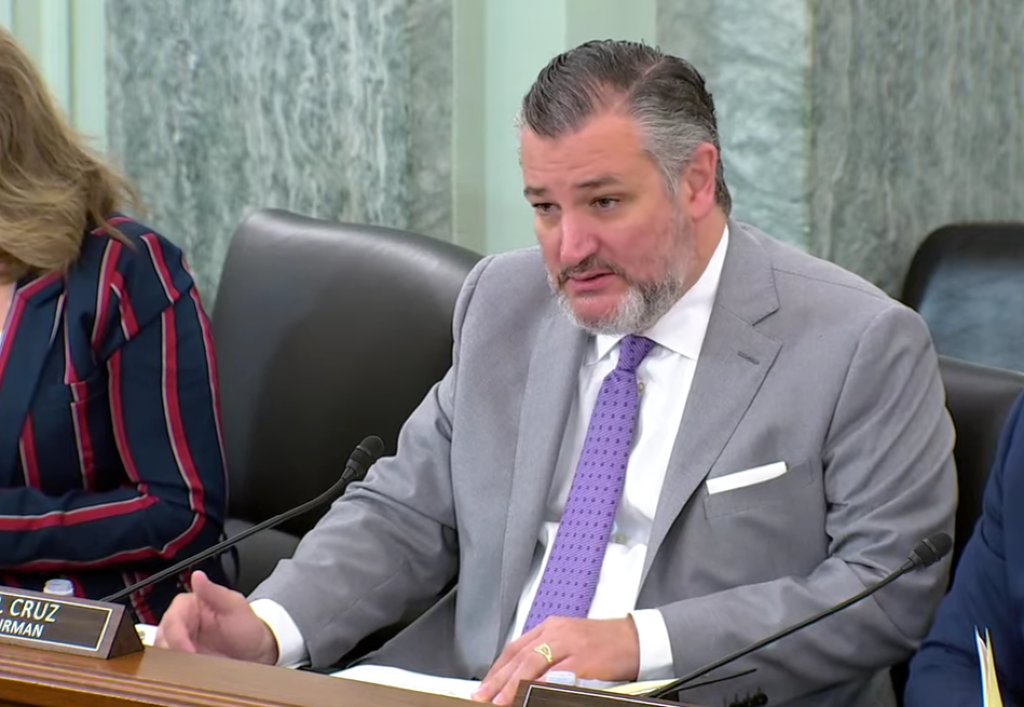
WASHINGTON, Sept. 11, 2025 – Developers of artificial intelligence may soon get a freer hand to experiment under a new plan from Congress.
 Broadband Breakfast
The SANDBOX Act, introduced Wednesday by Senate Commerce Chairman Ted Cruz, would allow companies to test AI systems in a controlled federal program exempt from certain regulatory barriers.
“A regulatory sandbox, a policy mechanism recommended by President Trump's AI Action Plan, will give entrepreneurs room to breathe, to build, to compete within a defined space bounded by guardrails for safety and accountability,” Cruz remarked during a Commerce hearing.

Under the bill, AI companies could apply for temporary waivers or modifications of federal rules to test, experiment with, or temporarily offer AI products and services. Waivers would last up to two years and could be renewed, with a hard cap of ten years.
To qualify, applicants must explain how their projects benefit consumers or the economy, detail foreseeable risks such as fraud or safety hazards, and outline mitigation steps. Participants would have to disclose their sandbox status publicly and notify regulators within 72 hours if harms occur.
Office of Science and Technology Policy to manage waivers
The measure does not shield companies from civil liability or unrelated criminal law, and it requires the White House Office of Science and Technology Policy to manage the waivers. The program would expire after 12 years unless reauthorized.
White House science adviser Michael Kratsios, director of the OSTP and the sole witness at the hearing Wednesday, argued that sandboxes provide regulatory clarity and certainty for innovators.
“If American innovators are to continue to lead the world, they will need regulatory clarity and certainty which legislative and executive branches must work together to provide,” Katsios said. “The creation of regulatory sandboxes for early product development [prevents] balkanized rulemaking that chokes product adoption.”
The SANDBOX Act instructs federal agencies to coordinate with state programs, but Cruz and Kratsios made clear their ultimate aim was to prevent states from imposing conflicting rules.
“We must prevent a patchwork of burdensome AI regulation, including oft conflicting state AI regulations,” Cruz said.
Getting rid of a patchwork of state laws critical, Kratsios said
“The President said very specifically in his remarks at the AI Action Summit - that we do not believe in allowing this patchwork to go forward,” Kratsios said. “State preemption is something we look at closely. We are very excited to work with Congress to find a way to deliver on what the President is looking to accomplish.”
Sen. Gary Peters, D-Mich., used the hearing to press Kratsios on both data security and the plan’s treatment of state laws.
“Without the highest standards for data protection and governance, rapid AI adoption can expose Americans’ information to some unparalleled risk that we need to be very, very concerned about,” he warned.
The senator alleged the chief data officer for the Social Security Administration was forced to resign after notifying his committee that DOGE was jeopardizing the social security data of over 300 million Americans.
“How can Americans trust this plan when the administration has shown it can't handle our most sensitive data?” he asked.
Peters also zeroed in on the White House’s call for agencies to avoid funding states with “burdensome” AI laws, pressing Kratsios on who within the administration would decide which state measures are “prudent” and which are “unduly restrictive.”



Member discussion