Data Centers Dramatically Drive Up Energy Needs

AI exposed the limits of the U.S. grid, and nuclear power became Washington’s answer.

Data Centers Dramatically Drive Up Energy Needs

For years, Americans imagined the virtual cloud as abstract – floating somewhere beyond the limits of physical infrastructure.

12 Days of Broadband 2025 (click to open)

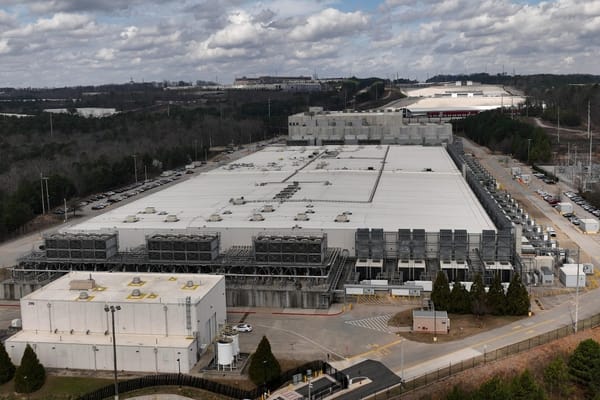
In 2025, the demand for artificial intelligence stripped away that illusion, exposing the hard physical limits of a digital economy built on enormous quantities of power and land. There’s some evidence that data centers could make your electric bill go up by 70 percent.

The biggest tech companies broke ground on some of the largest industrial data center facilities ever constructed. Triggering states to enact emergency energy laws to keep pace with data-center load. Utilities asked for unprecedented spending increases to meet demand. And, communities began to question whether the benefits of hyperscale development justified the costs.

By early February, global energy analysts were already cautioning that artificial intelligence had pushed demand for electricity into uncharted territory.

International Energy Agency Director Fatih Birol told U.S. policymakers that nuclear power, long dormant in Western markets, was “making a comeback,” driven not by climate mandates but by the sheer scale of AI compute needs.

Tech giants, he noted, were becoming some of the most important investors in next-generation reactors, as traditional grids could no longer keep up.

On Capitol Hill, congressional hearings were openly discussing whether the United States had enough electricity to support its own AI ambitions. Industry groups warned that permitting delays for new generation were becoming a competitive threat. Economists testified that the hyperscale buildout of 2024 was only a preview of what was coming.

For digital infrastructure builders the strain was already evident. Fiber providers explained in March that data centers were no longer being built at traditional network crossroads. The crossroads themselves had run out of power. 

"We've been dropping data centers in the metros where the long-haul fibers crisscrossed," said Dan Davis of Arcadian at the Metro Connect conference in Ft. Lauderdale, Fla. "Well, we've sucked up all the power where the fiber crossroads are."

New facilities were being pushed into remote regions with available substations, forcing multiyear fiber builds and permitting fights in rural communities that had never seen this scale of industrial infrastructure.

A White House plan to rebuild the grid for AI

By midsummer, the White House made explicit that the United States could not maintain leadership in AI without a historic expansion of power generation, transmission, and data center capacity.

Trump’s AI Action Plan, released in July, reframed the hyperscale buildout as a national industrial imperative. It called to “create a strategic blueprint for navigating the complex energy landscape of the 21st century” and for “the interconnection of reliable, dispatchable power sources as quickly as possible.”

The plan ordered for streamlined permitting of data centers and energy infrastructure, along with a national buildout of grid capacity. It called for embracing new energy generation sources at the technological front, like enhanced geothermal and nuclear.

“The power grid is the lifeblood of the modern economy and a cornerstone of national security, but it is facing a confluence of challenges that demand strategic foresight and decisive action,” the plan states. “We need to build and maintain vast AI infrastructure and the energy to power it.”

The AI Action Plan followed a set of executive orders signed in May. Surrounded by nuclear startup CEOs in the Oval Office, Trump issued directives aimed at quadrupling domestic nuclear generation within 25 years. 

“It’s time for nuclear, and we’re going to do it very big,” Trump said.

From doctrine to implementation

If the Action Plan was the doctrine, the White House’s newly created National Energy Dominance Council became one of its war rooms.

Council Executive Director Jarrod Agen pointed to an ambitious target of bringing 10 new large reactors under construction by 2030, part of the president’s broader effort to revive the domestic nuclear sector.

Until getting to that point, Agen described a three-phase strategy to “stabilize, optimize, and expand” the electric grid in order to support AI and data center loads.

Stabilization, Agen said, meant using existing authorities to keep coal fired plants online during periods of grid stress. Optimization focused on upgrading substations and transmission lines to squeeze more capacity out of existing infrastructure. And, expansion centered on bringing new nuclear reactors online and building out long distance transmission to connect them to load.

Wind and solar fall out of favor

The administration’s priorities on nuclear sharply contrasted with those on solar and wind.

Days after Trump’s AI Action Plan was issued, the Department of Energy canceled a $4.9 billion federal loan guarantee for the Grain Belt Express, an $11 billion transmission line designed to carry wind and solar power from Kansas to the eastern U.S. 

The Energy Department said it was “not critical for the federal government to have a role” in the project and criticized the loan commitment as one of several Biden era deals “rushed out the doors” after the election.

It was just one of many clean energy awards canceled by the Trump administration this year.

The nuclear acceleration begins

At the same time, the Energy Department was executing on one of the plan’s concrete directives: Identifying federal land for accelerated data center development. 

Within months, the agency and other departments had matched candidate sites to national labs and legacy nuclear campuses, including Idaho National Laboratory, Oak Ridge, the Paducah complex in Kentucky, and the Savannah River Site in South Carolina. The four selected sites were to be developed in partnership with the private sector. 

Across the country, states launched their own nuclear revival.

Several states, including Iowa, Pennsylvania, and Wyoming began reviewing proposals to repurpose former coal plants or dormant nuclear facilities into hubs for nuclear power. Others, like Wyoming, Utah, and Idaho inked regional nuclear pacts in an effort to align policies, attract private investment, and increase access to zero-carbon energy.

By mid-2025, nearly every major tech company had staked out its own nuclear strategy

Amazon announced a $20 billion investment in data center sites in Pennsylvania, including one alongside a nuclear power plant. Meta signed a 20-year power purchase agreement with Constellation Energy in Illinois to secure nuclear power to meet its computing needs. Microsoft plans to buy energy from Three Mile Island nuclear power plant, and Google announced a partnership to build an advanced small modular nuclear reactor (SMR) in Oak Ridge, Tennessee.

Critical obstacles to scaling nuclear remain

Still, it's unlikely the U.S. could quadruple its nuclear production in the time frame the White House specified. 

Experts repeatedly warned this year that the country simply does not have the industrial capacity, regulatory structure, or supply chain needed to deliver reactors on the timelines the White House had laid out.

At a Broadband Breakfast summit on data centers and nuclear in March, Carol Lane of X-energy noted that the U.S. lacks domestic manufacturing capacity for nuclear grade graphite, large forgings, precision castings, and advanced fuels, all of which are essential for small modular reactors. 

Today, she said, “we just don’t have domestic capability,” leaving deployment dependent on fragile international supply chains at a moment when geopolitical uncertainty is rising.

Even optimistic developers concede that SMRs remain five to ten years from meaningful commercial scale. Multiple experts warned that SMRs cannot solve the near term load crisis created by AI data centers. Energy demand is rising today; modular reactors may not be prepared to meet it until well into the 2030s.

That reality has pushed developers toward immediate options, including natural gas and coal, to help meet the demand for new power sources more quickly.

Calls for resiliency and new infrastructure solutions

By fall 2025, resilience had become the watchword across the infrastructure sector, triggered in part by a series of high-profile outages which took down thousands of websites and apps across the U.S.

At a Broadband Breakfast summit in September, executives from Equinix, X-energy, and DE-CIX warned that AI was pushing both the grid and the internet’s physical backbone into unfamiliar territory. Equinix’s Paul Brownell said the company would need to double its global capacity within five years just to keep up with compute demand.

Experts began calling for a ‘system-of-systems’ approach to boost resilience, arguing that this summer’s blackouts in Europe and past events in Texas, Pakistan, and South Africa have shown how quickly power failures can cascade into telecom outages, leaving millions without basic connectivity. 

In an Expert Opinion for Broadband Breakfast, Uplink CEO Carlos Lei argued that the AI era calls for rethinking how connectivity itself is architected. Lei called for moving toward decentralized, community-driven networks that can ride through grid shocks rather than failing in lockstep with them. 

“When the lights go out, our digital lives go dark, too,” Lei said. He warned that in an era of climate volatility and AI demand spikes, the grid has become a single point of failure for both electricity and broadband.

His proposed solution: Decentralized physical infrastructure networks. Community-built mesh networks, edge nodes, and microgrids capable of operating when centralized backbones fail.

Examples already exist, Lei said, including Red Hook, Brooklyn’s community mesh network relied upon after Hurricane Sandy. And, in India, Tibetan exiles, faced with chronically unreliable power, ingeniously patched together their own decentralized wireless network to stay connected. 

A turning point for America’s energy future?

The events of 2025 made one reality impossible to ignore: The future of AI now hinges on whether the United States can build the energy system powerful, resilient, and expansive enough to sustain it.

The year’s developments forced policymakers to confront fragilities within the U.S. grid, decades of underinvestment in power and transmission, and the permitting bottlenecks that currently underpin America’s digital ambitions of AI dominance.

Member discussion

Popular Tags