Who Will Dominate AI: The U.S., China, Both or Neither?

A ‘Sputnick moment’ for AI. A new cold war – the race to superintelligence – is on.

Who Will Dominate AI: The U.S., China, Both or Neither?

The year 2025 began with an artificial intelligence jolt: DeepSeek, a large language model developed in Hangzhou, China’s “Silicon Valley,” shook global financial markets. The AI phenom became the most-downloaded free app on Apple’s app store in the U.S., beating even ChatGPT.

12 Days of Broadband 2025 (click to open)

On the second day of broadband... | Broadband Breakfast
12 Days of Broadband is an innovative online event series featuring 12 distinct virtual sessions focused on critical topics in broadband connectivity, telecommunications policy, and digital infrastructure. Each day (Monday, Dec. 1-Tuesday, Dec. 16) wi…

Here, in spite of U.S. export controls keeping the most advanced chips by Nvidia out of the country, a Chinese AI startup appeared to have built a near-frontier AI model cheaply – and through open-source. It was a “Sputnick moment” if there ever was one for the U.S. 

A new “cold war” – the race to superintelligence – was on.
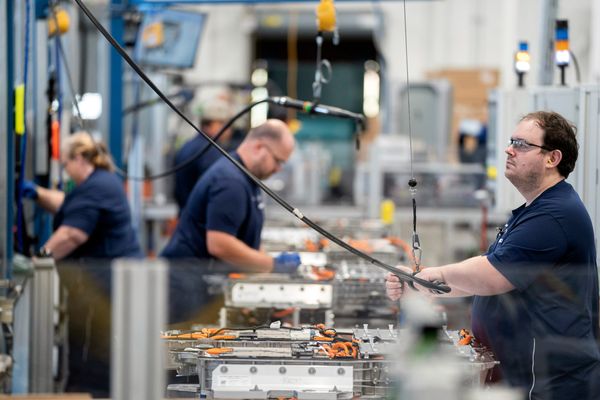
At the very heart of the AI race between the two superpowers was the battle over silicon chips and geopolitical-driven business models. Semiconductors sit at the center of the U.S.-China technology race, powering not only AI-driven data centers, but electric cars, drones and indeed all manufacturing. 

Indeed, control over chip design and manufacturing has become a measure of national power. Washington is pushing for self-reliance from global supply chains that are the longest in China. Beijing is seeking to enhance its state-backed production that seems to dominate industry after industry globally.

The architecture of AI

Chip-making architecture sits at the heart of AI development because it determines how efficiently models can be trained and run at scale. Silicon Valley’s Nvidia uses Graphical Processing Units (GPUs), a design that sets the standard. Fellow Silicon Valley rivals AMD and Intel are racing to offer rival accelerators and chiplet-based designs that cut costs and power use.

But powering Nvidia and others is the Taiwan Semiconductor Manufacturing Company, or TSMC, which plays a unique and essential role in the global chip industry. It is based on the island that China considers part of its own country.

Unlike previous chip-making giants like Intel, which attempted to design and build chips themselves, TSMC operates a foundry model where it manufactures semiconductors designed by its clients, like Nvidia.

TSMC’s control of leading-edge manufacturing makes it the quiet fulcrum of that contest. DeepSeek’s rise on constrained, China-only Nvidia chips shows how architectural efficiency and foundry access have become tools of geopolitical leverage.

Nvidia dominates the market for AI accelerators, holding an estimated 80% to 95% share. Its GPU architecture, software stack and high-bandwidth memory design are tuned for the massive parallelism and matrix math at the core of deep learning, making it the default platform for training frontier models. OpenAI’s ChatGPT is trained on it, as is Meta’s Llama and Grok by xAI, another Elon Musk venture.

Taiwan manufactures almost all of the advanced chips. TSMC’s role in developing advanced process nodes and packaging technologies (like chiplets and 3D stacking) largely determine how powerful and energy-efficient any of these architectures can be. It’s not just about clever chip design, but about who controls the performance, software ecosystems, and foundry capacity of global AI competition.

Yet constant threats from Beijing have put the island’s sovereignty and by extension, the world’s AI ambitions at risk. As some analysts put it: No Taiwan, no AI.

Trump administration efforts at outpacing China

The multiple executive orders on AI and data centers issued by President Donald Trump since taking office in January culminated in July’s “AI Action Plan,” replacing former President Joe Biden’s AI guardrails.

Trump characterized it as pro-industry, deregulation-focused. And it is clear that the two administrations have taken different approaches.

The CHIPS and Science Act of 2022, which aimed to boost domestic semiconductor production and reduce reliance on foreign manufacturing, poured $52.7 billion of federal funds into U.S. semiconductor manufacturing and research. The Biden administration also barred the most advanced chips, of Nvidia, for example, from export to China.

Hence the shock of DeepSeek.

Trump's tact was instead to accelerate AI exports. He also aimed to loosen permitting restrictions on data center construction, and tied the industry's rapid growth to his broader push for expanded domestic energy production — including coal, gas and nuclear power. 

"We need to make sure American AI — our stack, our chips, our models — are the ones the world uses," said senior White House Policy Adviser Sriram Krishnan in September. "Not Chinese models or Chinese chips."

Such comments have often been used to justify loosening certain AI guardrails, a stance echoed by House Energy and Commerce Committee Chairman Rep. Brett Guthrie. "We're not competing with Europe to regulate — we're competing with China to innovate," he said.

Hence the irony that policymakers invoking deregulation have overseen unprecedented government intervention in the chip market — suggesting the "deregulation" frame obscures more than it reveals.

State AI capitalism with an American face

For example, in August, Trump announced that the U.S. government had taken a 10% non-voting stake in Intel, converting $11.1 billion in previously pledged federal funds into equity. The move made Washington one of Intel’s largest shareholders. One could argue this strategy is a shift comparable to China’s state-backed capitalism.

The investment stemmed from money originally allocated under the CHIPS Act. Repurposed the pledged funds to take partial ownership in Intel, Trump and his administration framed it as a way for “America to get the benefit of the bargain.”

And – after briefly tightening export rules, Trump shifted course and allowed Nvidia and AMD to sell modified AI chips — Nvidia’s H20 and AMD’s MI308 — to China. The decision reversed the April export restrictions, despite warnings from Rep. John Moolenaar, R-Mich., chair of the House Select Committee on China. 

“The H20 is a powerful chip that, according to our bipartisan investigation, played a significant role in the rise of PRC AI companies like DeepSeek,” he said.

Under the new arrangement, Nvidia and AMD must give 15% of their China sales to the U.S. government. Critics questioned the legality of what they described as a de facto export tax, warning it blurred the line between trade policy and national security, yet both companies agreed to make a deal.

Meanwhile, OpenAI whose rise helped make Nvidia the largest company in the world, by market capitalization, signed a multiyear deal with chipmaker AMD to diversify its supply chain and reduce reliance on Nvidia.

China’s approach to the AI race

On the other side of the world, China hasn’t simply been standing by and watching.

“We oppose drawing ideological lines and overstretching national security concepts and politicizing economic and trade issues,” said Chinese Foreign Ministry spokesperson Guo Jiakun in response to congressional efforts to limit the use of DeepSeek over security concerns.

China has heavily invested in its AI economy. Chinese tech giant Alibaba recently unveiled a new AI chip that, according to Chinese media, performs on par with Nvidia’s H20 chip while consuming less power.

And global telecommunication equipment giant Huawei introduced its most powerful AI chip to date and outlined a three-year plan to challenge Nvidia’s central role in global AI infrastructure.

Jawad Haj-Yahya, a computer scientist who works with U.S. and Chinese chips, told SupplyChain that Chinese semiconductors now perform comparably to American ones in predictive AI tasks such as large language models. However, he noted they still lag in advanced analytics and complex processing capabilities.

Gregory Allen, director of the Wadhwani Center for AI and Advanced Technologies at think tank Center for Strategic and International Studies, warned in April that weaker U.S. export enforcement has enabled large-scale smuggling of Nvidia’s H100 chips to China. 

Allen cited networks moving more than $100 million worth of chips each, often using duplicate serial numbers to evade detection. Allen urged Congress to increase funding for the Bureau of Industry and Security, describing it as underfunded and technologically behind.

‘Nanoseconds behind’

China’s “buy everything while you can” strategy has led to widespread chip stockpiling, and Chinese manufacturer SMIC aims to produce 50,000 wafers per month at the 7-nanometer level by late 2025.

Allen said Huawei’s chips still trail Nvidia’s, but the rise of DeepSeek’s open-source community could strengthen Huawei’s Compute Architecture for Neural Networks framework and pose a long-term challenge to U.S. dominance in AI software.

Nvidia CEO Jensen Huang described China as being “nanoseconds behind” the United States in AI capabilities — a remark that carries weight given his acknowledgment that Nvidia’s 95 percent market share in China has dropped to zero.

And, nearly a year after it burst into the spotlight, DeepSeek released a new experimental large language model in September that it claimed offers better training and reasoning while operating at a lower cost. The Chinese venture said its model uses a “sparse attention” technique that cuts application programming interface costs in half.

One indicator of DeepSeek's open-source AI influence is popularity among developers and researchers. Hugging Face, a leading platform for sharing open-weight AI models, tracks engagement through “likes.” By this measure, China’s DeepSeek currently leads the field, with 12.8K likes — roughly double that of Meta’s Llama top model (6.3K). OpenAI ranks fifth with 4.0K.

Will ‘Great Power Competition’ hold?

The past year underscored how deeply AI competition is now intertwined with trade policy and national security.

Broadband Breakfast reported in October that Samm Sacks, a senior fellow at Yale Law School’s Paul Tsai China Center, said China scored a rhetorical advantage by casting itself as an inclusive, multilateral leader, while the U.S. under the Trump administration was framing its approach to global affairs around dominance. 

Sacks cautioned that developing nations are reluctant to be drawn into the U.S.–China rivalry and urged Washington to balance openness and democratic values without overreach.

Indeed, after years of bipartisan support for a tough “Great Power Competition” stance toward China, new data from the 2025 Chicago Council Survey shows that American public opinion has shifted: 53 percent of participants now favor friendly cooperation and engagement with Beijing—up sharply from 2024. Views on U.S.-China trade are now evenly split: about half said it strengthens national security, half said it weakens it. 

Member discussion

Popular Tags