
FCC Plans to Overhaul Rules Governing Upper Microwave Spectrum
A diverse coalition called for a light licensing approach to open idle frequencies.

Jericho Casper
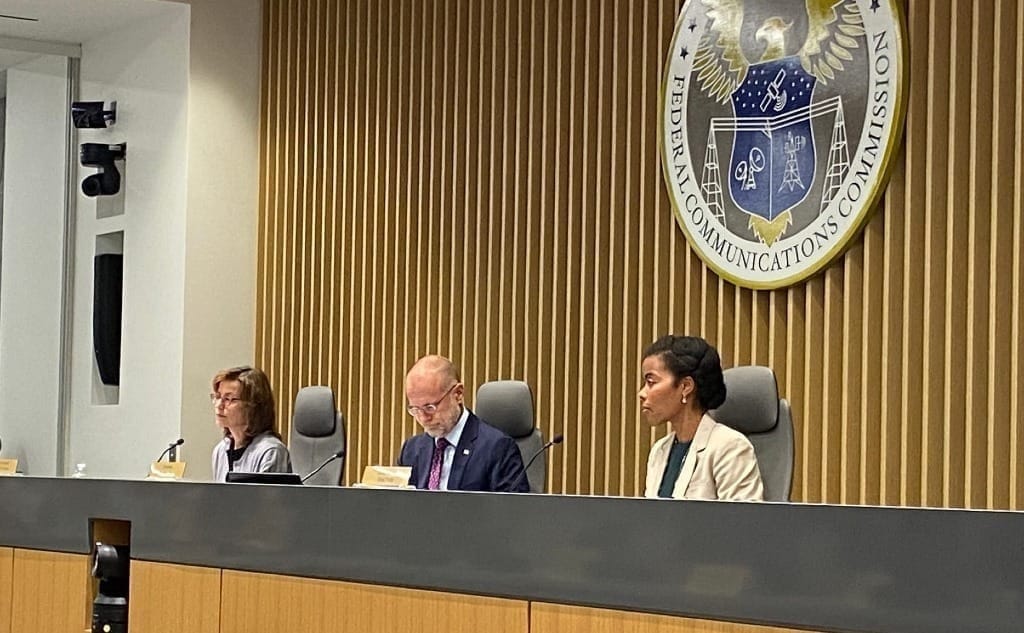
WASHINGTON, October 24, 2025 – A growing coalition has lined up in support of the Federal Communications Commission’s plan to modernize rules governing upper-microwave spectrum.
The FCC will vote Tuesday on a proposal to increase use of spectrum in the 24 GigaHertz (GHz), 28 GHz, upper 37 GHz, 39 GHz, 47 GHz, and 50 GHz bands, collectively known as the Upper Microwave Flexible Use Service (UMFUS) bands. These frequencies are jointly shared by terrestrial wireless providers and satellite operators.
Public interest groups, satellite operators, and spectrum coordination companies, met with the FCC staff this week to endorse the proposal, saying it would finally unlock airwaves that have remained largely unused since early 5G auctions.
Representing New America’s Open Technology Institute Michael Calabrese met with Commissioner Anna Gomez Tuesday to argue the FCC should replace the current manual coordination process with a light licensing system – an automated, database assisted system modeled on the 70/80/90 GHz bands.
The light licensing system functions as a middle ground between traditional exclusive licensing and unlicensed use. Instead of requiring case-by-case FCC approval, both satellite and fixed wireless operators would register sites in a central database that performs interference checks automatically.
Micronet Communications, a firm that helps operators navigate FCC frequency coordination, backed OTI’s call for a light licensing framework modeled on the 70/80/90 GHz bands, in a meeting with staff from Chairman Brendan Carr’s office on Tuesday.
The company said that shifting to a database managed coordination system could cut approval times from months or years to days and lower costs for smaller broadband and satellite providers.
“Database-driven coordination is a mature and well-understood process used successfully in multiple FCC frameworks, including the 70/80/90 GHz bands, the Citizens Broadband Radio Service, and TV white spaces,” said Fredrich Lamprecht, president of Micronet.
SpaceX joined that call for modernization. The low-Earth orbit satellite operator met with the offices of Carr, Gomez and Commissioner Olivia Trusty this week to urge the FCC to adopt a unified light licensing framework across all shared millimeter-wave bands.
“The Commission can clarify and enhance the draft item by proposing … to replace its current sharing framework in Section 25.136 with a fast, efficient light licensing approach,” Joseph Bissonnette, principal of satellite policy, wrote.
Bissonnette called for a unified system that would apply to “nearly all other shared, non-federal millimeter wave spectrum bands, including the Q/V-band (37–52 GHz), E-band (70/80 GHz), and W-band (90/100/110 GHz).”
Representatives from Public Knowledge argued the FCC should also encourage unlicensed or very-low-power sharing in UMFUS bands, similar to CBRS’s general authorized access tier, in areas without active licensees. That, they said, would extend private network and rural broadband options while keeping spectrum use efficient and transparent.
By contrast, CTIA, which represents major wireless carriers, struck a more cautious tone in meetings with FCC staff.
The wireless industry group, whose members spent roughly $10 billion acquiring upper-microwave spectrum licenses at auction and through the secondary market, urged the FCC to ensure its modernization plan “does not inadvertently undermine the rights of terrestrial license holders.”
Public Knowledge explicitly argued that many initial UMFUS license holders never used their spectrum and that large portions of those bands remain “lying fallow.”




Member discussion