Patent Scope, Not Invention, Decided the American Telephone Market
Bell had 3,000 telephones around Boston, and a patent. Western Union had $40M and every U.S. state. The patent won.

This article summarizes several of the key points in Lesson 1: The Telephone and the Telephone Network, which is part of Broadband Breakfast's online course, "150 Years of American Telecommunications." A new lesson will be released every Monday.
The United States Patent Office granted the first telephone patent on March 7, 1876, three days before anyone transmitted intelligible speech over a wire. Federal courts spent the next twelve years deciding whether that patent covered one man's instrument or every method of sending speech by electricity, and their verdict decided who would build the American telephone network.
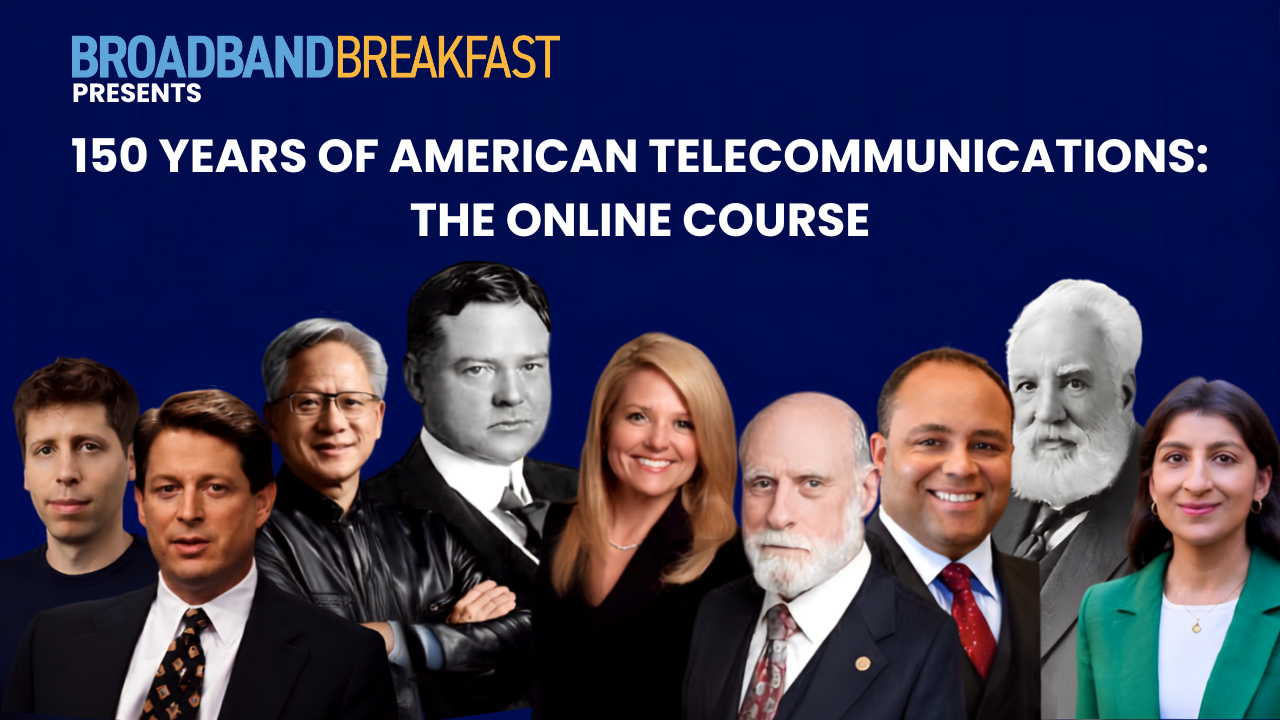
Two filings reached the office on Feb. 14, 1876. An attorney named Marcellus Bailey filed a completed application on behalf of Alexander Graham Bell, who taught speech at Boston University. Bell had not yet transmitted a word over a wire.
The application was titled "Improvement in Telegraphy," and the word telephone appears nowhere in it. It asked, specifically, for exclusive rights to "the method of, and apparatus for, transmitting vocal or other sounds telegraphically." Bell was claiming speech without naming the machine that would carry it.
Elisha Gray filed nothing of the sort. A co-founder of the Western Electric Manufacturing Company, Gray filed a caveat, which reserved him three months to submit a real application but conferred no rights on anything. Bell filed an actual patent application; Gray filed an intention to file one. The office granted Bell's three weeks later as Patent No. 174,465.
The filings and the litigation they set off open Lesson 1 of 150 Years of American Telecommunications, the 35-lesson Broadband Breakfast course released to members on Aug. 24.
A patent on the method, not the telephone itself
The courts never ruled on who invented the telephone. They ruled on infringement, which is building or selling something a patent already covers.
The man who forced the question was a physics professor at Tufts with a telephone that worked on a different principle. Bell's receiver used an electromagnet to vibrate a metal diaphragm. Amos Dolbear built one that worked on the changing electrical attraction between two plates, with no magnet in it, and patented it in 1879.
Dolbear conceded in court that Bell's invention had come first. His initial argument was that a machine working by other electrical means fell outside what the claim covered.
The federal circuit court for the District of Massachusetts rejected it. In American Bell Telephone Co. v. Dolbear, decided in 1883, the court held that Bell's patent covered any machine that carried speech by varying an electrical current, however that machine was built. Dolbear's telephone infringed, and he had to stop making and selling it.
Horace Gray, a Supreme Court justice sitting as a trial judge, wrote the opinion, and he drew two limits. The first was against Bell. Patent law had long held that nobody can patent a principle, and Gray applied it: the idea that speech travels by electricity belonged to no one.
The second was against Dolbear. Bell's patent, Gray wrote, was "not limited to a particular form of apparatus." It covered the method of varying an electrical current to match the vibrations of the air, then reproducing those vibrations at the other end of the wire. Dolbear's telephone did exactly that with different hardware, so it infringed.
Every telephone anyone could build had to vary a current to carry speech. For the 17 years the patent ran, no competitor could build one that did not infringe it.
55 cities change hands
Bell's competitor in 1877 was the largest telecommunications company in the country. Western Union ran the national telegraph network, the only system then carrying messages across the country by wire. The company entered that year with forty million dollars of capital and a first claim on the newspapers, hotels, railroads and rights of way.
Western Union licensed telephone designs from Gray, Thomas Edison and Dolbear, and it was selling telephone service in competition with Bell. Building out cost it almost nothing, since the poles, rights-of-way and the wire were already set up for the telegraph. Western Union operated in every state. Bell had installed roughly three thousand telephones, most of them in and around Boston.
Western Union had licensed telephone designs from Gray, Thomas Edison and Dolbear, and it was selling telephone service in competition with Bell. Building out cost it almost nothing, since the poles, rights-of-way, and the wire were already up for the telegraph. While Bell had installed roughly three thousand telephones in and around Boston, Western Union operated in every state.
Western Union had the scale, but Bell had a patent.
Bell sued for infringement in 1878, and the parties settled on Nov. 10, 1879, before any court ruled. Western Union agreed to leave the telephone business entirely and to hand over its exchanges in fifty-five cities. In return it took 20 percent of Bell's telephone rental revenue for the seventeen years the patent had left to run.
600 cases, then 6,000 competing exchanges
Bell's company went to court 600 times by its own count, defending the same two patents against every new entrant, and it won. The Supreme Court upheld them in 1888 by four votes to three, with two justices not participating. Those two patents carried the whole business, No. 174,465, the 1876 grant with the claim to transmitting vocal sounds, and No. 186,787, "Improvement in Electric Telegraphy," granted Jan. 30, 1877. Each ran seventeen years, and they expired in 1893 and 1894.
"A single vote on the U.S. Supreme Court did more to make Bell the telephone's sole recognized inventor than his own patent did," said Christopher Beauchamp, a professor of law at Brooklyn Law School who studies the litigation, at a Broadband Breakfast panel in June.
What followed the expirations was competition, on a scale the industry had never seen. Roughly six thousand independent companies formed within a few years, stringing wire in towns Bell had passed over and charging less than Bell charged. By 1904 those new entrants, none of them licensed by Bell, operated 6,150 exchanges serving more than two million customers, more than four times the 1,514 exchanges Bell ran.
 Broadband Breakfast