SpaceX Dominates the Space Economy, But Might That Change?
Panelists at Broadband Breakfast Live Online explore the competitive dynamics reshaping the space economy

WASHINGTON, April 15, 2026 – One week after NASA’s Artemis II mission around the Moon highlighted how space exploring is inspiring new generations of Americans, the commercial satellite industry may stand at an inflection point.
Reusable rockets have cut launch costs, and mega-constellations are reshaping broadband markets. And a rivalry between SpaceX and Amazon, and others, could play a role in transforming the next phase of the industry, three experts said Wednesday at a Broadband Breakfast Live Online event.
Reusable launch and the cost-price gap
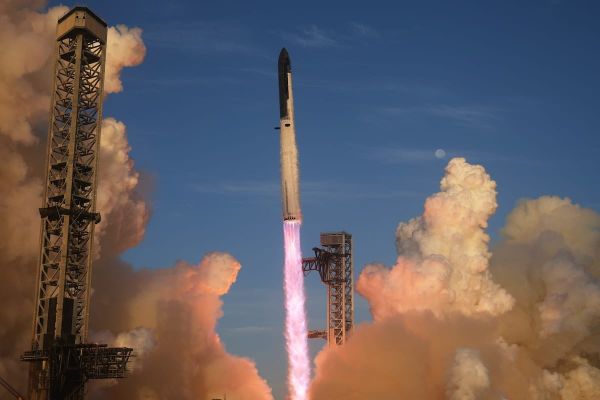
The revolution in reusable rocketry, pioneered by SpaceX's Falcon 9, has been the single most transformative development enabling today's satellite broadband industry, panelists agreed.
 Tom Stroup
Tom Stroup, president of the Satellite Industry Association (SIA), urged the audience to appreciate the broader significance: "We wouldn't be having the conversations that we are about the capacity, the capabilities of the industry without the drastically reduced cost of launch and then much more rapid cadence."
But Tim Farrar, president of consulting firm TMF Associates, drew a sharp distinction between what rockets cost to fly and what customers pay.
"The real thing that people don't focus on enough is the difference between cost and price," Farrar said, noting that SpaceX launches its own satellites for roughly $20 million per mission while charging external customers around $70 million. "Only when you actually have effective competition will you actually see the prices come down."
Amazon vs. SpaceX: A defining rivalry
Starlink now operates approximately 10,000 satellites and reported $11.4 billion in revenue last year. Amazon's Leo constellation, by contrast, is building toward 3,200 broadband satellites but has yet to launch commercially.
Caleb Henry, director of research at boutique financial research firm Quilty Space, traced the rivalry's origins to a pivotal moment when Elon Musk fired several Starlink leaders and Jeff Bezos recruited them. "That began one of the most dynamic rivalries that we see not just in the space industry broadly," Henry said. "It's impressive to have one disruptor, but two really makes the whole world pay attention."
Farrar argued that Amazon faces a structural disadvantage so long as it remains separated from Blue Origin, Bezos' rocket company. Amazon has committed over $10 billion in launch contracts, he noted, while SpaceX's internal cost for comparable mass would be closer to $2 billion.
"Something has to change," Farrar said, "because it's going to be nearly impossible for Amazon to produce a cost-effective broadband solution" under the current arrangement.
Direct-to-device and defense
The panel also examined direct-to-device connectivity, which allows satellites to communicate with ordinary smartphones. Amazon's $11 billion acquisition of Globalstar, finalized on Tuesday, April 14, signals the company's ambitions in this space. Henry noted that Amazon's target market has expanded from "tens of millions" of customers to "hundreds of millions of endpoints," illustrating how the logic around market size has shifted.
Yet Farrar cautioned that early adoption figures are underwhelming, with fewer than 10 percent of eligible users accessing Starlink's direct-to-cell service monthly. "There's a serious risk that direct-to-device turns into another disappointment like MSS [mobile satellite services] did in the 1990s," he said.
On the defense front, Henry observed that Starlink's dominance has pushed traditional satellite operators toward government customers. "This is like a safe area," he said.
Stroup agreed, noting that satellite services are "integral to national defense" and that the war in Ukraine has reinforced recognition of their strategic importance, from identifying the Russian buildup to sustaining Ukrainian communications throughout the conflict.
OneWeb, spectrum, and the road to WRC-27
The competitive pressures facing smaller constellation operators were also on display. OneWeb, now owned by French company Eutelsat, operates roughly 600 satellites but remains dwarfed by Starlink. Henry noted that OneWeb was forced to purchase Falcon 9 launches after Russia seized approximately three dozen of its satellites in retaliation over the Ukraine conflict, underscoring the geopolitical risks embedded in the launch supply chain.
As Eutelsat prepares to replenish the fleet, it will likely continue relying on SpaceX "because there's just not another affordable, frequently launched rocket," Henry said.
Panelists also touched on the Artemis II mission, which circled the Moon in the days before the panel, as a reminder of the government's foundational role in sustaining space investment, even as proposed NASA budget cuts of roughly 25 percent drew concern across the industry.
Looking ahead, Stroup noted that 85 percent of issues on the agenda at the International Telecommunication Union's World Radiocommunication Conference in 2027 are space-related.
Among the most contentious is a proposal to relax equivalent power flux density rules governing low-Earth orbit (LEO) satellites, which Henry said could multiply constellation capacity by five to eight times, but which Stroup acknowledged has divided the satellite industry between geostationary and non-geostationary operators.
"This is a very controversial issue within the industry," Stroup said. "SIA has not been able to achieve consensus on it."