Tech Trade Group CCIA Makes the Case for One AI Rulebook as Congress Weighs a Floor
Matt Schruers leads the industry side of a preemption fight that tech companies lost in the Senate and in Connecticut

WASHINGTON, Nov. 29, 2026 – The tech industry's push for a single national AI standard enters the 120th Congress after a run of setbacks. The House bill closest to that goal is being rewritten so that stronger state laws would survive it.
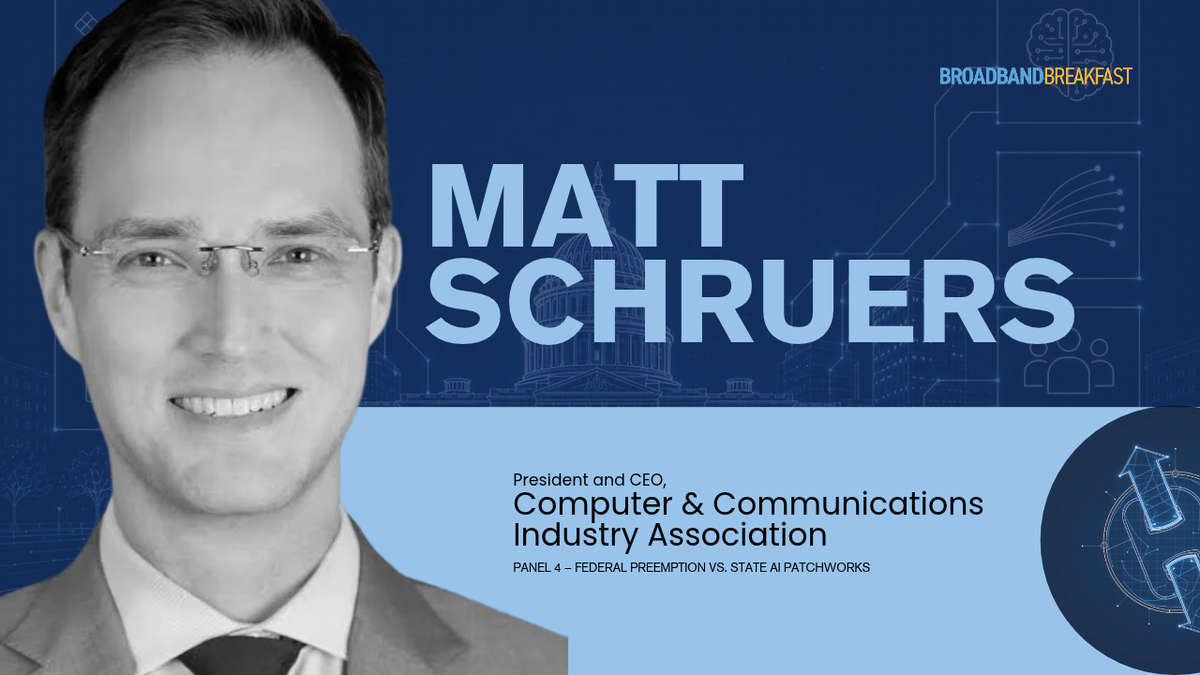
Carrying that argument to Broadband and AI in the Next Congress is Matt Schruers, president and CEO of the tech trade group Computer & Communications Industry Association.
He joins the 3 p.m. Dec. 1 panel "Federal Preemption vs. State AI Patchworks," moderated by Rebecca Kern, senior correspondent at the subscription policy news service The Capitol Forum.


A lawyer who joined CCIA from private practice in 2005, Schruers was its chief operating officer before taking the top job, where he speaks for its member tech companies in Washington. He has taught internet and intellectual property law at Georgetown and American University.
A cost argument with a number attached
Federal preemption of state AI laws would save the federal government about $600 billion through 2035, according to a November 2025 estimate by CCIA chief economist Trevor Wagener. About $561 billion of that comes from added tax revenue that he attributes to faster AI adoption.
The same analysis counted 1,134 state AI bills introduced in 2025 and 131 enacted. The savings figure rests on CCIA's own assumptions about adoption and productivity, not on an independent estimate.
Fighting state bills one at a time
Connecticut's SB 5, a broad 2026 AI law, drew CCIA opposition at a March 4 committee hearing. In a May 7 letter, CCIA state policy manager Kyle Sepe requested a veto, warning that "SB 5 risks creating a fragmented regulatory environment." Gov. Ned Lamont, D, signed the bill anyway.
The Senate voted 99 to 1 on July 1, 2025, to strip a 10-year moratorium on state AI laws from the reconciliation bill. Executive Order 14365, signed Dec. 11, 2025, then directed a Justice Department task force to challenge state AI laws and barred states with "onerous" ones from BEAD non-deployment funds.
The White House followed on March 20 with a legislative framework seeking a "minimally burdensome national standard." The framework "underscores the urgency of advancing U.S. leadership in artificial intelligence," Schruers said that day, adding that "an overly restrictive approach not calibrated for risk may invite legal challenge."
In the House, the FRONTIER Act, H.R. 9925, introduced July 23 by Reps. Jay Obernolte, R-Calif., and Lori Trahan, D-Mass., covers only developers training models above 10^26 operations. Its Section 9(b) would bar states from imposing "new substantive obligations" on AI developers in risk transparency, third-party audits and incident reporting.
On Nov. 19, Trahan released a section-by-section that converts that clause to "floor preemption." State laws more protective than the bill would survive. Full text has not been released.
CCIA was not among the nine organizations Trahan's office quoted praising the bill on July 28.
What to watch at 'Broadband and AI in the Next Congress'
- Would CCIA accept a federal floor, or does a floor leave industry with the same patchwork it has now?
- What would the industry trade for preemption: Audits, incident reporting or whistleblower protections?
- Can a $600 billion estimate built on CCIA's own assumptions persuade a Democratic House majority?
Sign up for Broadband and AI in the Next Congress on Dec. 1.