Who Determines the Rules, Who Pays for the Infrastructure?
7 members of Congress. 4 awesome panels, and 4 questions that will shape the future of artificial intelligence


WASHINGTON, Nov. 25, 2026 — When the 120th Congress convenes Jan. 3, 2027, lawmakers will confront two disputes over artificial intelligence’s expansion: Whether federal safeguards should preempt state laws, and whether technology companies or other utility customers, including households, pay for the infrastructure powering it.
Highlights Reel:
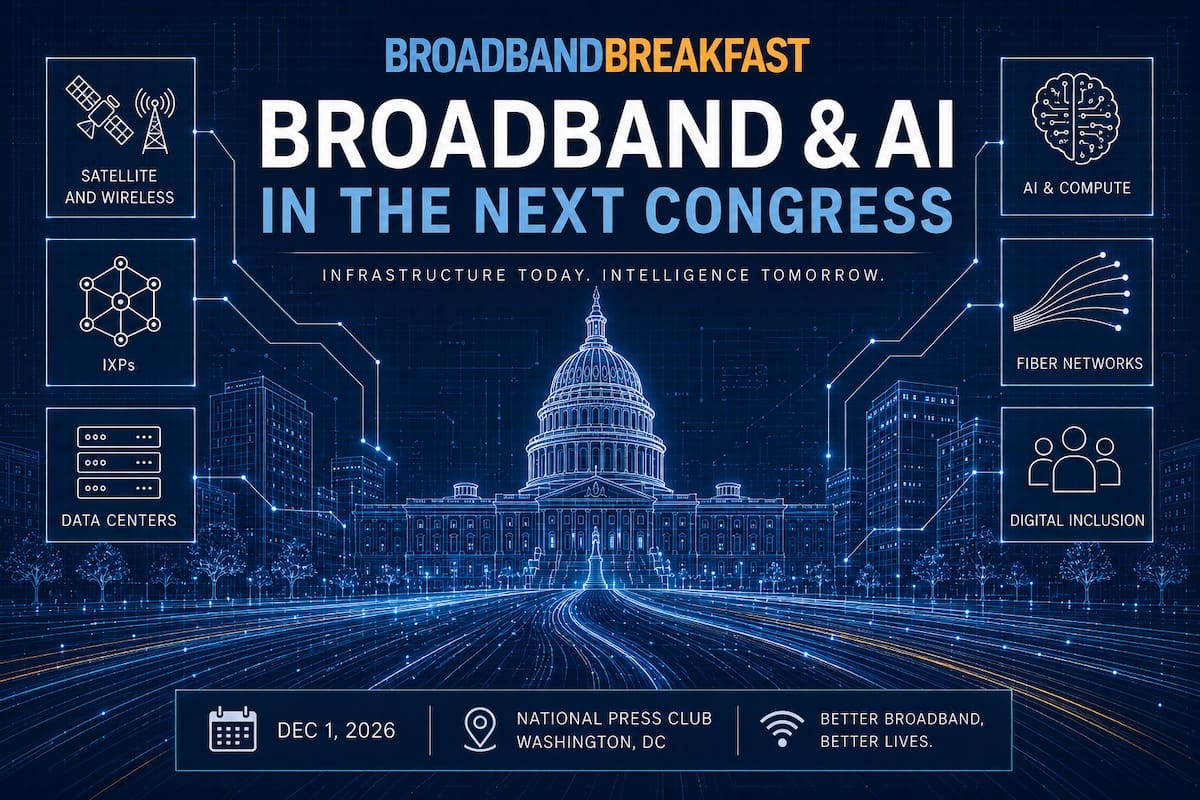
Those questions will bring seven members of Congress, state lawmakers, utility regulators and technology companies to Broadband Breakfast’s “Broadband and AI in the Next Congress” on Dec. 1 at Washington’s National Press Club.


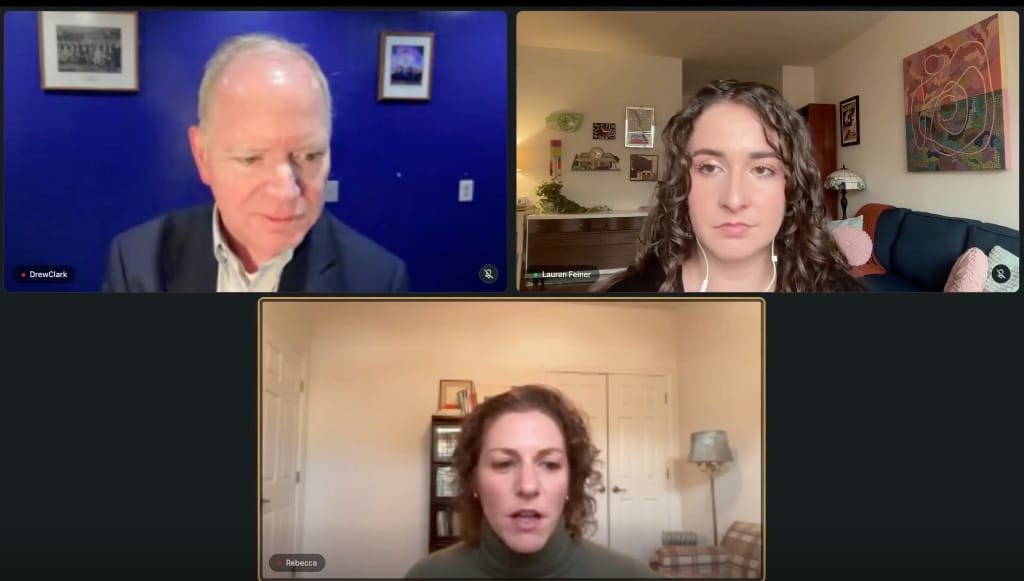
In a Wednesday preview, Rebecca Kern, senior correspondent at the subscription news service The Capitol Forum, and Lauren Feiner, senior policy reporter at technology publication The Verge, outlined the choices framing their upcoming panels.
State laws become models for a federal bill
The developers of the Claude and ChatGPT chatbots, Anthropic and OpenAI, helped shape AI legislation in New York and Illinois before its passage, Kern said. Federal legislation modeled on those laws would face less industry resistance because the companies had already helped shape the requirements, she said.
Both companies participated in negotiations over Illinois’ legislation, according to Capitol News Illinois. In July, OpenAI’s chief global affairs officer, Chris Lehane, called the approach “reverse federalism,” arguing that aligned state laws could establish a national standard before Congress acts.
The dispute concerns preemption, federal action that overrides state law, and whether Congress would establish baseline protections or bar states from imposing stricter AI safety requirements.
California’s AI law, SB 53, covers frontier models trained using more than 100 septillion computational operations. Developers with more than $500 million in annual revenue must publish frameworks explaining how they manage catastrophic risks. The law also requires incident reporting and protects whistleblowers who disclose safety concerns.
New York’s RAISE Act similarly requires safety disclosures and incident reports, while creating an oversight office within the state Department of Financial Services. Illinois became the first state to require annual independent audits of compliance with its frontier-AI safeguards, beginning in 2028.
Those protections complicate a federal compromise. Kern said Democrats could push for stronger safeguards next year instead of accepting concessions negotiated in the current Congress.
The federal FRONTIER Act illustrates the bargain. Introduced by Rep. Jay Obernolte, R-Calif., with bipartisan cosponsors including Rep. Lori Trahan, D-Mass., the proposal would make model-testing and auditing requirements uniform nationwide, Kern said. States could still regulate harms involving children, employment and discrimination, she said.
Trahan separately outlined revisions Nov. 19 that would preserve stronger state laws, expand independent verification and empower federal officials to order developers to correct inadequate safeguards. They would establish an Office of AI Security within the Commerce Department. Full bill text was still forthcoming.
A broader proposal would require AI companies to obtain renewable federal charters. Proposed by Rep. Pramila Jayapal, D-Wash., who will speak at the event, the National AI Charter Act framework calls for renewal every 10 years and congressional approval for companies valued at $1 billion or more.
Chartered companies could own computing infrastructure or the AI systems running on it, but not both. High-risk systems would undergo testing in isolated government facilities before release, and federal inspectors could order emergency shutdowns.
Who pays after the infrastructure is built?
Data centers have supported online services for decades. AI has made their expansion more visible while increasing the infrastructure needed to serve them, Feiner said.
“When we say the cloud, the cloud is basically just a bunch of data centers,” she said.
Serving a facility can require new generating capacity, transmission lines and local delivery equipment. If it closes or uses less electricity than expected, households and other businesses could face higher bills unless contracts or utility rules assign the remaining costs to the developer.
Residents fear being “left holding the bag” if an AI downturn leaves data centers unnecessary, Feiner said. Upfront financing from technology companies does not settle who supports the expanded infrastructure afterward.
The concerns also differ by community, Feiner said, extending to environmental effects and the proximity of facilities and power infrastructure to homes. In Memphis, residents of Boxtown and Whitehaven have raised concerns about air quality, noise and water infrastructure. In Virginia’s Great Oak neighborhood, residents have complained about persistent noise from cooling equipment at nearby Amazon data centers.
The Power and Water for Families Act, introduced June 24 by Rep. Michael Baumgartner, R-Wash., addresses the financial risk. It would require state utility regulators and utilities outside their jurisdiction to consider rules making large electricity customers cover the upgrades needed to serve them.
Those rules would require financial guarantees or upfront contributions before construction and recover infrastructure costs from a data-center customer even if it ends its electricity contract or stops buying power.
Feiner identified data centers as a possible opening for action before January, given the issue’s momentum before the midterms. Her panel will examine permitting and construction obstacles and who bears responsibility for financing expansion without transferring the risk to residents.
Participants include Tashia Roberson-Wing, a senior legislative assistant to Rep. Greg Landsman, D-Ohio; Tony Clark, executive director of the National Association of Regulatory Utility Commissioners, which represents state utility regulators; Josh Levi, president and CEO of the Data Center Coalition; and Cy McGeady, head of energy policy at data-center operator Equinix.
Four panels and seven congressional speakers
Broadband Breakfast CEO Drew Clark framed the event around four questions: “How do we manage AI’s risks? Who builds the networks? How do we pay for the energy it will consume? And who decides, Washington or the states?”
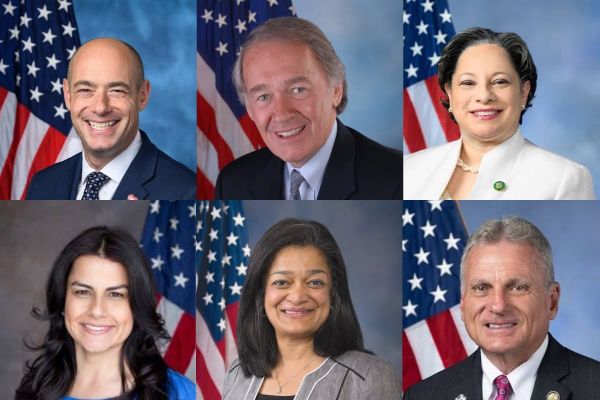
Joining Jayapal and Landsman are Sen. Ed Markey, D-Mass., and Reps. Buddy Carter, R-Ga.; Nanette Barragán, D-Calif.; Jennifer McClellan, D-Va.; and Ted Lieu, D-Calif.
Clark highlighted Markey’s role in establishing E-Rate, which subsidizes internet access for schools and libraries, and children’s privacy legislation. The House author of the 1998 Children’s Online Privacy Protection Act, Markey has championed COPPA 2.0 to extend protections to teenagers and prohibit targeted advertising to children and teens.
The four panels are “What Do We Have to Fear? AI and Catastrophic Risk,” moderated by The Washington Post’s Cat Zakrzewski; “Permitting Reform and the AI Race,” moderated by Law360’s Christopher Cole; “The Data Center Power Crisis and Ratepayer Protection,” moderated by Feiner; and “Federal Preemption vs. State AI Patchworks,” moderated by Kern.
Gold sponsors are Comcast, the media and telecommunications company, and Broadband Nation Expo, the digital-infrastructure conference held in New Orleans last week. Silver sponsors are INCOMPAS, the competitive communications trade association, and NTCA–The Rural Broadband Association.
 Broadband Breakfast
Full Event Video of the Preview Session: