
Amazon Rebrands Project Kuipier Satellite Service to ‘Amazon Leo’
Amazon has 153 active satellites, plans to launch enterprise service in 2025, removes reference to 'affordable broadband'

Akul Saxena
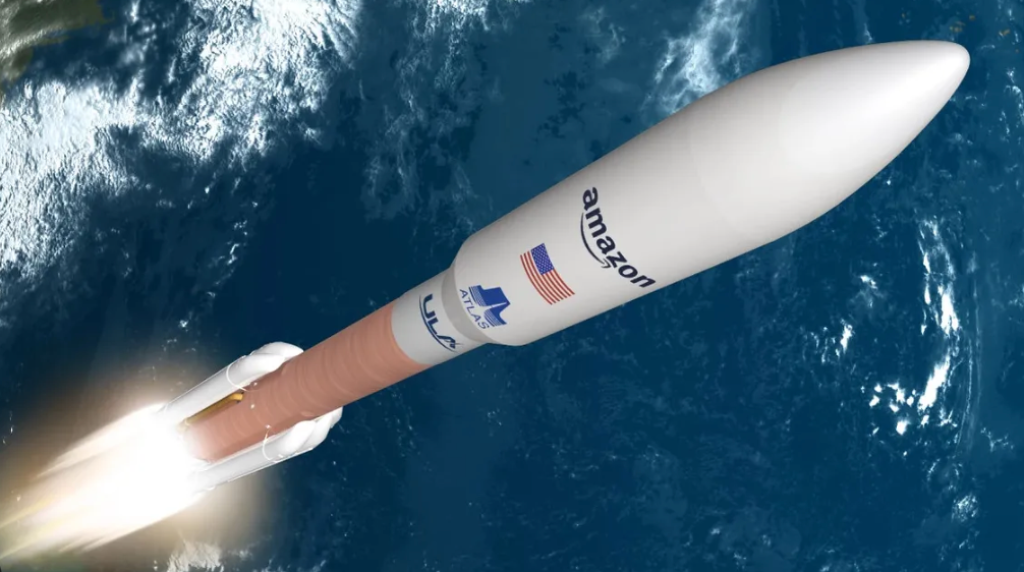
WASHINGTON, Nov. 17, 2025 — Amazon rebranded its Project Kuiper satellite broadband program as Amazon Leo on Thursday, with 153 satellites in orbit as the company approaches a federal deployment requirement set by the Federal Communications Commission.
Amazon announced the rebrand as it shifted from prototype tests to commercial deployment under its 2020 FCC authorization to build and operate a 3,236-satellite low-Earth orbit constellation. The FCC required Amazon to place half of those satellites in active service by July 30, 2026, a rule intended to prevent companies from warehousing orbital spectrum without deploying networks.
Amazon's April 28 launch on a United Launch Alliance Atlas V rocket marked the first operational satellites counted toward the FCC requirement. Five additional launches followed through October, including missions on SpaceX Falcon 9 rockets.
Amazon said it secured more than 80 launch missions across several providers to meet the 2026 federal milestone. These providers included Blue Origin, the commercial space company founded by Amazon's former chief executive Jeff Bezos, and Arianespace, the European state-backed launch provider.
The combined launch contracts were described by Amazon as the largest commercial launch purchase on record.
Satellite production took place at a facility in Kirkland, Washington, where Amazon reported a capacity of five spacecraft per day. Processing and integration occurred at Kennedy Space Center in Florida, which served as the staging site for all six operational launches conducted so far.
Amazon said it planned to begin service to “select enterprise” service before the end of 2025, with broader commercial availability expected in 2026 as the constellation expands and ground infrastructure is completed. The company introduced three user terminals that offered speeds of 100 megabits per second, 400 megabits per second, and 1 gigabit per second.
Early commercial partners include JetBlue, which seeks improved in-flight connectivity, and Airbus, which plans aviation trials. Amazon on Wednesday announced Connected Farm, which focuses on rural automation networks.
Early commercial partners include JetBlue, seeks improved in-flight connectivity, and Airbus, which planned aviation trials. Amazon on Wednesday announced Connected Farm, which focuses on rural automation networks. Pilot programs for Connected Farm are scheduled to begin in 2026 in North America and the United Kingdom.
Company removes references to ‘affordable broadband’
TechCrunch reported Sunday that Amazon removed all affordability references from its recent marketing materials.
Archived 2024 pages described Kuiper’s mission as providing “affordable broadband” for globally unserved communities. Current descriptions emphasize network reliability and enterprise capabilities and remove explicit references to price or unserved households.
Amazon's satellites operate at altitudes between 367 and 392 miles above Earth. SpaceX Starlink, which remains the dominant low Earth orbit broadband provider with more than 7,000 satellites, operate at lower altitudes at roughly 340 miles. Amazon said its network would integrate with Amazon Web Services to support business applications.
Amazon faces a July 2026 deadline to deploy half its authorized constellation, under FCC licensing rules. The requirement calls for 1,618 satellites to be in active service, leaving Amazon with 1,465 satellites still to launch from its current total of 153.






Member discussion