Building BEAD: From Federal Awards to Finished Networks
BEAD’s next phase will depend on workable contracts, timely permitting and consumer-focused accountability as broadband projects move toward construction.


WASHINGTON, Sept. 23, 2026 — The $42.5 billion Broadband Equity, Access and Deployment program is finally moving from years of rulemaking into construction, but its hardest test may be turning federal awards into projects that providers can finance, permit and finish.
That shift, from designing BEAD to building it, framed a Broadband Breakfast Live Online discussion Wednesday. With every state’s grant agreement approved and initial connections coming online, panelists said success now depends on practical contracts, faster permitting and flexibility when projects change.

“We’re now at the point where the rubber meets the road on operationalizing the actual funds,” said Joe Kane, director of broadband and spectrum policy at the Information Technology and Innovation Foundation.
The program’s revised, technology-neutral bidding widened participation by fiber, fixed wireless and low-Earth-orbit satellite providers while preserving billions for other uses. Kane said the approach appropriately focuses on the service consumers receive rather than favoring a particular network.
Yet lower awards do not eliminate execution risk. Providers are already dropping locations or abandoning projects as costs, coverage maps and business calculations change. Those decisions will determine whether states can move quickly without trading away the reliability and accountability Congress expected from BEAD.
Contracts meet construction
For companies preparing to build, the subgrant agreement is where policy becomes financial exposure. Steve Coran, chair of the Broadband, Spectrum and Communications Infrastructure practice group at Lerman Senter, said states generally use either milestone payments or reimbursements tied to approved invoices.
The milestone model is friendlier to providers because payments do not wait for invoice review, Coran said. But other contract terms can make projects difficult to finance, including termination-for-convenience clauses, immediate default remedies and clawbacks that may seek all awarded money even when construction is nearly complete.
“You gotta be able to derisk these so that they are investment-friendly,” Coran said. “The funding doesn’t stop just when the state is writing checks.”
That matters because subgrantees typically contribute matching funds, may raise debt or equity and must operate the networks after federal support ends. Coran said agreements should resemble commercial contracts, not one-sided grants, because providers will own the infrastructure and face years of compliance.
Some companies have walked away because agreements carried too much risk, another provider already served the area, private easements looked unworkable or labor and fiber costs rose, Coran said. States are filling gaps by approaching neighboring BEAD winners, second-place bidders, satellite providers and, in some cases, internet service providers that never applied.
“There’s a cleanup before we get to the cleanup,” Coran said, describing reallocations underway before another formal bidding round. The situation remains “very fluid,” he added.
Permits, performance and people
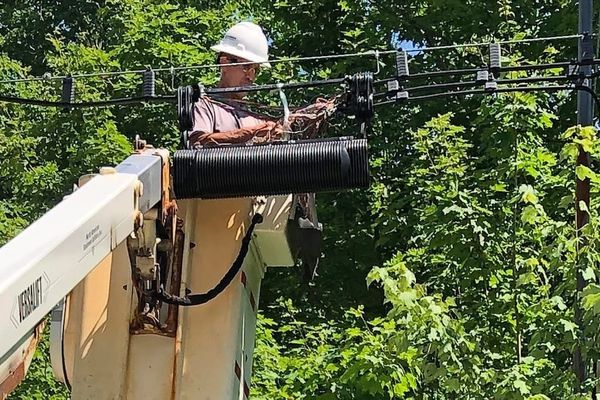
Even signed projects can stall at local approvals, railroad crossings, pole attachments and environmental reviews. Kane said permitting fees should reflect actual government costs and decisions should face firm timelines.
“The benefit of this universal connectivity through BEAD is the connectivity,” Kane said. “We don’t want it to get eaten up by permitting.”
Oversight will continue after construction begins. States will collect progress reports and performance tests for speed, latency and coverage, while federal and state officials retain audit rights. Coran said providers must also maintain low-cost service options and comply with federal liens and transfer restrictions.
Still, both panelists argued that deployment alone will not close the digital divide. With roughly $21 billion potentially remaining after network awards, Kane urged policymakers to address affordability and digital literacy through targeted, consumer-directed support rather than broad operating subsidies.
Coran favored giving states a menu of permitted uses, including adoption, workforce development, 911 improvements, resilience and supplemental support for projects. A single national formula, he said, would overlook local needs.
The emerging lesson is that BEAD’s success will not be measured only by miles of fiber or money awarded. It will turn on whether states can keep projects investable, hold providers accountable and connect households before changing economics overtake plans written years ago.