
A Year of Telecom Mergers and Acquisitions
The wireless carriers are expected to continue scooping up fiber providers.

Jake Neenan
Fiber broadband saw a flurry of major deals in 2024. Major mobile carriers are expected to continue snapping up fiber providers in the coming year, as they look to offer converged services in a regulatory environment that looks to be getting friendlier.
News that Verizon was looking to acquire Frontier in early September was seen by analysts as the beginning of this trend in earnest. The deal, valued at $20 billion, would see Verizon take on Frontier’s 7.6 million-location footprint across 25 states in addition to the carrier’s existing 18 million fiber passings. It’s expected to close in mid-2025.
The 12 Days of Broadband (click to open)
- On the First Day of Broadband, my true love sent to me:
An extra-planetary-life-promoting tech billionaire set on electing a president. - On the Second Day of Broadband, my true love sent to me: 23 million served by the Affordable Connectivity Program.
- On the Third Day of Broadband, my true love sent to me:
3rd year without the Federal Communications Commission having spectrum auction authority. - On the Fourth Day of Broadband, my true love sent to me:
$42.5 billion in Broadband Equity, Access and Deployment funds already allocated. - On the Fifth Day of Broadband, my true love sent to me:
5,500 active satellites currently in Low-Earth Orbit. - On the Sixth Day of Broadband, my true love sent to me:
More than 6 years of service at the FCC by Commissioner and Chairman-designate Brendan Carr. - On the Seventh Day of Broadband, my true love sent to me:
More than 70 billion kilowatt-hours of electricity annually consumed by data centers in the U.S. - On the Eighth Day of Broadband, my true love sent to me:
$8.1 billion dollars in annual Universal Service Funds. - On the Ninth Day of Broadband, my true love sent to me:
$90 billion in global telecom Merger & Acquisition deals value in 2024. - On the Tenth Day of Broadband, my true love sent to me:
100 broadband-related rulemakings at the FCC relying on Chevron Deference. - On the Eleventh Day of Broadband, my true love sent to me:
Nearly 11 years to complete the Rural Digital Opportunity Fund, complete with defaulted locations. - On the Twelfth Day of Broadband, my true love sent to me:
More than a dozen policy-makers and pro-tech thinkers echoing the Andreessen-Horowitz “Little Tech” agenda.
All told, the first three quarters of 2024 saw global telecom M&A deal value surge to approximately $90 billion, according to Bain & Co.. This represented a significant increase from about $24 billion during the same period in 2023. The Americas accounted for 63% of this global total.
“We have been arguing for a couple of years that all the fiber assets would eventually be rolled up into the three big national carriers,” New Street Research’s Jonathan Chaplin wrote at the time. “We thought the big deals would start in earnest in late 2025 or 2026. But we always knew that if one carrier started the process, others would have to follow swiftly because there are three wireless carriers and only one fiber asset in every market with a fiber asset.”
Some major Frontier investors balked at the deal, arguing the company should have pushed for a higher price, but shareholders ultimately voted to approve the deal in November. It’s pending before the Federal Communications Commission.
T-Mobile had got to work even earlier. The carrier formed in April a joint venture with a private equity firm to buy regional fiber ISP Lumos, putting up $950 million for a 50 percent stake. The company did the same with Metronet, investing $4.9 billion for 50 percent equity and all the company’s fiber operations.
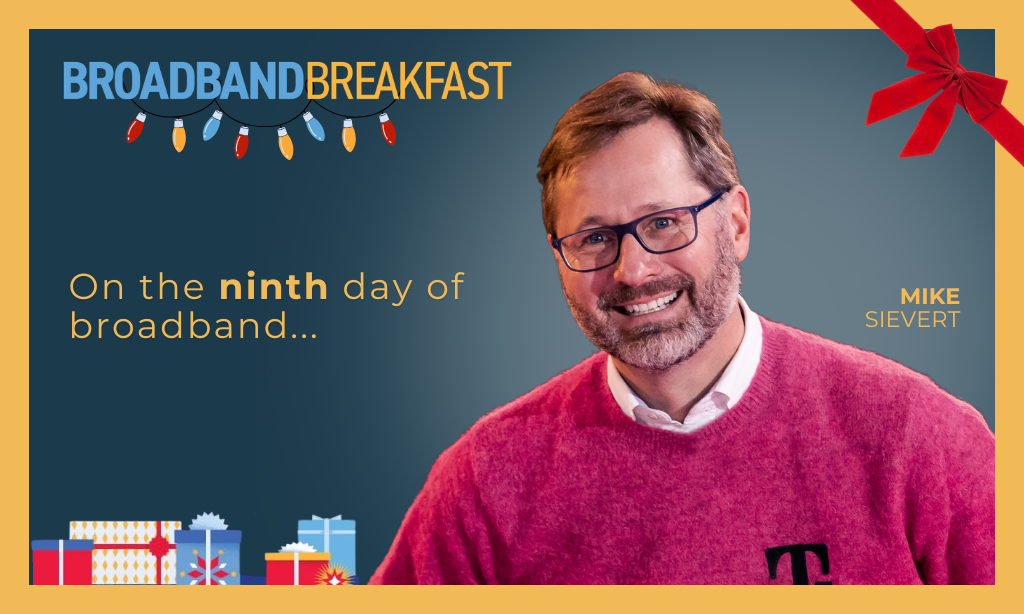
The companies being scooped up are smaller, with Lumos passing more than 320,000 locations and Metronet passing about 2 million, but the T-Mobile CEO Mike Sievert said at an analyst day the company is aiming to hit 12 million to 15 million passings by 2030. Both will operate as open access providers with T-Mobile being the anchor tenant.
AT&T and Verizon have reported lower customer churn when subscribers sign up for both mobile and fixed broadband service, hence the push to expand fiber and scoop up smaller and regional providers.
MoffettNathanson Senior Managing Director Craig Moffett has been skeptical of the strategy, noting getting fiber to every location in the country would require huge amounts of cash.
“AT&T is perhaps the best positioned here… but it’s all different degrees of bad,” he wrote in an investor note after AT&T’s Q3 earnings call. “As with Verizon and T-Mobile, AT&T doesn’t have a wireline answer in the vast majority of the country, and there is no path for them to get one.”
For its part, AT&T has more than 28 million of its own fiber passings and has been building out quickly, with plans to pass 50 million by 2030. The company said earlier this month it plans to increase the build out target for its Gigapower venture, an open access joint venture with BlackRock, to 5 million from its initial target of 1.5 million.
In deals not centered on convergence, private equity firms Searchlight Capital and British Columbia Investment are getting close to closing their $3.1 billion transaction taking Consolidated Communications private.
Canadian telecom company BCE is also set to acquire Northwest fiber provider Ziply for $3.6 billion, and the major mobile carriers have been splitting up UScellular.
T-Mobile’s taking the towers and customers, plus some airwaves, for $4.4 billion and Verizon and AT&T have each spent $1 billion on more of the company’s spectrum assets.
Looking ahead
The deals themselves were not expected to hit major regulatory roadblocks if Democrats had taken the White House, aside from the FCC potentially asking for conditions like low-income plans or phone unlocking timelines. Under Trump, the runway is seen as completely clear.
“President-elect Donald Trump's appointment of Brendan Carr as FCC chair and the anticipation of Lina Khan’s FTC replacement suggest a return to a pro-deregulation agenda,” wrote consulting firm PwC in its 2025 telecom deals outlook. “This move could accelerate consolidation, empowering dominant players to expand their market control.”
Trump tapped FTC Commissioner Andrew Ferguson to head the agency on Dec. 10. Ferguson pledged in a memo obtained by Punchbowl News to “repeal burdensome regulations” and stop the current FTC’s “war on mergers.”


Member discussion