New Year, New FCC Chair
Brendan Carr has supported a deregulatory stance toward ISPs.

Jake Neenan
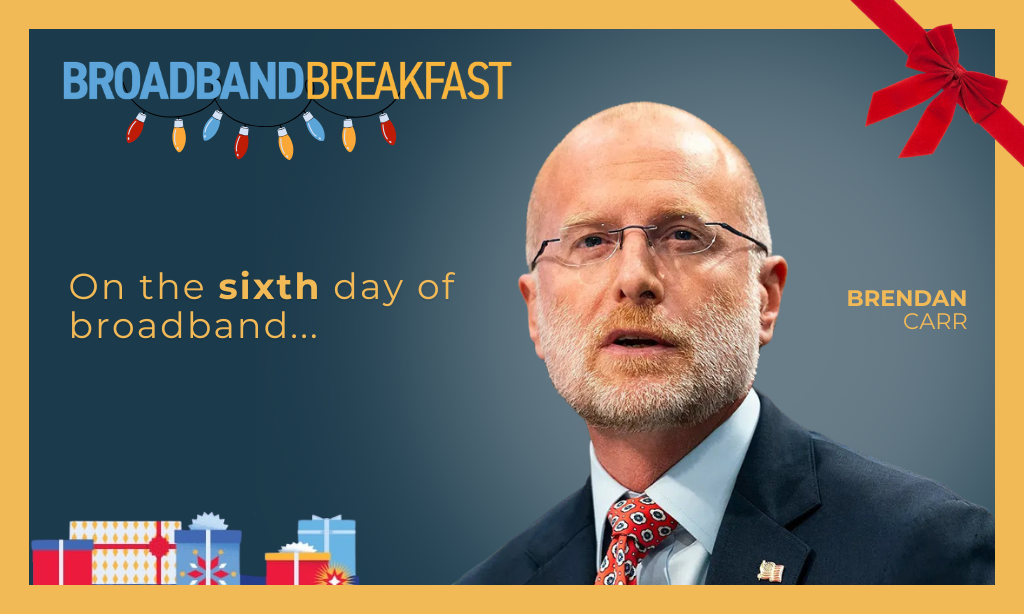
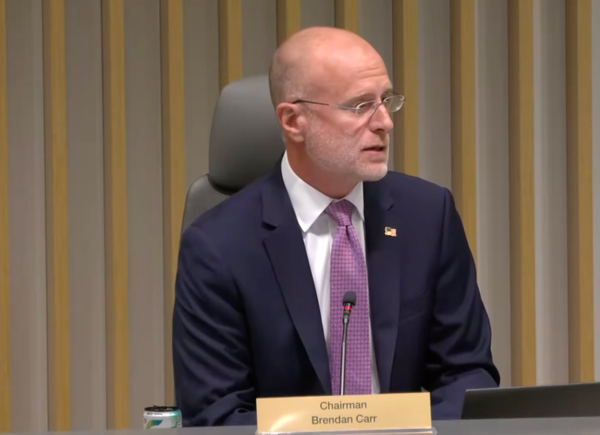
President-elect Donald Trump tapped Brendan Carr to lead the Federal Communications Commission in his second term, and he’s poised to roll back many of the major rulemakings enacted by current FCC Chairwoman Jessica Rosenworcel.
The agency’s senior Republican, Carr has been at the FCC since 2012 and briefly served as general counsel before being nominated and confirmed as a commissioner in August 2017 under the first Trump administration.
The 12 Days of Broadband (click to open)
- On the First Day of Broadband, my true love sent to me:
An extra-planetary-life-promoting tech billionaire set on electing a president. - On the Second Day of Broadband, my true love sent to me: 23 million served by the Affordable Connectivity Program.
- On the Third Day of Broadband, my true love sent to me:
3rd year without the Federal Communications Commission having spectrum auction authority. - On the Fourth Day of Broadband, my true love sent to me:
$42.5 billion in Broadband Equity, Access and Deployment funds already allocated. - On the Fifth Day of Broadband, my true love sent to me:
5,500 active satellites currently in Low-Earth Orbit. - On the Sixth Day of Broadband, my true love sent to me:
More than 6 years of service at the FCC by Commissioner and Chairman-designate Brendan Carr. - On the Seventh Day of Broadband, my true love sent to me:
More than 70 billion kilowatt-hours of electricity annually consumed by data centers in the U.S. - On the Eighth Day of Broadband, my true love sent to me:
$8.1 billion dollars in annual Universal Service Funds. - On the Ninth Day of Broadband, my true love sent to me:
$90 billion in global telecom Merger & Acquisition deals value in 2024. - On the Tenth Day of Broadband, my true love sent to me:
100 broadband-related rulemakings at the FCC relying on Chevron Deference. - On the Eleventh Day of Broadband, my true love sent to me:
Nearly 11 years to complete the Rural Digital Opportunity Fund, complete with defaulted locations. - On the Twelfth Day of Broadband, my true love sent to me:
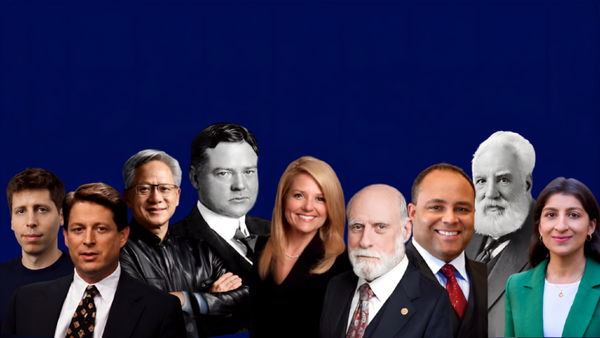
More than a dozen policy-makers and pro-tech thinkers echoing the Andreessen-Horowitz “Little Tech” agenda.
The Rosenworcel FCC swung for the fences on expanding consumer protection regulations, moving in the second half of 2023 to reinstate net neutrality rules, prevent disparate broadband deployments in low-income and minority communities, and instituting expanded data breach notification rules.
The agency also started an inquiry into broadband data caps, and Rosenworcel circulated a proposal to look into bulk billing agreements between broadband providers and landlords or homeowners’ associations.
The 2023 rules were each challenged in court by telecom industry groups this year. The first two were argued before the Sixth and Eight Circuit Courts of Appeal respectively, both of which are considered conservative benches that might be tougher turf for the FCC.
ISPs also had a new line of attack available in the Supreme Court’s recently expanded major questions doctrine; a Sixth Circuit panel stayed the net neutrality order on Aug. 1 on the basis that the industry challengers were likely to succeed on that basis, though the separate panel that heard oral arguments wanted to focus more on the text of the statute.
Under Carr, the rules are expected to be rolled back, weakened, or not enforced. He’s favored a lighter touch regulatory regime and dissented from all three rulemakings — he spoke for more than half an hour lambasting the net neutrality order at the agency’s open meeting in April before it was adopted. He also opposed the data cap and bulk billing inquiries.
Carr wrote the communications policy chapter of Project 2025 – the Heritage Foundation blueprint for a potential Trump administration – in which he outlined his priorities for the FCC if he were Chairman. He’s one of several authors tapped for leadership positions in the Trump administration.
Advocating for reinterpreting Section 230
He advocated for reinterpreting Section 230, which protects online platforms from liability for user-generated content and how they moderate it, to limit those moderation protections. It’s part of Carr’s consistent complaints that tech companies suppress conservative content online, but isn’t an area the FCC has traditionally operated in.
Carr also detailed plans more traditionally within the agency’s wheelhouse, like making it easier for telecom providers to deploy infrastructure and getting more Chinese companies out of American networks.
“The FCC’s prior reforms focused on streamlining the rules for small wireless facilities,” Carr wrote in his chapter. “The FCC should now explore similar action for the deployment of other wired infrastructure by imposing limits on the fees that local and state governments can charge for reviewing those wireline applications and time restrictions on the government’s decision-making process.”
The Rosenwrocel FCC also worked to ease access to utility poles — frequently a hot-button issue before the agency — but stopped short of expanding guardrails on local reviews. Then-Commissioner Rosenworcel and her Democratic colleague Geoffrey Starks dissented from a 2020 item that made it more difficult for municipalities to block less substantial modifications to cell sites.
While new rulemakings and orders would need a third GOP commissioner to move forward, Carr wouldn’t need a majority to stop work on in-progress proceedings like the data caps inquiry, or simply to avoid enforcement actions under the net neutrality and digital discrimination rules should they survive court challenges, according to industry analyst and former FCC chief of staff Blair Levin.
The chairman-designate has railed against social media platforms and broadcasters, alleging bias against conservatives in moderation policies and newscasts.
He’s said in posts on X and in an interview with CNBC that the agency would enforce the Communications Act’s public interest requirement for broadcasters and that revoking licenses held by stations owned or affiliated with the major news networks was “on the table” — a stark departure from agency precedent of not revoking licenses based on content.
“The Communications Act says you have to operate in the public interest,” Carr told CNBC. “And if you don’t, yes, one of the consequences is potentially losing your license. And of course, that’s on the table. I mean, look, broadcast licenses are not sacred cows.”
Experts have cast this as an effort to show allegiance to Trump, who has repeatedly called for such action after critical coverage, and exert political pressure to influence coverage, rather than a material threat to fully revoke licenses.
That pressure could come in the form of holding up transactions, like a currently pending $8.4 billion deal between Skydance Media and Paramount Global, which requires FCC approval to transfer 28 full-power TV stations in 17 markets. The Justice Department has approved the transaction.
The latter owns stations in the CBS network, and Carr has said a news distortion complaint filed by the Center for American Rights over the editing of a 60 Minutes interview with Vice President Kamala Harris during the presidential campaign is likely to factor into the FCC’s review of the deal.