The 'Little Tech Agenda' Becomes a Manifesto for Trump 2.0
Deregulation, spending cuts, H1-B visas for legal immigration. Are these now Trump administration policy?

If there was a defining moment in the 2024 election, in hindsight, it was not the assassination attempt on Donald Trump. It was not J.D. Vance’s unverified claims about dogs and cats being eating by immigrants in Springfield, Ohio. It was not the photo ops at McDonalds, Madison Square Garden, or the garbage truck.
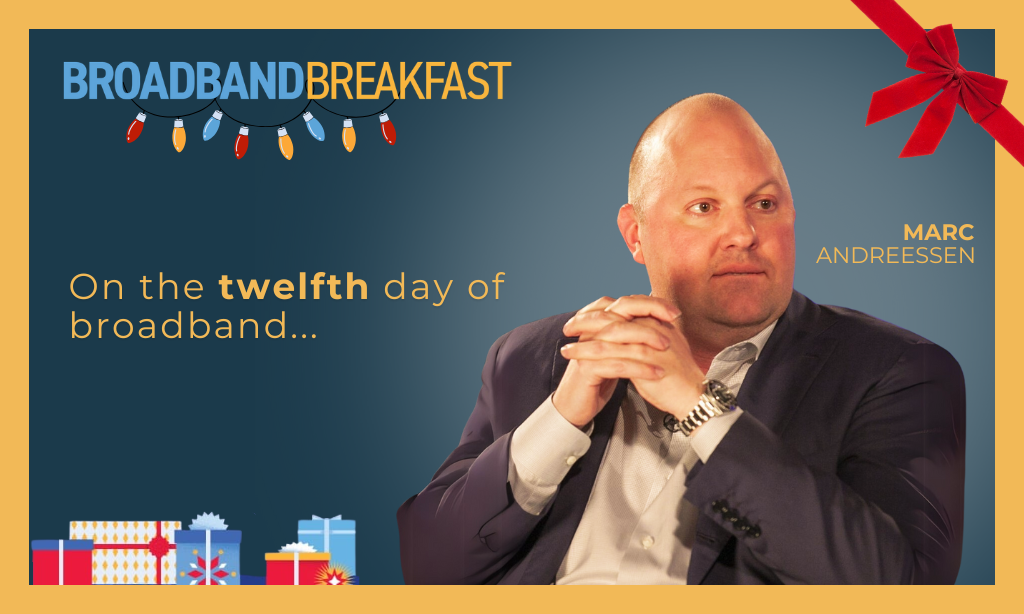
It was, instead, an obscure blog post, “The Little Tech Agenda,” written by two wonky (if rich) Silicon Valley insiders, founders of their eponymous Venture Capital firm, Marc Andreessen and Ben Horowitz.
The 12 Days of Broadband (click to open)
- On the First Day of Broadband, my true love sent to me:
An extra-planetary-life-promoting tech billionaire set on electing a president. - On the Second Day of Broadband, my true love sent to me: 23 million served by the Affordable Connectivity Program.
- On the Third Day of Broadband, my true love sent to me:
3rd year without the Federal Communications Commission having spectrum auction authority. - On the Fourth Day of Broadband, my true love sent to me:
$42.5 billion in Broadband Equity, Access and Deployment funds already allocated. - On the Fifth Day of Broadband, my true love sent to me:
5,500 active satellites currently in Low-Earth Orbit. - On the Sixth Day of Broadband, my true love sent to me:
More than 6 years of service at the FCC by Commissioner and Chairman-designate Brendan Carr. - On the Seventh Day of Broadband, my true love sent to me:
More than 70 billion kilowatt-hours of electricity annually consumed by data centers in the U.S. - On the Eighth Day of Broadband, my true love sent to me:
$8.1 billion dollars in annual Universal Service Funds. - On the Ninth Day of Broadband, my true love sent to me:
$90 billion in global telecom Merger & Acquisition deals value in 2024. - On the Tenth Day of Broadband, my true love sent to me:
100 broadband-related rulemakings at the FCC relying on Chevron Deference. - On the Eleventh Day of Broadband, my true love sent to me:
Nearly 11 years to complete the Rural Digital Opportunity Fund, complete with defaulted locations. - On the Twelfth Day of Broadband, my true love sent to me:
More than a dozen policy-makers and pro-tech thinkers echoing the Andreessen-Horowitz “Little Tech” agenda.
The agenda, on the surface, is decidedly modest. Claiming not to support “Big Tech,” the authors want regulatory agencies to be more hands off to startup tech companies, specifically those innovating in cryptocurrencies and artificial intelligence. And they wanted to stop a proposal to tax unrealized capital gains.
In many ways, “The Little Tech Agenda” has gone from being the tail wagging to the dog barking: Observers seeking to deduce how Trump will govern in his next administration will do better to study the Andreessen-Horowitz document than anything else said or written by Trump or Trump campaign officials.
Timing is everything
Part of the blog post’s genius was its timing. It dropped on July 5, 2024. That was after it was clear Trump would be the Republican nominee. But it also days after it became clear that President Joe Biden was not fit to be the Democratic nominee.
Owing to Biden’s disastrous debate performance against Trump on June 27, the choice then appeared to be Trump or Biden. And yet the Republican National Convention, and Trump’s selection of Vance as his running mate, was still in the future, if only by a matter of weeks.
It was at this moment that “The Little Tech Agenda” - officially a non-partisan document - set the stage for Silicon Valley’s warm embrace for the return to Donald Trump, 2.0.
Andreessen is the co-author of Mosaic, the first widely used web browser with a graphical user interface and co-founded Netscape. He’s been a Democrat most of his life, having endorsed and voted for Bill Clinton, Al Gore, John Kerry, Barack Obama and Hillary Clinton. In 2016, he endorsed Republican candidate Carly Fiorina, CEO of computer manufacturer Hewlett-Packard, but switched his endorsement to Hillary Clinton after Fiorina dropped, citing Trump's immigration stances.
His business partner Horowitz was even more pro-Democrat. He and his wife Felicia Horowitz supported Democratic presidential nominee Kamala Harris throughout her career.
Leaning in on innovation, and finding an open door
As these developments were unfolding in early July, Broadband Breakfast reported extensively on “Crypto and the Republicans,” and how a tech-focused GOP used their convention to seize momentum against pro-innovation Democrats by embracing cryptocurrencies, accelerationist views on AI, and even touting space exploration, Elon Musk-style.
 Sarah Oh Lam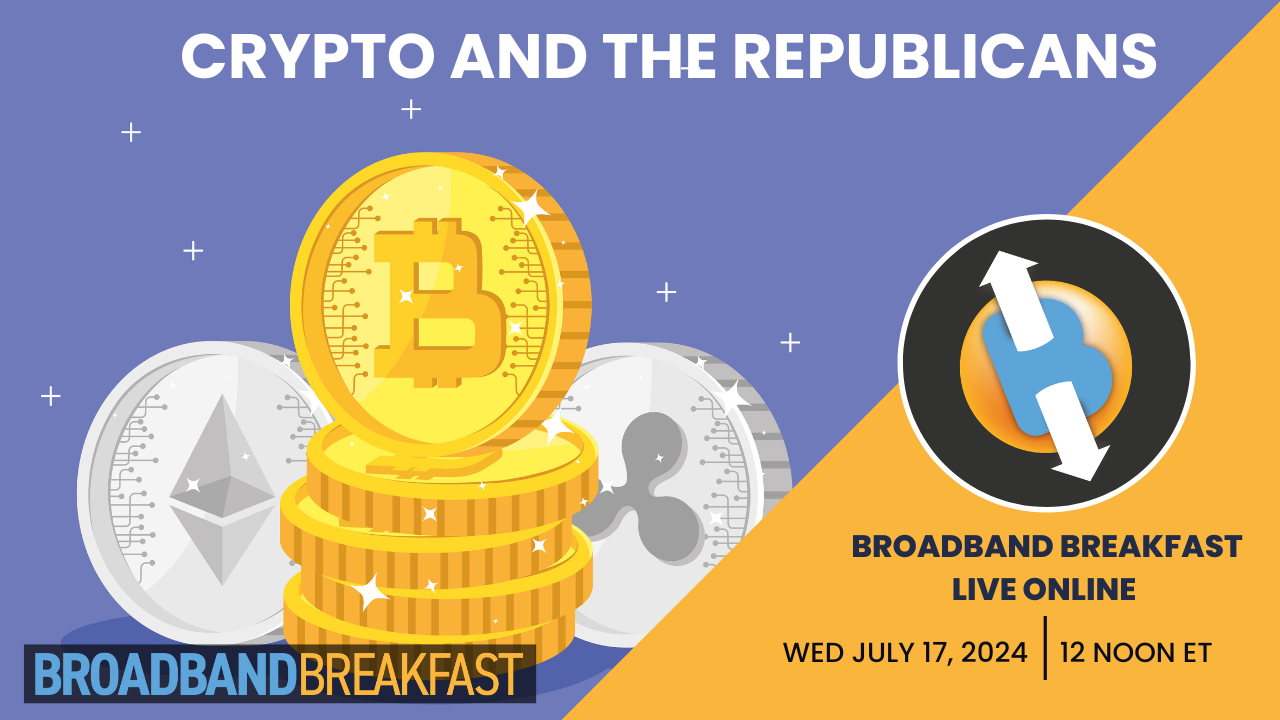
 Broadband Breakfast
More than a dozen policy-makers and pro-tech thinkers echoed the talking points of the “The Little Tech Agenda.” The party’s platform even honed in on the issues raised by the document. And more than a dozen policy-makers and pro-tech thinkers echoed its talking points.
As, the Republican National Convention opened on July 15, Trump announced his selection of Vance, a former VC himself, before running for Senate from Ohio. And on July 16, Andreessen and Horowitz upped the ante: The firm committed to making donations to political action committees supporting Trump.
Slyly, the non-partisan blog post had become a manifesto for American greatness. It was one arguing for a particular version of it in the form of presidential candidate Trump.
Indeed, the bellwether VC firm of Silicon Valley had pointed to a deluge. After Harris became the Democratic party nominee, Horowitz said he and his wife had donated to the Harris-Walz campaign, but didn’t backtrack on his firm’s pro-Trump stance.
 Drew Clark
The stampede included prominent each tech investors – including Palantir co-founder Joe Lonsdale and crypto billionaires Cameron and Tyler Winklevoss – in contributed to political action committees for Trump. Musk had also official joined in.
Venture capitalist David Sacks — connected to Musk and early Trump supporter Peter Thiel through their common work at PayPal – became a bridge between Silicon Valley’s libertarian-leaning anti-politics and the country’s rightward shift.
Sacks, who spoke on the opening night of RNC, had co-hosted a critical fundraiser for Trump in San Francisco that laid the ground for Trump’s selection of Vance. And Sacks also landed Trump himself on his “All-in Podcast” on June 20, during which program Trump declared his desire that any foreigner graduating from an American university be given an automatic green card.
Silicon Valley goes to Washington
Less than three weeks away from Trump’s second inaugural, it’s becoming clearer than ever that the Trump 47 Administration may look remarkably different from the last go-round.
 Broadband Breakfast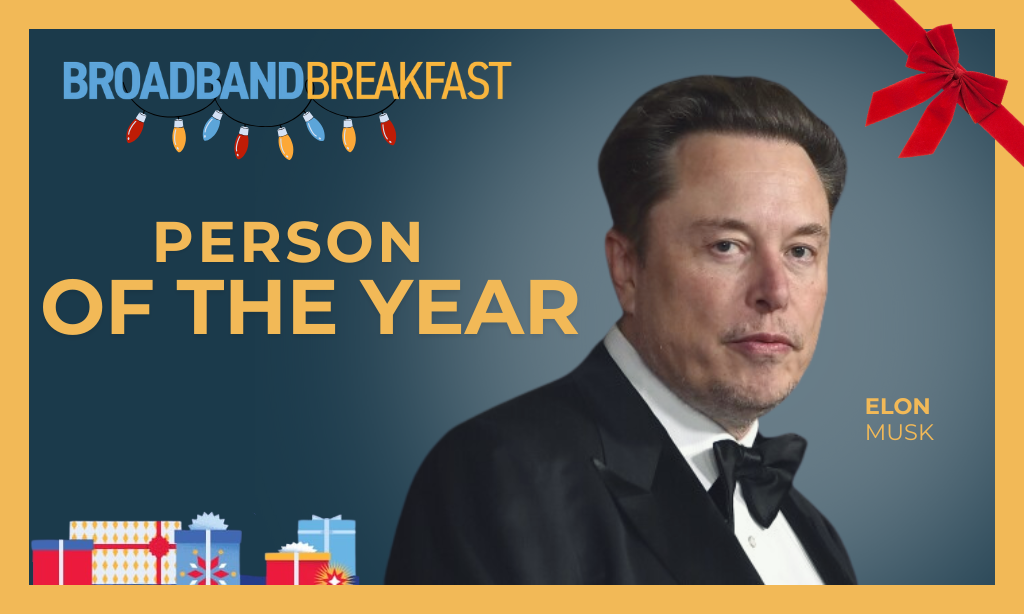
Look back just over two weeks since the First Day of Broadband, on December 18, when Broadband Breakfast declared Musk its Person of the Year, and wrote:
Trump 47 could become the “Silicon Valley” administration. Although Musk has deep ties with the communities and power centers in the Valley (for example, he was one of the group that launched OpenAI in its non-profit days), he – like Trump – is a disruptive outsider to their culture.
This is what Musk, finally, brings to Trump: A disrupt-or-die ideology.
Silicon Valley once was the place to which Democrats and Republicans paid lip service, and claimed they wanted to emulate. But did the Democratic and Republican politicians do anything of their own to disrupt Washington?
The venture capitalists who have flocked to Trump’s side, locked arm-and-arm with Musk, have finally found a way to be both in favor of the disruption that Silicon Valley allegedly represents, and also potentially against the particular power centers (think Google, Meta, Amazon, Apple and now Microsoft) of the tech industry.
And what else has happened in these past two weeks?
- The Silicon Valley mafia of Musk, Sacks and Andreessen have de facto taken over many aspects of job placement in the Trump Administration.
Musk is co-head of the Department of Government Efficiency (“DOGE”). Sacks is the administration’s Crypto and AI Czar. Andreessen has spent half of his time in recent weeks on the Trump transition, seeking to roll back Biden’s regulations on cryptocurrency; lobbying against recent activity by the Federal Trade Commission and calling for contracting changes in the Defense Department.
Andreessen has dubbed Trump’s win a cultural moment for this “techno-optimist” ideology: “It’s morning in America, so I’m very happy,” he said in a podcast interview. “People are finally poking their heads out of the frozen tundra of the culture and realizing that it’s actually OK to build things, hire on merit, celebrate success, and fundamentally be proud of the country and be patriotic.”
- The DOGE killed the first version of the bipartisan continuing resolution that would have funded the federal government at existing levels.
Musk’s posts on X were the major factor leading to the death of the first version of the budget bill on Dec. 18, when House Speaker Mike Johnson tore up and agreement that would have funded the government at current levels through March 14, provided $100 billion in disaster aid and $10 billion in agricultural assistance to farmers, among other funding provisions.
Biotech entrepreneur and former GOP presidential candidate Vivek Ramaswamy, Musk’s partner co-leading leading the DOGE, also posted against the bill, as did Trump's eldest son, Donald Trump Jr. Spending cuts, a constant point of discussion on Sack's "All-in Podcast," is now apparently Trump administration policy.
Johnson's second attempt at the funding bill, on Dec. 19, failed to eliminated the debt ceiling as Trump had requested. The House passed a slimmed-down version, while still continuing funding at existing levels, along with the disaster aid and farm aid – but without a debt ceiling waiver – before midnight on Dec. 20, 2024.
- Trump weighed in favor of legal immigration in the form of increased H1-B visa, a long-term top priority of Musk, Sacks, Andreessen and other Silicon Valley grandees.
In an interview with the New York Post last last Saturday, Trump even praised the use of visas to bring skilled foreign workers to the U.S. The topic has become a flashpoint within his conservative base.
“I’ve always liked the visas, I have always been in favor of the visas. That’s why we have them," Trump said on Saturday.
Trump has actually criticized H-1B visas in the past, calling them “very bad” and “unfair” for U.S. workers. But it’s also brought attention to Trump's comment to Sacks during the June 20 "All-in Podcast": “I think you should get automatically, as part of your diploma, a green card to be able to stay in this country.”
Will Silicon Valley and Trump diverge?
Deregulation, spending cuts, H1-B visas for legal immigration: These are now among the top Silicon Valley agenda items. And they are also among the most talked about items by officials who might be driving policy in the incoming Trump administration.
Want to know where technology, communications and innovation in governance might be going in the Trump 47 Administration? Read “The Little Tech Agenda.”