BEAD Non-Deployment Funds Could Fund Precision Ag. States Are Still Waiting to Find Out
State broadband and agriculture agencies remain siloed despite precision agriculture's growing connectivity demands, panelists said.

Akul Saxena
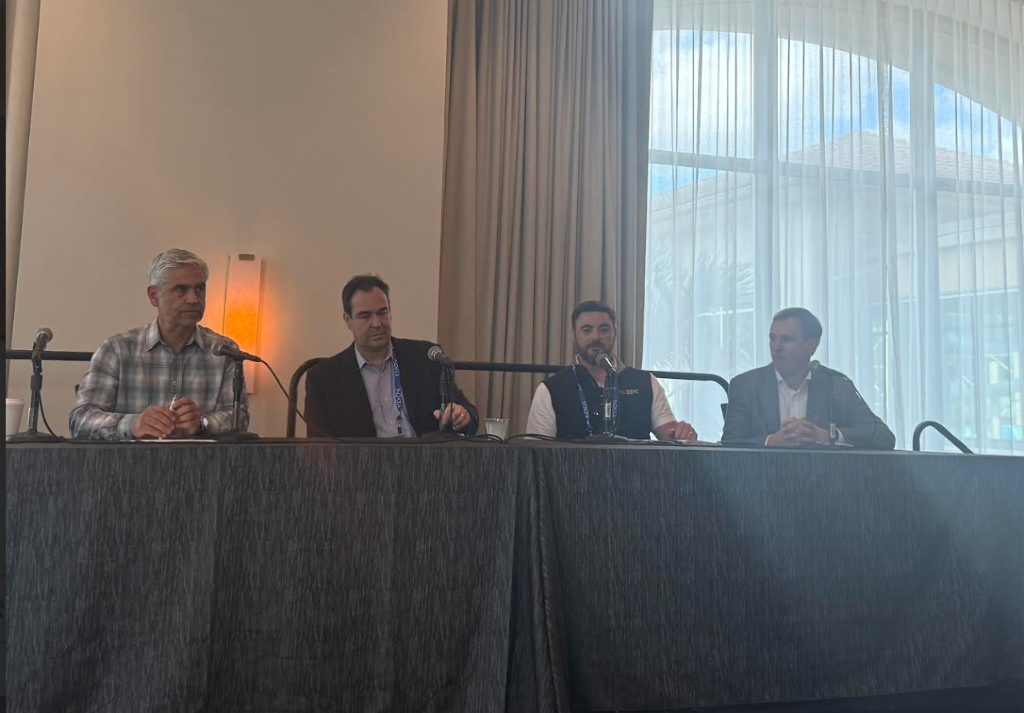
ORLANDO, May 18, 2026 — Eighty-six percent of American farms are family-owned and generate less than $350,000 a year in revenue, making the managed services and information technology infrastructure that precision agriculture requires economically out of reach for most of the farms that grow the country's food supply.
Fiber operators and agricultural technology advocates gathered here Monday argued that closing that gap requires not just connectivity but a subsidized service model, a federal funding framework, and an education pipeline that does not yet exist at scale.
Precision agriculture uses sensors, drones, autonomous equipment, and real-time data analysis to manage crops and livestock at the field level, reducing water, fertilizer, and pesticide use while increasing yields. The technology exists, which needs to extend its economic model and connectivity to small farms.
"Getting fiber to the doorstep is a portion of the battle," said Josh Etheridge, chief strategic officer at EPC, the West Monroe, La.-based fiber infrastructure company. "ISPs are not going to do this out of the goodness of their heart. It has to have cash flow."
The scale of the problem
The United States has 1.8 million family farms, which produce 30 to 40 percent of the national food supply. Farm yields have increased 50 percent since 1995, but those efficiencies have largely flowed to large operations. One family farm files for bankruptcy every day, Etheridge said, and consolidation is accelerating as input costs for seeds, fertilizer, and water continue to climb.
Farm broadband requires a fundamentally different service profile than home broadband, said Kevin Driscoll, moderator of a subsequent session and representative of Netceed, the fiber network solutions company. A household connection is built for downloading.
A farm is the opposite. Cameras monitoring fields for pest pressure, drones uploading full days of field video, and soil sensors transmitting moisture data all push data upstream continuously. A farm may need ten gigabits of upload capacity where a household needs a fraction of one.
"Broadband to a farm looks different than broadband to a home," said Chris Crowe, chief executive of t3 Broadband, the Frisco, Texas-based internet service provider. "You have to think about that when you're building your broadband platform."
The federal funding gap
About $22 billion in non-deployment funds remains in the Broadband Equity, Access, and Deployment program without federal guidance on what it can support, said Thomas Tyler, founder of C207 Partners, the Baton Rouge, Louisiana-based broadband consultancy. Precision agriculture is one of the uses that funding could unlock, but no deadline exists for federal guidance to reach the states.
While at the Louisiana State Broadband Office, Tyler said his team explored partnering with Louisiana State University and the state's agricultural extension offices, the county-level institutions that serve as trusted local advisors to farming communities, to direct non-deployment funds toward precision agriculture training and equipment access. That conversation is on pause pending federal guidance by the National Telecommunications and Information Administration.
"What works in Louisiana may be completely different than what's needed in Nebraska," Tyler said. "Having the right partners at the table to ensure policy decisions result in the best return on investment is the end game."
The panel converged on agricultural extension offices as a viable distribution channel. Those offices exist in every county in the United States, are trusted by farming communities, and are positioned to translate precision agriculture programs into practice. Connecting them to state broadband offices and state departments of agriculture, panelists said, is a policy link to emphasize.