The Internet Dispersed Power. The Supreme Court is Concentrating It
Panelists at BroadbandLive event including the ‘father of the Internet,’ the author of the maxim that ‘Code is Law’ and a pivotal FCC chairman

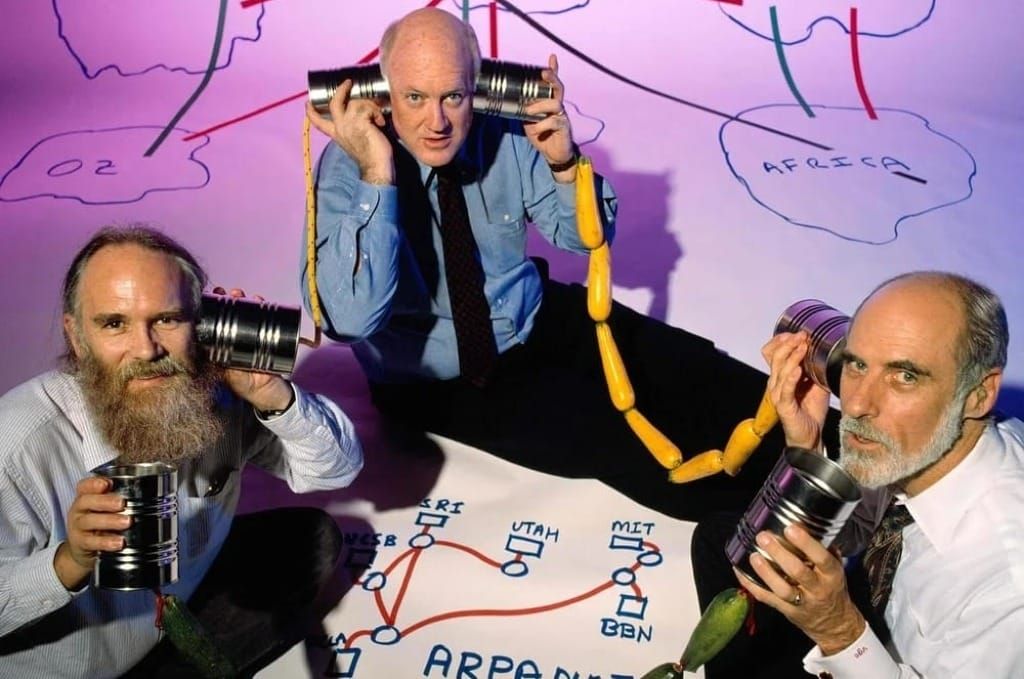
WASHINGTON, July 1, 2026 — Some of the founding lights of the Internet said Wednesday at a Broadband Breakfast Live Online event that the power decentralization of distributed computing is being concentrated into a one-man version of executive power by the Supreme Court.
Among those who helped build the Internet as we know it today, including Vint Cerf, co-designer of the Internet's core protocols, and author Lawrence Lessig, a Harvard Law School professor and author of Code and Other Laws of Cyberspace, agreed with former Federal Communications Commission Chairman Reed Hundt when he excoriated the Supreme Court’s Monday decision in Slaughter v. Trump.
“So what has the Supreme Court done? It has decided that the president can kick any commissioner out of a multi-member agency,” said Hundt, chairman of the FCC from 1993 to 1997, when the agency was implementing the 1996 Telecom Act.
The high court sanctioned the summary firing of minority commissioners from independent agencies like the Federal Trade Commission and, presumably, the FCC.
“The meaning of that is that the court has discouraged bipartisan decision-making. It's discouraged even the reality of having a bipartisan commission,” Hundt continued.
“Many critics of this decision have already decried the end of independent agencies, and it is surprising that the clear congressional intentions of more than a century are so blithely rejected by the court with hardly a smidgen of rationale. But it's the loss of bipartisanship and not independence that is the major injury on good government that the court has inflicted.”
Is the Internet a failed experiment in decentralization?
Kicking off Monday’s discussion, which was the third of three special BroadbandLive events celebrating 250 Years of American Independence and 150 Years of American Telecommunications, was Cerf, who celebrated the decentralized architecture of the Internet.
Cerf recalled that the Internet’s design was deliberately layered so it could change without breaking: “The whole architecture was designed to be evolvable and changeable, and that’s exactly what has happened,” Cerf said
Cerf is widely regarded as the “father of the Internet’s” core technology, TCP-IP (Transmission Control Protocol / Internet Protocol), together with the late Bob Kahn.
The three Broadband Breakfast webcasts are a preview for an in-person event celebrating America250 / Telecom150 on October 1, 2026, at the National Press Club.
The evolvability of the Internet meant that new capabilities could be added, as when Tim Berners-Lee’s invention of the World Wide Web was stacked on top of TCP/IP. Alternatively, new physical media like optical fiber could be slid in “underneath” and begin carrying Internet traffic instantly, Cerf said. Nothing already working had to be torn out to add the next thing.
Cerf said further that while every major technology arrives expensive and available to only a few, it then falls in price until ordinary families can afford it. The microwave began as World War II radar before it became a kitchen oven; the mobile phone began in 1973 as a two-and-a-half-pound Motorola brick before it shrank into a pocket.
None of them survived on novelty alone, Cerf said. Each needed a working business model, an affordable price and a real market, to sustain it, and AI would be no different.
Making decisions bipartisan and unanimous
Yet this powerful decentralized design is now colliding with agentic technologies that the Internet was never built to govern, Cerf said.
And that’s not the only problem. Several panelists bemoaned Congress’ failure to act on against challenges like abuse in social media, or confronting the policy issues stemming from artificial intelligence.
The Slaughter ruling struck hard for Hundt, he said, because of his own experience in implementing the 1996 Telecom Act, the law’s last major rewrite.
"When you're running a multi-member commission, you need to grasp very clearly that it is a mini version of Congress,” Hundt said. “It has Democrats. It has Republicans, and they are going to echo the same debates that occurred among the legislatures."
That was a version of independent agencies like the FCC that was common – before Monday of this week.
The 1996 Telecom Act required the agency to write roughly four dozen rules, Hundt said. He pushed hard to make those votes unanimous, he said, because bipartisan rulings from a multimember commission were the ones most likely to survive court review. A commission that serves at the president's pleasure cannot play that role.
Lessig took the point further. The problem was not one agency but a court that had “lost all sense of judicial humility,” making policy judgments that courts are ill-suited to make.
Harms from social media could, in principle, be curbed by government action, Lessig said. But that’s only if the government were able to act.
"We don't have a government that can legislate, only a Supreme Court that can dictate," Lessig said.
Lessig, who was a Supreme Court law clerk to Antonin Scalia, called for a return to conservative judges like Robert Bork and the early-1970s conservatives who railed against judicial activism. They would be astonished at a court "arrogating to itself policy judgments that neither the Constitution, nor good sense, vested in them."
Why the Internet held such promise
If the Internet’s decentralized design spread without permission, its adoption abroad still had to be won, Hundt said. He cited the 1997 World Trade Organization Agreement on Basic Telecommunications with the Clinton Administration U.S. Trade Representative Charlene Barshefsky, in which the Clinton Administration secured a treaty with 69 countries to admit the Internet.
Much of its governance was deliberately handed to nonprofits rather than governments.
"The notion that the government just let the Internet happen is a silly idea," Hundt said.
At the same time, there was an administrative logic to commercialization of the Internet’s core, said Shane Greenstein, a business professor at Harvard, the author of How the Internet Became Commercial, and the panel’s fourth panelist.
A browser released in 1994 pushed the Internet into public view, and ChatGPT did the same for AI in 2022. The browser reached 100 million users by 1998, then well over half the online population; ChatGPT reached a billion this spring, roughly a third of the world's non-Chinese Internet users.
That reallocation of investment is already enormous, and its consequences will fall to the next generation, Greenstein said.
"We are in the middle of what I would call a technology gold rush," Greenstein said.
Still, the first to the gold mine aren’t always the long-term champions, he said as the largest winners tend to arrive late: Google paired ad auctions with search in 2002, and Amazon Web Services, the cloud division that became the company's profit engine, launched in 2006 and lost money for years.
Greenstein's concern was that AI has not yet produced the range of uses that eventually made the Internet valuable.
What comes next, after law meets code
Asked by Hundt whether the Internet's designers bore responsibility for what social media has wrought, Cerf put the burden on back its users.
"The Internet is not a human right, in my opinion. It's a privilege," Cerf said.
For the part of AI that cannot be wished away – its physical footprint – Hundt offered a plan for striking a bargain providing regulatory predictability for the construction of data centers.
But right now, oversight is too scattered. More than 50 federal agencies now have some role in AI, and more than a dozen congressional committees claim jurisdiction, Hundt said.
"More than 50 is a bad answer for everybody," he said.