Where to Find 800 Megahertz of Spectrum For Auction?

Citizens Broadband Radio Service hasn’t got an explicit defense from the Trump administration, but the FCC hasn’t said it intends to alter it.

Where to Find 800 Megahertz of Spectrum For Auction?

The Federal Communications Commission’s ability to auction spectrum expired for the first time since the nineties in March 2023. More than two years later, In July 2025, Congress reinstated that authority and tasked the agency with selling off 800 megahertz by September 2034.

12 Days of Broadband 2025 (click to open)

Of that, 500 megahertz will have to be federal spectrum identified for reallocation by the National Telecommunications and Information Administration, which manages federal spectrum use. The agency has to find at least 200 megahertz of that by July 2027, and the rest by July 2029.

The remaining 300 megahertz can come from anywhere, although if NTIA finds more federal spectrum than is required it could count toward the total. The FCC has to finish an auction of at least 100 megahertz in the upper C-band by July 2027, which FCC Chairman Brendan Carr has said will be a heavy lift.

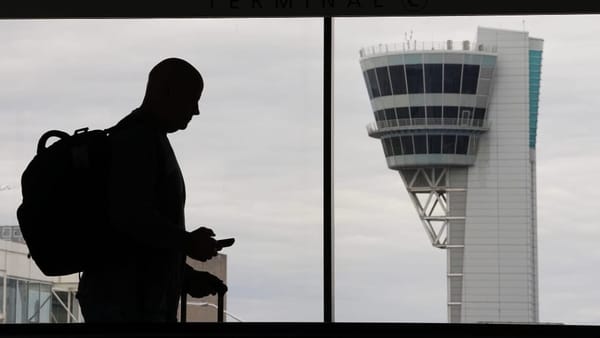
The 3.1-3.4 GigaHertz (GHz) and 7.4-8.4 GHz bands, used by the military and eyed by the wireless industry, were exempt from FCC auction authority. 

The 300 megahertz from the FCC

The FCC is first tasked with finishing an auction of at least 100 megahertz in the 3.98-4.2 GHz band, or upper C-band by July 2027. The airwaves are currently occupied by satellite video distribution services and directly below spectrum used by airplane altimeters, and the agency was already looking into opening it up to carriers or satellite operators.

The auction could potentially bring in more, though, as the agency is looking to sell off as much as 180 megahertz.

That number was arrived at by the major wireless carriers and airlines, who told the agency recently that next-generation altimeters should be able to operate safely with the carriers taking that much of the band.  

In a proposal seeking comment on rules for the auction, unanimously approved Nov. 20, sought input from satellite operators in the band, mainly SES and Eutelsat, on how much they could clear. SES has said 100 megahertz should be doable quickly, and Eutelsat has put the number at 130 megahertz.

In a meeting between FCC and SES staff on Nov. 10, the company “discussed potential technical solutions” for maintaining its services “if the Commission were to repurpose a significant portion of the Upper C-band.” 

While Elon Musk’s SpaceX had expressed interest in the band, the mobile carriers are getting the win they predicted when the FCC said it was looking into the band earlier this year. The agency isn’t planning to allow any new satellite users into the band because of the complexity of the repacking process and the tight timeframe the agency has to work with.

It’s not clear where the rest of the 300 megahertz is coming from. 

A House draft of the One Big Beautiful Bill Act (OBBBA) also protected the unlicensed 6 GHz band and the shared CBRS band in 3.55-3.7 GHz. When that didn’t end up in the final version of the legislation, users of both bands were worried the spectrum could be on the chopping block as the FCC looks to meet Congressional benchmarks.

Trump administration officials have since defended 6 GHz, largely used for Wi-Fi and opened up in the first Trump administration. NTIA Administrator Arielle Roth in September urged the FCC to preserve the band, and Robin Colwell, deputy director of the White House National Economic Council, said he doesn’t want the band partially sold.

The carriers had been interested in at least the upper part of the band, and a top lawyer for CTIA, the industry’s trade group, suggested they still were earlier this month. Umair Javed, CTIA’s senior vice president and general counsel, said the 7.125-7.4 GHz band, federal spectrum currently in line for study by NTIA, was really only attractive for carriers  if some 6 GHz was opened up too.

Some concerns about the shared CBRS band

CBRS hasn’t got as explicit a defense from the Trump administration or FCC officials, although the agency hasn’t signaled it actually intends to alter the band, a less than straightforward process. Both Carr and FCC Commissioner Anna Gomez were asked about CBRS at the agency’s Nov. 20 meeting, and Carr didn’t comment on how he was thinking about the band or future spectrum auctions.

“Our main focus at this point is the C-band,” he said. “We’re under the clock to get that done by July ‘27. That takes a tremendous amount of both staff resources and chairman’s office resources.”

Gomez, for her part, said “I don’t have a proposal before me on CBRS. I haven’t seen one.”

She defended the band though, calling it a success story and an important resource for smaller providers competing with bigger ISPs. She said if there were to be presented with an item on the issue she “will be concerned about what this does to the competitive ecosystem in our country.”

CBRS users, mostly wireless ISPs or companies operating private networks, have been consistently making their case to the FCC in recent months. They’ve marshalled support from GOP lawmakers in both chambers of Congress, and a group of companies spun up a pro-CBRS lobbying group last week. 

WISPA, which represents wireless ISPs, wrote in a September letter to the FCC that as the agency looks to find airwaves to auction, “That spectrum should not come from CBRS.”

The group said that the top 50 megahertz, used by free general access license holders, might seem like an easy target, but would “be extremely destructive to existing users” and disrupt rural broadband services.

The cable industry has also defended both CBRS and 6 GHz. 

Cable providers have some priority CBRS licenses and use Wi-Fi to offload traffic on their mobile services, but they also generally prefer spectrum sharing to the exclusive, high-power licenses that will be sold off. Those give the carriers more headroom to offer fixed wireless services that compete for broadband subscribers.

The 500 megahertz from the NTIA

As part of the bill, NTIA was given a $50 million appropriation to study the 2.7-2.9 GHz, 4.4-4.9 GHz, and 7.25-7.4 GHz bands for potential repurposing. 

The agency is close to finishing study plans for the 2.7 GHz and 4.4 GHz bands, NTIA Chief of Staff Brooke Donilon said at a Nov. 12 event hosted by the Center for Strategic & International Studies and sponsored by CTIA.

Roth is particularly interested in opening as much of the 4.4 GHz band as possible to carriers. That’s not an uncomplicated task, as 15 federal agencies currently use the spectrum.

Donilon said the agency had had “really great conversations” with the Defense Department and the Justice Department, the two largest users. 

She also said NTIA views the 500 megahertz benchmark as a floor rather than a ceiling.

“We absolutely plan to meet our mandate, ideally, early,” she said. “My engineers will get very mad at me for saying that, but we want to be on time and we want to overdeliver.”

Giulia McHenry, AT&T’s senior vice president of public policy, spoke alongside Donilon and said 4 GHz was “music to my ears.” Javed, also at the event, said the band was “very important for our industry” because it was a large, contiguous swathe of airwaves and was being studied for global uses.

An arduous process for spectrum studies

The process of getting funding in order for other government agencies to collaborate on spectrum studies can be arduous, Donilon said, and there’s “a lot more work to do” to secure the necessary funding for the 2.7 GHz and 4.4 GHz studies. 

The Biden administration was already interested in looking at the 7 GHz spectrum, and the funding for those studies were secured at the end of last year.

There’s also the issue of where to relocate federal systems in order to auction their current spectrum. Sen. Ted Cruz, R-Texas, the chief architect of OBBBA's pipeline, said in all likelihood that would include some of the spectrum blocked from auction, setting up a conflict between him and lawmakers who would prefer critical military systems there not be disrupted.

Sens. Deb Fischer, R-Neb., and Mike Rounds, R-S.D., who negotiated the carve-outs with Cruz in the first place, are backing a provision in a defense policy bill that would allow the Defense Department to veto any changes at all to those bands. 

The Senate passed the bill with the provision intact, but the House hasn’t approved its own language yet. 

Rep. Richard Hudson, R-N.C., head of the House Commerce Committee, also said he’s opposed to the spectrum language, as did the White House in a policy statement.

For her part, Fischer has said that the White House knows her feelings on the issue.

Member discussion

Popular Tags