What We're Doing With '150 Years of American Telecommunications'
Some personal reflections on the value of looking back over 250 Years of American Independence, and our broadband heritage

Last week Broadband Breakfast launched its online course, 150 Years of American Telecommunications. We released Lesson 1 on Monday, and will release a new lesson in the 35-lesson series each Monday at 9 a.m. ET.
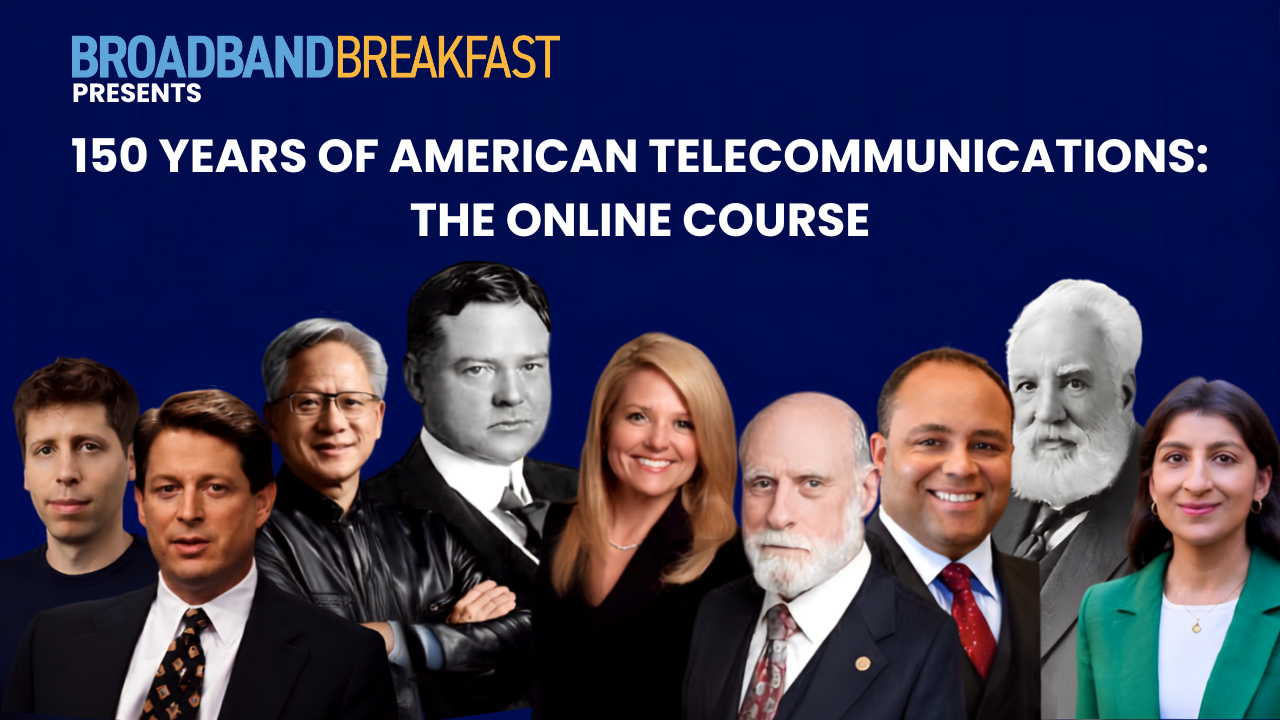
In a way, I’ve been thinking about this course for more than 20 years — since I first read Paul Starr's wonderful book, The Creation of the Media: Political Origins of Modern Communications. That book, published in 2004, covered the sweep of American communications history from pre-colonial times in America, including the creation of the public sphere for communications in society. It also compared the U.S. to the United Kingdom and to Europe.
Starr’s book leaned on the role of printed newspapers and book publishing. But of course it also delved into the “technologies” of modernity: The telegraph, the telephone, the popular press, a/k/a what we now call “The Media.”
It also covered the beginnings of broadcast radio and television. But I was disappointed that Starr ends his story at World War II. That was just when developments were getting interesting!
Notable events and American exceptionalism
The proximate cause for Broadband Breakfast deciding to create an online course was the observation that, in celebrating 250 Years of American Independence, we are also celebrating 150 Years of American Telecommunications.
Alexander Graham Bell, his March 7, 1876, patent fresh in hand, displayed the telephone at the United States’ Centennial Exhibition in Philadelphia in June of 1876. Some Americans at the time (and subsequently) did view the debut of telephone as one of divine providence. Perhaps this is a continuation of turning 50-year anniversaries into singular perceptions of manifestations.
July 4, 1826, was also one such day. The 50th Anniversary of the publishing of the Declaration was also the day on which the nation’s second and third presidents, John Adams and Thomas Jefferson, died within hours of each other. In the eyes of their country, it was their deaths on the same day that made the date of July 4 our national celebration of independence.
The America250 / Telecom150 observation led us to think of a three-part online series for Broadband Breakfast Live Online, with each event covering a distinct 50-year arc of American communications history.
The first, on the telephone and the telegraph, covered the 50 years beginning in 1876. This was the era of the wire.
The second, for the 50 years beginning in 1926 or 1927, began the era of broadcasting, plus all of the political controversies that continue to surround radio and particularly television.
The third, reflecting on the past 50 years beginning with America’s bicentennial, moved naturally to our thinking about the era in which we currently live: Computing, the Internet, and artificial intelligence.
The Broadband Breakfast business and community team began engaging with many esteemed historians, and many participated in these three sessions. (The Broadband Breakfast editorial team continues to focus on the daily broadband news of today.)
As the team did this, we realized that we simply had to bring all these threads together in a celebratory in-person event. That event, “250 Years of American Independence, 150 Years of American Telecommunications,” will take place here in Washington on October 1, 2026.
250 Years of American Independence & 150 Years of American Telecommunications
An in-person event on Thursday, October 1, 2026
Register for $250!Recurring themes: Innovation and competition
We also realized that there was more to the story than could be covered in three hour-long BroadbandLive sessions, or even a day-long celebratory event.
If there is an overarching structure to these American250 / Telecom150 events, and to course launched last Monday, it is the recurring themes of innovation and competition.
This is present from the very beginning, with Bell’s invention, patented on March 7 and demonstrated in a Boston laboratory in March 10, as well as the Centennial Exposition. Bell created the Bell Telephone Company the following year.
A telephone created by rival inventor Amos Dolbear operated under different a technology. Dolbear licensed his telephone to Western Union, then the country’s major telegraph monopolist. Western Union in turn created the American Speaking Telephone Company in December 1877. Bell sued, and won his patent infringement lawsuit because courts read his patent as covering a process – transmitting speech by gradually varying current intensity – rather than any particular apparatus.
So much for competition.
But wait! When Bell’s patents lapsed in 1893 and 1894, roughly 6,000 independents appeared within a few years, prices fell, and rural service finally arrived.
So far as AT&T (the successor to Bell’s company) was concerned, the years ever since have been dominated by a love-hate relationship with U.S. competition law: The Kingsbury Commitment of 1913, the consent decree confining AT&T to regulated communications in 1956, and the November 1974 Justice Department antitrust lawsuit that ultimately led to the company’s divestiture on January 1, 1984.
Sign up for the course to read the whole, multi-lesson story. The first four lessons of Section A are free; join the Broadband Breakfast Club to obtain access to the full course, at no additional charge beyond Breakfast Club Membership.
Join Broadband Breakfast to Celebrate America250 / Telecom150!
View Telecom150 optionsReady for annual signup for the Breakfast Club? Purchase Breakfast Club access (including the course) for only $590/year.
How the course addresses innovation and competition
These themes of innovation and competition – or is it innovation versus competition? – run throughout the 150-year time span. Several other, broader points also emerged.
As was noted in Lesson 0, the course introduction, also released last Monday:
The American arrangement was unusual. Most countries ran communications through the post office and the state. America ran them through private companies, public rules, and courts. That combination produced the most inventive networks in the world and the longest-running fights over access and power.
The fights recur. Who pays to build networks to the places the market skips. Whether a dominant carrier must share its lines with rivals. What obligations come with a license to use the public airwaves. Whether a new medium fits an old law or needs a new one. Each has been argued, decided, and argued again across the 150 years. The arguments made about broadband funding and artificial intelligence in 2026 are close relatives of arguments once made about the telegraph, the telephone, and radio.
The outcomes were not inevitable. Nearly every rule in this course won an argument, and the losing case is recoverable from the record. Knowing what was decided, who decided it, what the losing side said, and what followed is useful equipment for following the versions being argued now. The course supplies that record.
Political origins of communications
What Starr emphasized in his book, as well as what is emphasized in the course, 150 Years of American Telecommunications, are the political origins of decisions about communications. This starts with the telephone and the telegraph; and continues toward the use of radio-frequency spectrum for broadcast radio, television, mobile wireless communications; and to the Internet.
My reporting, writing and editing for more than two decades has focused on the political origins, and political controversies, of communications.
I began covering technology and politics in 1998, just two years and some months after passage of the 1996 Telecom Act. I worked then as a reporter at the National Journal Group, where I first focused on legal issues: Copyright, the Microsoft antitrust case, privacy and cybersecurity.
These were rich issues in the late 1990s and early 2000s, in part because we did not know when or whether the United States would get a privacy law. (Hint: Congress still had not passed a federal privacy law.)
The Microsoft antitrust case, on the other hand, set clear parameters for the behavior of monopolies in the digital age. In hindsight, policymakers and market participants can see now how that antitrust action (as with the breakup of AT&T a generation earlier) created opportunities for companies that had been shut out of the marketplace.
In 2003, I switched beats at National Journal Group, moving from privacy, technology and law to telecommunications – plus the emerging subject of broadband.
Just switching from one beat to another caused me to learn a lot of new lingo. This was the middle of the so-called triennial review, one of the last spasms of action by the Federal Communications Commission concerning how, specifically, the 1996 Telecom Act might have been used to promote competition by competitive carriers against regional Bell operating companies.
Decisions instead moved the United States to what some have called a world of facilities-based competition.
A world of convergence?
Think of the last 150 years this way. Generations of inventors, entrepreneurs, network-builders (and policy-makers) purpose-built networks for participations technological use cases, or what we might today call “applications.” The telephone network became a network for person-to-person voice communication, a/k/a telephony.
The broadcast networks, through a combination of leased lines and local broadcast towers, offering the masses access to “broad”-based communications, a/k/a mass media. The cable networks, originally built to redistribute television signals, became a form of TV more than just “broadcast” TV. Then it deployed widescale fast internet through its DOCSIS standard. (And that short capsule leave satellite and its role in the communications ecosystem out entirely.)
The Internet – which of course is a major part of this course, and fills eight full lessons in Section D – promised a near-perfect example of the opposite type of network: One in which an abundance of content and applications are transmitted over a common protocol.
Broadband networks were effectively the first multi-application networks. The applications, in other words, converged on a single network, that network of networks that is the Internet. The genius of Transmission Control Protocol / Internet Protocol (TCP/IP, Lesson 15), is that many and varied type of transmission could pass over a single, capacious fiber-optic wire.
Join on this journey with us. You’ll learn a lot… and we’ll learn a lot together with you, too!
Broadband Breakfast is the community for Better Broadband, Better Lives
I founded Broadband Breakfast in 2008, soon after I read Starr’s book. We’ve been many things over the past 18 years, but the most constant and consistent one is as an online community, a place for education, engagement and hopefully enlightenment about all issues surrounding broadband: Telecommunications, communications, and computing.
Think of the course “150 Years of American Communications” is a concerted effort to bring American history of this field of broadband, to bear on American action in this field of broadband.
We’ll keep covering all the daily broadband controversies. But in taking this course, you’ll join our effort to step back and consider how historical developments reflect and address American values — and how they fall short.
Take advantage of our special America250 / Telecom150 offer:
- $150 — Get three months of Broadband Breakfast Club, including all news, paid member spaces, and unlimited access to “150 Years of American Telecommunications.” You’ll also be able to stream the October 1 event at no charge.
- $250 — Get everything above, plus a reserved seat to the October 1 event.
As you take the course, let us know in the comments - or by emailing support@breakfast.media – if you have any suggestions, corrections, complaints or recommendations.