Midterms Could Change the Politics of AI
If Republicans suffer heavy losses, it could push the party toward tougher AI legislation, panelists said


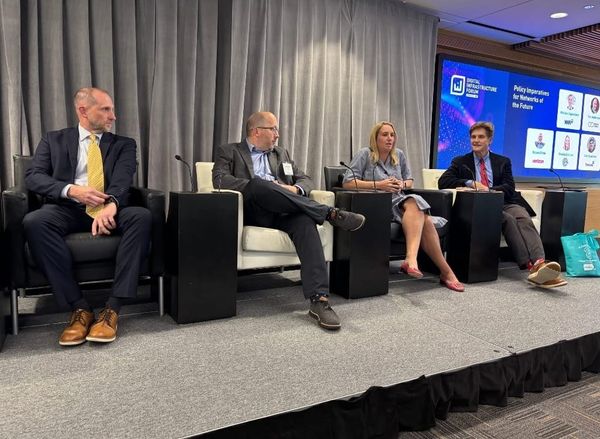
WASHINGTON, Oct. 15, 2026 — The Nov. 3 midterm elections are unlikely to produce major federal AI legislation, but the story told afterward could change how both parties approach the technology, four telecom policy experts said Wednesday during BroadbandLive.
Highlights Reel:
A standoff over preemption, the power of federal law to override state rules, awaits the next Congress regardless of the result, said Blair Levin, a senior fellow at New York University's Center on Technology Policy. He was chief of staff to former Federal Communications Commission Chairman Reed Hundt and led the Obama administration's National Broadband Plan.
Preemption remains the sticking point
Democrats will likely win the House and refuse to pass an AI bill that broadly preempts state and local rules, Levin said during a Broadband Breakfast Live Online session. President Donald Trump, meanwhile, is unlikely to sign one that leaves those state laws standing.

The conflict has already defeated one attempt to restrict state authority. In July 2025, the Senate voted 99-1 to strip a 10-year ban on enforcing state AI laws from the budget reconciliation bill. Trump issued a December executive order threatening some federal broadband funds for states with AI laws the administration considered “onerous.”
The earlier moratorium fight has made even narrower preemption proposals politically suspect, said Joel Thayer, president of the Digital Progress Institute, a Washington telecom and technology policy group. Proposals are labeled “a gift to big tech” before their scope and legal effects receive serious discussion, he said.
A narrower agreement could remain possible, said Evan Swarztrauber, principal at CorePoint Strategies, a technology policy consulting firm, and a former adviser to FCC Chairman Ajit Pai. Broad AI preemption is not politically viable, but preemption limited to safety testing could be, he said.
The electoral margin could shape the response
Gas and grocery prices will matter more to most voters than AI policy, Thayer said. Whether they can “afford eggs” matters more than where a data center was built.
Levin focused on the conclusions politicians might draw afterward. If former Sen. Sherrod Brown, a Democrat challenging Republican Sen. Jon Husted in Ohio, wins while Republican Texas Gov. Greg Abbott loses, the narrative could become that “Sherrod was right on data centers and AI, and Abbott was wrong,” he said.
Those outcomes could convince “everybody else in the political business” that “the revolt against AI and data centers is real, and politicians have to be sensitive to that,” Levin said.
Abbott, who faces Democratic state Rep. Gina Hinojosa, froze new data center grid connections in August after requests reached more than five times the grid’s record peak. Levin described the move as a reversal of Abbott’s earlier welcome of data center investment.
The size of Republican losses would also matter, Swarztrauber said. Because the president’s party usually loses seats in midterm elections, a narrow Democratic House majority could leave Republicans claiming vindication for their light-touch approach to AI regulation, he said.
That approach emphasizes protecting households from data center electricity costs and pressing companies to address public concerns without extensive new regulation, Swarztrauber said. The White House’s Ratepayer Protection Pledge, signed by AI companies in March, promises that data centers will not raise household electricity bills.
A Democratic wave large enough to flip the Senate could instead push Republicans toward tougher bills, Swarztrauber said. He pointed to Sen. Josh Hawley’s AI liability legislation and the bipartisan FRONTIER Act.
The AI LEAD Act, introduced by Sen. Dick Durbin, D-Ill., and Hawley, R-Mo., would classify AI systems as products. People harmed by them could then pursue claims under product liability law.
The FRONTIER Act, introduced by Rep. Jay Obernolte, R-Calif., and Rep. Lori Trahan, D-Mass., scales requirements to developers’ size. The largest would face independent audits and incident reporting. Its sponsors present it as one national standard instead of differing state requirements.
The buildings behind the AI backlash
“Most Americans don’t live next to a data center, yet they are very broadly unpopular,” Swarztrauber said. The buildings are “the physical manifestation of the technology,” giving people a place to register displeasure with a future they fear.
Thayer called the data center “a Rorschach test,” with people reading broader frustrations with AI into the facilities. Local land-use and energy concerns are legitimate, although “a bit overblown,” he said.
The industry could rebuild trust by changing both the facilities it constructs and what it offers surrounding communities, said Nicholas Garcia, senior policy counsel at Public Knowledge, a Washington consumer advocacy group.
The public pictures a hyperscale data center, a massive computing facility often powered by on-site natural gas turbines, Garcia said. He called that model the “worst possible version” of data center development.
Even efforts to protect ratepayers can reinforce that model by encouraging companies to install gas turbines rather than draw electricity from the grid, he argued.
Garcia professed his support for smaller facilities built for inference, the work of answering users’ requests, rather than concentrating investment in huge campuses for training AI models. Those smaller projects could be developed alongside broadband and fiber networks serving nearby communities, he said, with greater use of renewable power.
Building local support also requires transparency about proposed developments and concrete benefits for residents, Garcia said. Companies should “stop with the NDAs,” the nondisclosure agreements that restrict disclosure of information about data center projects, and sign community benefit agreements spelling out what residents will receive.
Developers should explain benefits such as tax revenue and drop “phony promises” about lasting jobs, he said.
Energy policy also affects whether AI becomes affordable to use, Garcia said. Lower prices for tokens, the units of text AI services process and charge for, require investment in the electricity infrastructure supporting that computing. He argued that the Trump administration’s cuts to subsidies for energy sources such as solar work against its goal of advancing AI.
Skepticism crosses party lines
AI “has a massive trust problem,” Garcia said. But party affiliation does not neatly explain people’s positions on the technology. Their expectations of what AI will become capable of doing, and which harms concern them, can be more revealing, he said.
Skepticism already links Steve Bannon, Trump’s former chief strategist, and Sen. Bernie Sanders, I-Vt., noted moderator Drew Clark, Broadband Breakfast’s CEO.
After a large Democratic victory, Florida Gov. Ron DeSantis or Hawley could seek the Republican presidential nomination against Vice President JD Vance on an anti-AI platform, Levin said. Either could become “the candidate of the Bannon wing of the MAGA movement.”
That overlap has a precedent in antitrust, Thayer said. Both parties concluded that technology markets were too concentrated, although conservatives emphasized censorship and liberals emphasized monopoly power.
Whoever passes a regulation could own the fallout
Acting on public concern could carry political risks of its own, Levin said. He predicted that an AI market bubble would eventually burst and that if it were Democrats passing legislation beforehand could be blamed for subsequent losses, regardless of what caused them.
“The facts are kind of irrelevant,” Levin said. The parties would play “a game of chicken” over showing concern without owning the fallout.
Federal policy now amounts to “trust the White House, and the White House trusts AI,” he said. “I don’t think that’s a tenable political position long term.”
Broadband construction could become collateral damage
Opposition to AI infrastructure could weaken support for measures to speed broadband construction, Swarztrauber warned. Carriers have told him that residents are beginning to lump proposed 5G sites together with data center developments.
“I hope that broadband doesn’t become a casualty of the AI bad blood,” he said.
Broadband investment itself is unlikely to earn either party much electoral credit, Levin said. “Voters don’t give blame or credit” for the $42.45 billion Broadband Equity, Access, and Deployment program, created in 2021.
Yet the program offered an opportunity to lay fiber alongside data center construction and extend the benefits to surrounding communities, Garcia said.
Some hyperscaler contracts block that opportunity to expand community broadband access, Swarztrauber said. He cited a recent report describing clauses that prohibit fiber providers from using data center connections to serve nearby homes and communities.
Hyperscalers should turn their infrastructure spending into concrete benefits for surrounding communities, Swarztrauber argued. Fiber construction for rural data centers should support BEAD-funded broadband projects and deployments financed without government money, he said.
“If hyperscalers can’t find a way to do the right thing there, I think that tells you a lot about why people don’t trust AI,” Swarztrauber said.
Full Event Event Available for Free:
 Broadband Breakfast